

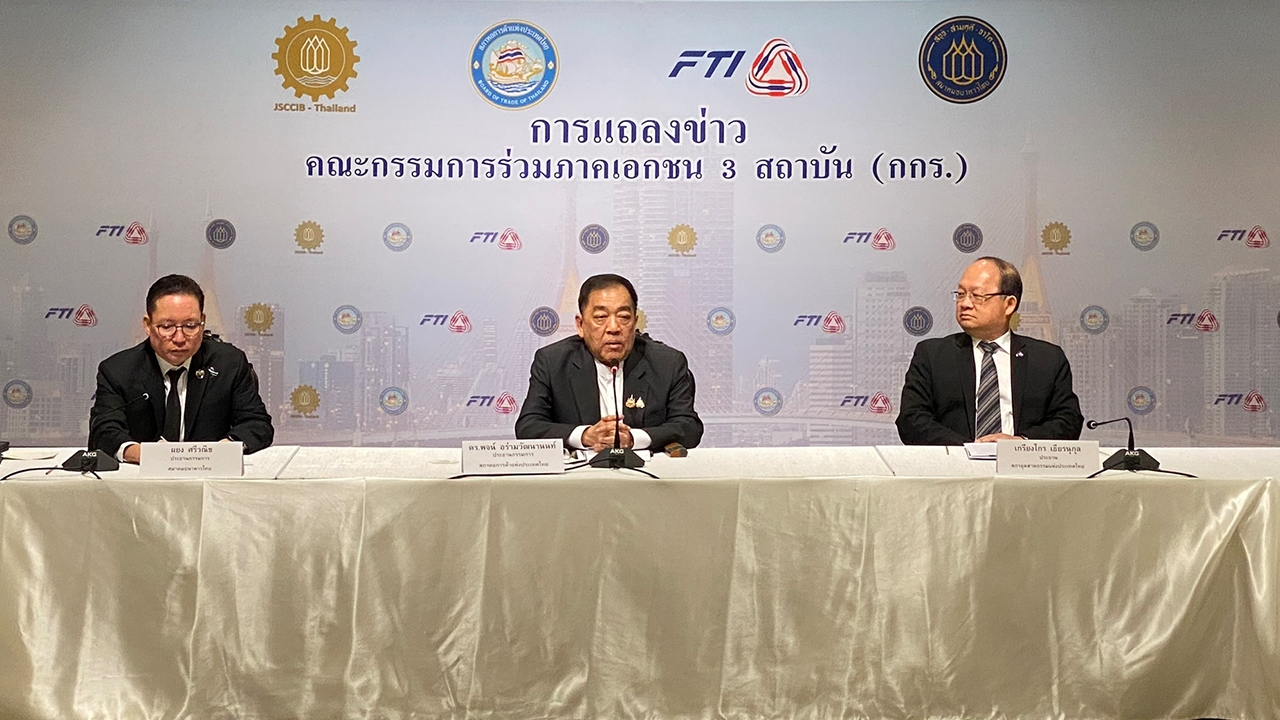
The Joint Public-Private Sector Commission (JPC) is concerned about the Thai economy's contraction in the Year of the Horse, expecting growth below 2% for the first time in 30 years and the lowest in the region. The economy faces widespread vulnerabilities, and the JPC hopes the new government will expedite Thailand's economic restructuring.
Mr. Phot Aramwattananon, Chairman of the Thai Chamber of Commerce and the Council of Thai Chambers of Commerce, revealed that the Joint Public-Private Sector Commission (JPC) forecasts Thailand's economy in 2026 to grow less than 2%, marking the first time in 30 years outside crisis periods. Amid various challenges, Thailand is expected to have the lowest growth in the region due to existing structural vulnerabilities, including a large informal economy and high household debt, weakened competitiveness in the new global environment, fiscal budget constraints, and government challenges such as numerous regulations and unlinked data. These are compounded by impacts from last year's disasters, a strong baht, cybercrime, grey capital flows, and risks from delays in the budget-making process.
The JPC is concerned about the baht's 8.2% appreciation last year, the second highest in the region, which pressures exports similar to an additional tariff on businesses. This erodes the business sector, especially exporters. The JPC urges regulatory agencies to monitor currency movements linked to gold prices and the role of digital asset trading in Thailand affecting the baht. The JPC supports government efforts to "connect the dots" by enhancing transparency of foreign currency sources and detailed baht data from non-residents, moving beyond traditional regulatory frameworks to prevent such transactions from undermining the country's competitiveness and real economy.
Moreover, global economic uncertainty in 2026 is increasing due to geopolitical factors, reflected in the U.S. intervention in Venezuela, highlighting a clearer division in the global economic and political order (New World Order). This affects the global economy, which is expected to slow compared to the previous year. Furthermore, the impact of U.S. tax measures will continue to affect Thai exports, excluding electronics, which have already begun to contract. This reflects heightened uncertainty for the Thai economy, emphasizing the need for Thailand to keep pace with these changes.
The JPC hopes the post-election government will continue efforts to restructure Thailand's economy by formalizing the economy and sustainably addressing debt issues, which will boost purchasing power and enhance entrepreneurs' capabilities. It aims to reduce business obstacles to encourage new investment and strengthen supply chains, as well as improve anti-corruption measures and law enforcement to build trust and confidence and reduce hidden business costs. The JPC advocates cooperation under the "Reinvent Thailand" framework to address domestic challenges and reinforce strengths for sustainable growth. The JPC is closely monitoring progress in driving New S-Curve industries, including support measures for Thai entrepreneurs to enhance competitiveness through the Board of Investment’s (BOI) capacity-building fund, urging entrepreneurs to join and consider extending the application deadline ending late January. It also supports credit guarantee mechanisms like the ‘SMEs Credit Boost,’ soft loans, and credit guarantees by the Thai Credit Guarantee Corporation (TCG), aiming to simplify processes, link supply chains, upgrade skills, create employment, and generate real added value for the economy.
Read more " Government Policy " here