

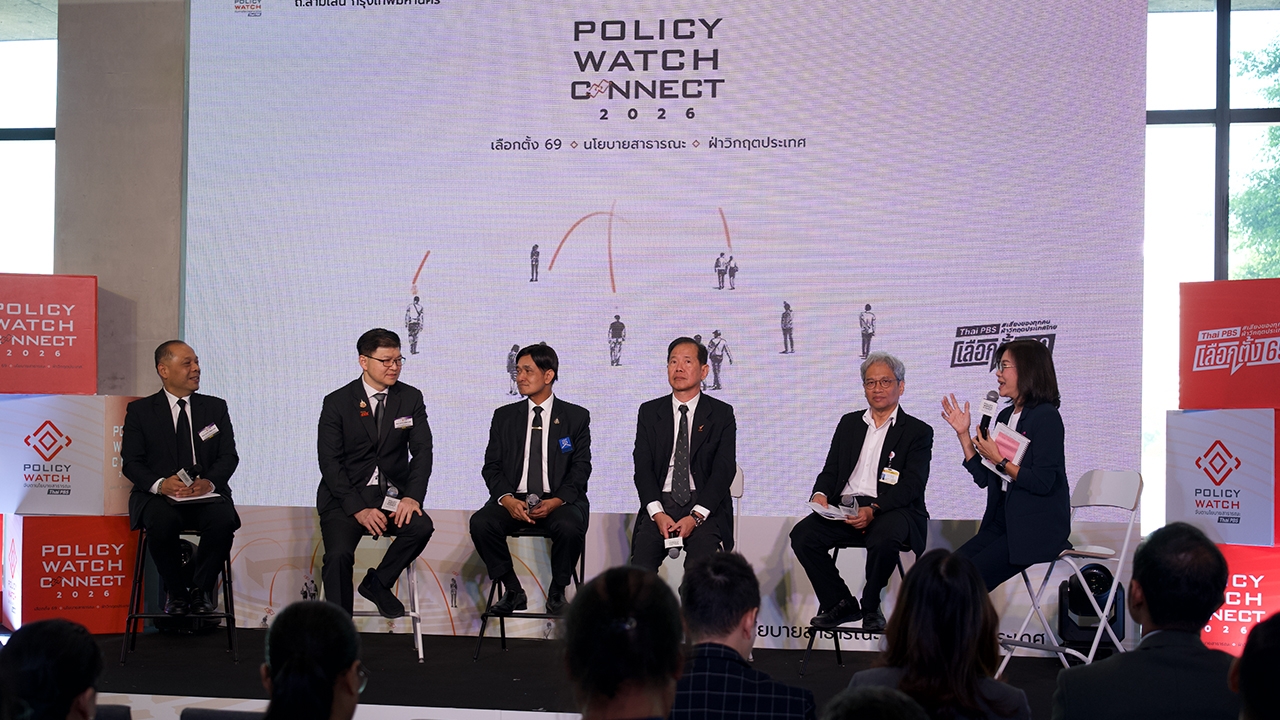
"Policy Watch Connect 2026" transforms crisis into hope by listening to the public voice to create "public policies" delivered to political parties. The chairman of the Senate Committee on Political Development emphasized that the state faces a credibility crisis, with policies failing to match promises and falling short. He stressed the importance of spaces for public participation to enable citizens to think and design policies. The initiative aims to tackle major national challenges through a "White Paper" delivered to political authorities, recommending that the government and bureaucracy open opportunities and engage all sectors to help resolve the country's crisis.

On 12 Jan 2026 GMT+7 at the Parliament, Policy Watch – The Active, Thai PBS, and over 40 network organizations jointly held Policy Watch Connect 2026. The event opened a space to connect “the public” and “policy makers” to gather major national issues and distill them into tangible policy proposals to be forwarded to political parties ahead of the election.
Nareset Prachakorn, a Senator and chairman of the Committee on Political Development, Public Participation, Human Rights, Freedoms, and Consumer Protection, stated that public policy is not distant but part of everyone's daily life. The quality of public policies determines each person's life opportunities. However, in the past, policies were decisions made by the state to act or not, affecting citizens' quality of life.
Nareset said the 8 Feb 2026 GMT+7 election is a critical moment featuring two events: the general election and a constitutional referendum. He believes it will mark a major political change in Thailand as it offers a chance to restructure power. This makes Policy Watch Connect 2026 very important as it serves as a bridge allowing the public to voice their concerns to political parties. “This is why we organized this event. Next month is the campaign period when parties compete to make promises. Usually, parties present policies, and the public only listens passively. This time, we aim to change that by letting the public initiate and design policies. The event connects public policies to public voices, representing hopes and concerns across 12 discussion forums addressing the country's major issues,” Nareset said.

Nareset added that one key challenge is the state's credibility crisis, which makes announced policies difficult to implement due to public distrust. Therefore, public participation in policy-making is crucial. “All proposals from Policy Watch Connect 2026 will be compiled into a White Paper and organized into a 'Policy Market' to connect citizens, civil society, and political parties. This space allows the public to question, monitor, and demand accountability from parties, while parties can explain their past work. This will begin elevating grassroots proposals to political parties for the upcoming election. Good policies should not be defined solely by politicians but must emerge from genuine public participation,” he said.

At the forum “Hope for the Election, Overcoming Thailand's Crisis,” Wanchai Tantivitayapitak, director of the Public Broadcasting Organization of Thailand (Thai PBS), said there is always hope in elections. Similarly, with Policy Watch Connect 2026, he hopes that after the election, political parties will implement what civil society has committed to. If that happens, it will strengthen democracy. “For example, 20 years ago, Singapore faced severe haze pollution not caused by itself but by neighboring countries. Civil society pressured the government to enact laws penalizing companies involved in forest burning. This pressure, including on goods from burning, led to clear air quality improvements. It shows how the Singapore government listened to civil society, leading to change. Thus, Policy Watch Connect 2026 represents a social contract; if political parties or the new government adopt these policies, it will be beneficial,” Wanchai said.

Assoc. Prof. Praphas Pintobtang, a Senator and member of the Committee on Political Development and Public Participation, emphasized that the country is currently in a multidimensional crisis—political decline, weakening democracy, economic hardship, and stagnant welfare. People share concerns about how much hope the upcoming election can offer, given past governments' inability to solve crises concretely. He invited reflection on how Policy Watch Connect 2026 gathers lessons and experiences from various sectors working on solutions to propose policy options and push for legislation, representing genuine grassroots policy. However, these may not always be in the hands of decision-makers like political parties or politicians. The key question is how to bring socially-driven policies developed with public participation into the hands of political decision-makers. “Policy Watch Connect 2026 is like a policy market where grassroots actors offer their policies. The challenge is how to ensure these reach decision-makers and the legislative process,” Praphas said. He cited concrete examples from civil society partners working on inequality and welfare issues. Civil society has worked intensively to reach consensus on grassroots policy proposals, which have been debated and compiled into the White Paper. One innovation is a policy on urban poor housing, proposing rental housing instead of ownership, shifting the approach to public housing. It is hoped that such grassroots policies will become public policies with mechanisms to monitor and ensure implementation.

Dr. Pongthep Wongwatcharaipiboon, manager of the Thai Health Promotion Foundation (ThaiHealth), urged society to acknowledge that social and quality-of-life problems are too complex for politics and bureaucracy to handle alone, despite their authority. Thus, it is necessary to involve various social sectors to collaboratively solve problems and drive change. “ThaiHealth exists to bridge this gap by supporting civil society to create prototype models or problem-solving processes that can be expanded by the government nationwide. However, these processes sometimes face complexities that require political will to support, monitor, and scale up effectively. I want to see accessible public policies, not ones implemented solely by bureaucracy or politicians, but involving all sectors to tackle complex problems. If this is accepted, the bureaucracy must let go in part and engage other sectors to work together for the public good,” Dr. Pongthep said.

Consistent with Dr. Suthep Phetmak, secretary-general of the National Health Commission, who acknowledged that problems are increasingly difficult, leading many to pin hopes on this election to improve conditions. Public policy is crucial. Professor Prawes Wasi once emphasized that the greatest ideal of humanity is to create complete health in body, mind, and society; failure to do so would threaten humanity. Therefore, solving problems requires knowledge from social and political sciences. Policy Watch Connect 2026 offers a valuable platform connecting all sectors, generating extensive knowledge. “Good public policy involves participatory processes, enabling the country to find solutions and build grassroots democracy. I believe many aspects of Policy Watch Connect 2026 will help drive hope and successful action, and should be done whenever possible,” Dr. Suthep said.

Similarly, Natthapong Rodmee, assistant secretary-general of the King Prajadhipok's Institute, emphasized the importance of having spaces for participatory policy thinking, especially collaboration with civil society networks. He acknowledged that everyone's policy hopes differ but stressed how to best reflect these hopes and needs into clear policy implementation. He expects three key outcomes: 1. Election processes must be transparent, fair, and verifiable, as everyone expects; 2. Public policies should ensure the voices of the marginalized reach party policy tables and that parties develop policies not merely by choice but truly for the people; 3. Participation is the next step to involve civil society in responding, monitoring, and evaluating policies as key mechanisms for policy advocacy. He believes this election will be a milestone for national change. Policy Watch Connect 2026 gathers major national issues and distills them into tangible policy proposals, held from 12-23 January 2026 GMT+7 at Sappaya-Sapasathan (Parliament Building), Samsen Road, Bangkok. Interested individuals can register for free athttps://forms.office.com/r/uQ8UamnAVSor follow more information athttps://theactive.thaipbs.or.th/news/policy-watch-connect
Read more news on " State Policies " here