

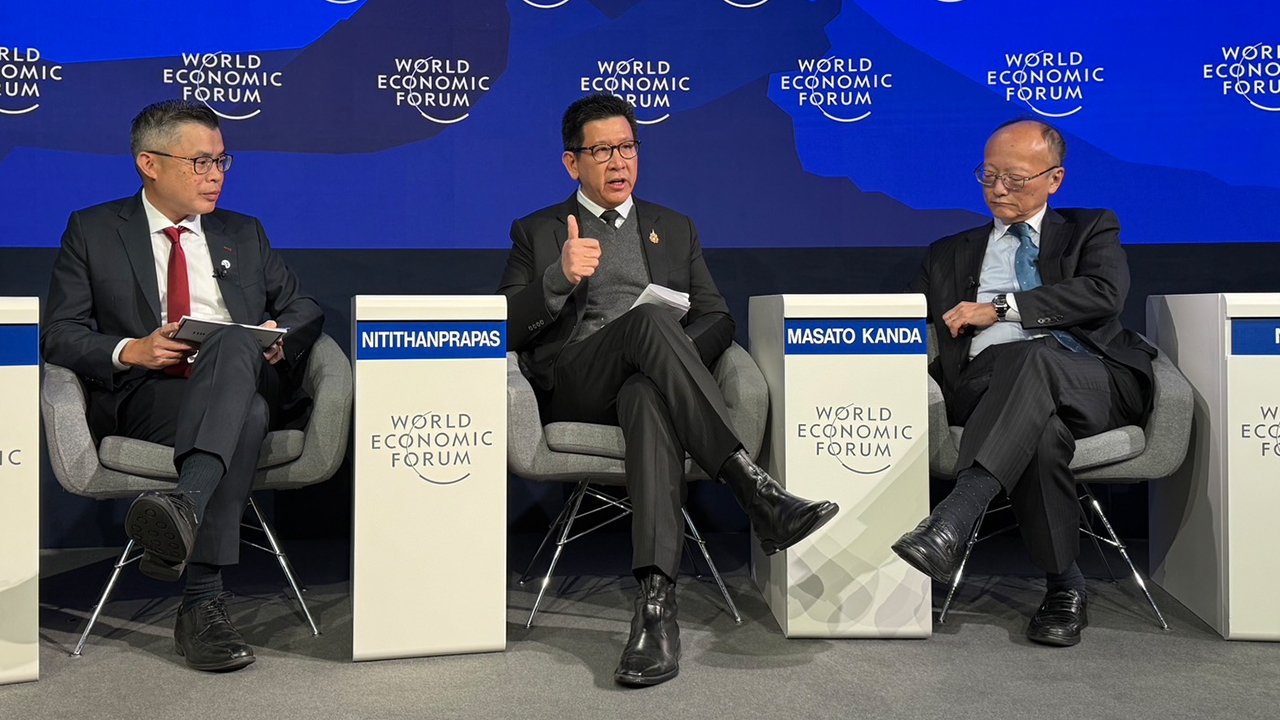
Deputy Prime Minister Akaniti led Team Thailand to highlight the country's role at Davos, connecting global economic leaders and top company CEOs to showcase Thailand's potential as the region's new economic hub. The mission aimed to advance collaboration toward high-tech investments, create quality jobs, and upgrade Thai workforce skills, while moving forward with investment plans totaling over 500 billion baht in Thailand.
Mr. Narut Therdsteerasak, Secretary-General of the Board of Investment (BOI). He revealed that the mission of Deputy Prime Minister and Minister of Finance Akaniti Nitithanprapas and Team Thailand at the World Economic Forum Annual Meeting 2026 in Davos, Swiss Confederation, from 19 to 22 January 2026, was highly successful in boosting confidence in Thailand. The team expanded cooperation networks with international organization leaders, showcased Thailand's role on the global leadership stage, and held discussions with executives of leading global companies to foster investments and collaborative projects beneficial to Thailand's economy in the future.

The Deputy Prime Minister emphasized that the Davos visit achieved three main objectives: (1) leading government and private sectors to reinforce Thailand's image among world leaders as a capable country with clear policy direction, neutrality amid geopolitical conflicts, and readiness to be a regional hub for new economic cooperation; (2) negotiating with leading company executives to realize tangible investments beneficial to the country, especially in New S-Curve industries using advanced technology, creating business opportunities for Thai entrepreneurs, generating quality jobs, and developing Thai workforce skills aligned with future global trends; and (3) building cooperation to pave the way for hosting the IMF–World Bank Annual Meetings 2026 in Bangkok, demonstrating Thailand's capacity to host major global events and its potential as an ASEAN leader.

Global tech giants advance a 500 billion baht investment plan while enhancing workforce and supply chains. During the WEF meeting, the Deputy Prime Minister and his delegation met with executives from nine leading global companies with existing and planned investments totaling over 500 billion baht. This fostered confidence during the government transition and accelerated ongoing projects in Thailand.
They also attracted new investments in the New S-Curve industries, divided into digital and AI sectors with six companies, smart automotive and aviation sectors with two companies, and the food sector with one company, as follows.
Digital and AI sector.
AWS: The company reaffirmed its long-term investment plan of over 150 billion baht in Thailand over 15 years, having already invested more than 24 billion baht. It supports the government's Cloud First policy and is interested in the Skill Bridge project for developing Thai workforce skills. AWS plans to discuss details and aims to train more than 50,000 people in digital and AI fields through this program.
Microsoft: Presented AI applications to enhance efficiency in government and business sectors, supporting SMEs to adapt and compete, and discussed cooperation opportunities in workforce development for the digital economy transition.
TikTok: Confirmed a long-term investment plan totaling over 270 billion baht and discussed using its platform to empower SMEs to access markets and increase income opportunities. The company proposed expanding Thailand as a regional hub for activities such as content development.
DAMAC
Group: A global data center infrastructure developer planning to invest over 130 billion baht in Thailand. Discussions covered developing utility infrastructure for data centers, especially electrical networks, to support cloud expansion and AI technologies in Thailand.
HCL
Technologies: A leader in software and AI technology development and services, discussing ways to apply AI to enhance agriculture, manufacturing, and tourism sectors, as well as improving government services efficiency (GovTech).
NVIDIA: A leader in chip and AI platforms, discussing ways to enhance Thailand's AI ecosystem, including workforce and developer team development, creating Thai language models and applications to boost key industries, and expanding centers of excellence to strengthen AI learning in Thailand.

Smart automotive and aviation sector.
Hesai
Technology: The world's largest LiDAR technology provider for intelligent vehicle systems decided to invest in establishing its first production base outside China in Thailand, with an investment of over 1.5 billion baht. The company is ready to collaborate on developing robotics and AI workforce under the Skill Bridge project to prepare personnel for expanding the supply chain and AI/Robotics ecosystem in Thailand.
Archer
Aviation: A leading company in personal air transport discussed opportunities for collaboration and joint ventures with Thai firms to develop Urban Air Mobility services, providing new fast and efficient transportation options in densely populated cities.
Food sector.
Nestlé: A global leader in food and beverage industry with a long-standing presence in Thailand, currently operating four companies and supported by eight investment projects. It has continuously invested over 28 billion baht in Thailand, covering food, beverages, pet food businesses, and operates regional offices here. The company plans further investment expansion in the near future.

Connecting global economic organizations – reaffirming Thailand’s proactive role and readiness to host IMF-World Bank 2026.
The Deputy Prime Minister held discussions with Mr. Ajay Banga, President of the World Bank, and Ms. Kristalina Georgieva, Managing Director of the International Monetary Fund (IMF), exchanging views on global economic directions, inclusive growth support, and quality job creation. They also discussed Thailand’s preparations to host the IMF–World Bank Annual Meetings 2026. The Thai side emphasized that hosting this event is a strategic platform for policy exchange covering economic resilience, inclusive growth, fiscal sustainability, and mobilizing private sector financing for business development. At the WEF, the Deputy Prime Minister also met with leaders from government and international organizations, including the OECD Secretary-General, ministers from Finland, Hong Kong, and Saudi Arabia, Gates Foundation Global Development Chair, World Economic Forum Managing Director, and Uplink WEF executives. Team Thailand further advanced cooperation on new economic issues important globally. The Deputy Prime Minister participated in key WEF sessions such as the Informal Gatherings of World Economic Leaders (IGWEL) on "What’s Ahead for the Global Economy – Boom, Bust or In-between?", the strategic meeting on "New Pathways for ASEAN Growth and Productivity," the panel "Is ASEAN Moving Fast Enough?", and other significant forums to exchange views on inclusive, sustainable growth, competitiveness enhancement, and regional economic integration, while showcasing Thailand’s strengths, investment opportunities, and policy experiences for regional expansion.
Read more news " Government policy " here