

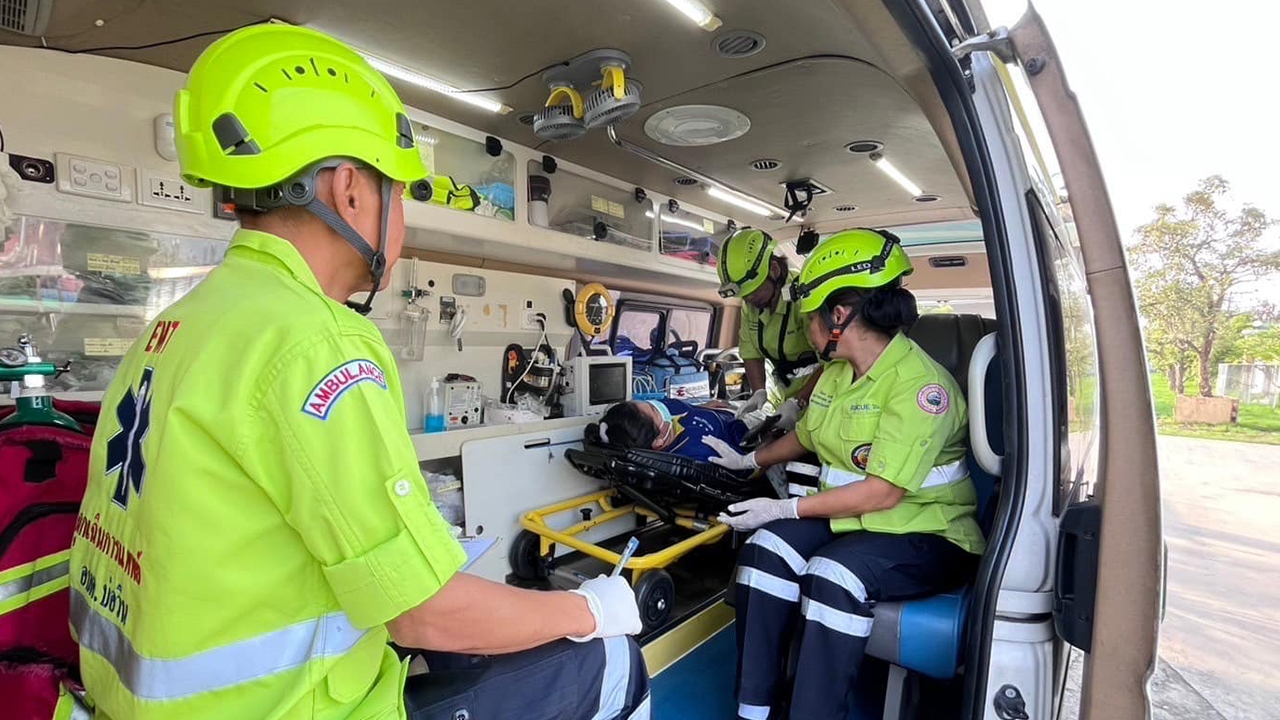
From life-or-death moments to the country's future! The National Institute for Emergency Medicine (NIEM) urges the new government to revise the emergency medical services concept as essential infrastructure requiring state investment. It reveals Thailand’s per capita emergency medical budget is only 16 baht, 60 times lower than global standards, questioning whether this is sufficient to care for Thai citizens’ emergency conditions and support the country’s economic stability.
Dr. Pichet Nongchang, Secretary-General of the National Institute for Emergency Medicine (NIEM). He joined a press conference presenting policy recommendations for the new government to develop Thailand’s emergency medical system, elevating it to a core state infrastructure requiring strategic investment. The plan includes expanding coverage to every subdistrict, aiming to reduce emergency illnesses, deaths, and disabilities, while supporting the economy through internationally standard safety systems to build confidence among tourists and investors. This was announced during the "Voices from Health Organizations for a Longer, Healthier Life for Thais" event, uniting eight health organizations (Ministry of Public Health, NIEM, Thai Health Promotion Foundation, National Health Security Office, and others) to urgently propose reforms to political parties or the incoming government to unlock limitations and solve key issues affecting Thai citizens’ quality of life and the economy, held at Meeting Room 112, Sappaya-Sapasathan (Parliament).

Dr. Pichet revealed, “The emergency medical system is not merely about providing emergency patient care; it is essential infrastructure that the state must strategically invest in to ensure the safety and protection of people facing emergencies. This reduces death and disability rates, improving citizens’ quality of life. Moreover, it not only saves lives but strengthens Thailand’s economic growth, especially through tourism.”
Currently, Thailand’s emergency medical system faces several issues and limitations, including insufficient budget to develop the system, affecting the coverage of emergency medical units, inadequate air emergency medical units (Thai Sky Doctor), and a shortage of paramedics—only 1,790 exist with an annual production of 210, while actual demand exceeds 22,305 (data as of 31 December 2025). Public awareness and skills in basic first aid, such as CPR and AED use, remain inadequate.
The insufficient budget for developing the emergency medical system is a major constraint. The Emergency Medical Fund receives only about 1.05 billion baht annually, paying emergency operation compensations at rates below actual costs for over 20 years. An additional emergency budget of over 200–300 million baht per year is necessary. Importantly, the emergency medical budget represents less than 0.01% of the country's total health budget, equating to just 16 baht per person annually—far below the World Health Organization (WHO) standard of 5-10%. Compared to countries with strong emergency medical systems like Japan, Singapore, and South Korea, budgets range from 100 to 1,000 baht per person per year (World Bank, 2024).

Budget constraints directly impact the expansion of local infrastructure. Currently, about 2,600 local administrative organizations out of more than 7,255 cannot operate emergency medical services due to the high investment cost of nearly 3 million baht per unit for ambulances and hiring 6–9 personnel to provide 24-hour service. Consequently, most smaller localities invest in other infrastructure such as roads or electricity instead. This limits emergency medical access for critically ill patients (red category), with only 34.45% able to access services (data as of 30 September 2025).
In 2025, Thailand ranked 9th globally for quality public health services, but the emergency medical system still requires development to avoid negatively affecting citizens' quality of life and the confidence of tourists and investors, which are vital to the national economy.
The long-standing problems have impacted coverage and standards of emergency patient care as stipulated by the Emergency Medical Committee, resulting in higher death rates, reduced confidence from tourists and investors, and ultimately severe consequences for the economy and society.

The NIEM Secretary-General emphasized that NIEM’s key recommendations for the "incoming government" to drive as national policy to reform Thailand's emergency medical system include four crucial investment areas for improving citizens’ quality of life:
1. Invest in emergency medical units equipped with ambulances, equipment, and personnel covering every subdistrict, ensuring sufficient and rapid high-level emergency medical services for critical patients.
2. Transition fully to Digital EMS by investing in information technology, digital systems, and databases covering incident reporting, automatic location identification, real-time operations, and Emergency Telemedicine systems, while maintaining the highest standards for patient data privacy.
3. Strengthen emergency medical systems for crises by building capabilities to handle disasters and public emergencies, including emergency vehicles for patients, communication equipment, radio, internet and satellite communication vehicles, medical supplies, and emergency medical teams for timely response.
4. Build safe communities by ensuring communities, public places, facilities, and agencies are prepared for initial emergency response, such as providing AED devices in communities, supporting personnel and citizens with basic first aid and CPR knowledge to increase survival chances before medical help arrives, ensuring accurate emergency reporting via hotline 1669, and promoting “community emergency volunteers” in every household.
“Our goal is to make Thailand’s emergency medical system accessible, equitable, accurate, and timely, supported by modern infrastructure and technology, alongside sufficient quality vehicles, equipment, and personnel so that everyone in Thailand can equally access services. This infrastructure must be promptly invested in by the state. If the new government endorses and advances these health investment strategies as policy, Thailand will achieve an efficient emergency medical system, boosting confidence in tourism safety standards—a key factor in sustainable economic growth—while enhancing the quality of life for all Thai citizens. Moreover, it will significantly reduce preventable losses and make Thailand one of the safest countries in emergency medical care,” the NIEM Secretary-General concluded.
Read more news on " Government Policy " here