

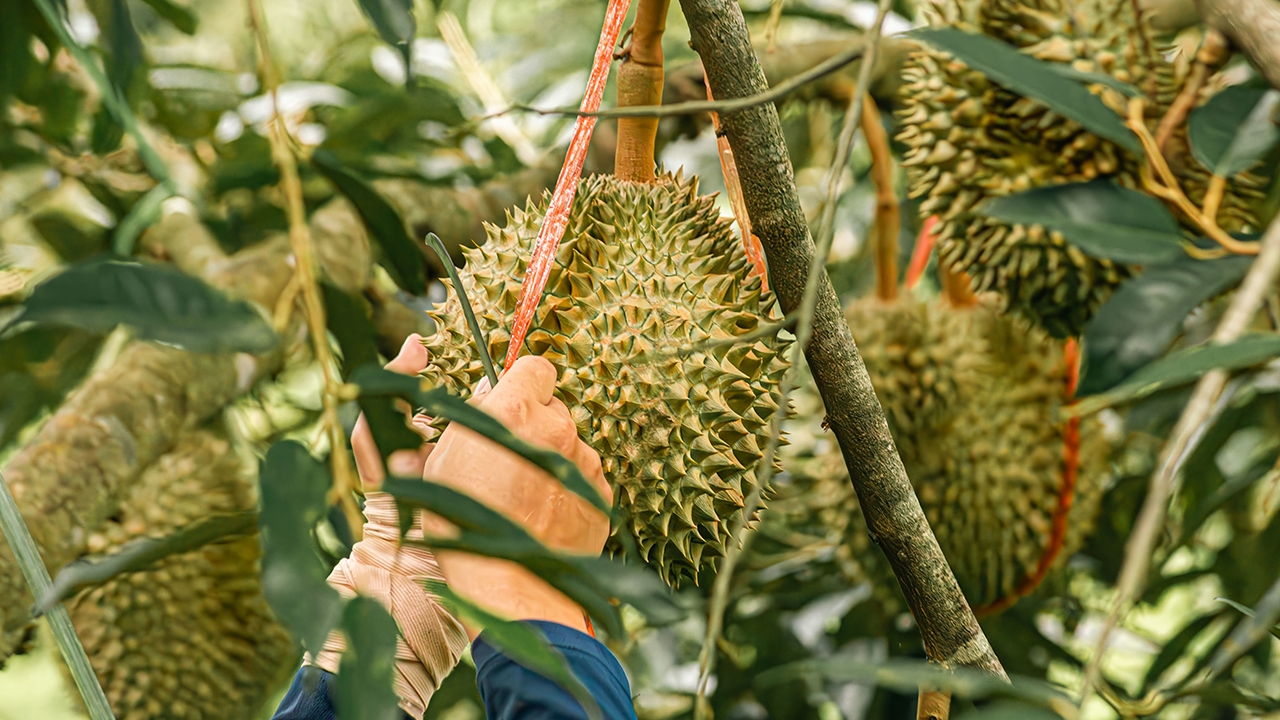
The Department of Internal Trade is concerned about a labor shortage for durian harvesting this year and has called on relevant agencies to expedite solutions. It is also accelerating plans to manage an expected production of up to 1.78 million tons, while clearing transport routes to China to prevent delays, and promoting domestic consumption with a price target not below 100 baht per kilogram. Regarding rice, discussions are underway with convenience stores and vending machine manufacturers to produce ready-to-eat boxed meals priced at 35 baht per box.
Mr. Witthayakorn Maneenet, Director-General of the Department of Internal Trade, revealed that the department has prepared plans in advance to handle key agricultural products before harvest, especially rice and durian, including medium- and long-term measures to stabilize prices for farmers. The product currently receiving urgent planning is durian, with an expected production this year of 1.78 million tons, a 10% increase from last year—1.06 million tons from the Eastern region and 720,000 tons from the South. The peak season will be April to May 2026. However, this year may face labor shortages for durian harvesting because previously skilled Cambodian workers were employed. This year, alternative labor must be found and trained, requiring time to develop skills. Relevant agencies are urged to resolve this to avoid impacting product prices. The target selling price this year is not less than 100 baht per kilogram. Export prices remain a concern due to the strong baht.
In addition, there are plans to address strict residue controls, including BY2 and cadmium, prepare containers, and coordinate with border checkpoints for durian shipments to China. Preparations are also underway for the transitional period when durians from the Eastern and Southern regions overlap around June 2026, especially readiness of collection centers, as poor management could depress Southern durian prices early in the season. Transport routes to China via R8, R12, and R9 must be kept clear, particularly the routes passing through Thailand, Laos, and Vietnam.

"This year, Vietnam will produce up to 2 million tons of durian, competing with Thai durian in the Chinese market. Therefore, we plan to expand the Western China market access through Vietnam to reach Chengdu, and utilize the R3A route from Thailand through Laos to Kunming, which should not pose problems. There is also a plan to open new markets in the Middle East, focusing on frozen durian sold like ice cream. Feedback from exhibitions in Dubai has been positive," he added.
At the same time, there are plans to stimulate Thai durian consumption by organizing Thai Durian Day festivals, building confidence in durian exports via the first container shipments to China, and increasing domestic consumption from the current 25% share to a target of 500,000 tons, with exports of 1.28 million tons. Cooperation with wholesale markets will distribute durians to remote areas, invite influencers to livestream durian sales at markets, and promote activities targeting tourists from China, India, Russia, South Korea, and others.
Regarding rice, there are no price problems with jasmine rice, but support will be given to farmers to store rice rather than sell immediately after harvest. The use of Thai SELECT restaurants as a channel will be promoted. For white rice, Pathum fragrant rice, and glutinous rice, measures will slow sales, link with packaged rice entrepreneurs, and establish purchase points during harvest. Discussions are ongoing to produce affordable boxed rice meals for sale through vending machines.
"Currently, discussions with the Thai Chamber of Commerce are underway to produce boxed rice meals sold through vending machines, where buyers can choose dishes such as stir-fried holy basil, prepared by well-known chefs. Multiple companies are involved with vending machines, aiming to sell boxes at 35 baht each. Talks with convenience stores to stock these meals are ongoing, but sales commission rates are high; we have requested reductions. Results are expected by February 2026. If feasible, the plan will proceed; if not, alternative methods will be sought," he said.
Additionally, plans include reducing costs through the Green Flag Project, selling affordable chemical fertilizers and agricultural inputs, revising seed import regulations to accelerate private sector involvement, and promoting rice processing into value-added products. Efforts will continue to promote premium rice varieties such as organic, specialty, colored, and Geographical Indication (GI) rice. Awareness campaigns will target both domestic and international markets, collaborating with MasterChef, airlines, hotels, and restaurants to promote these products as health-oriented gifts.
/news " State policy " More