

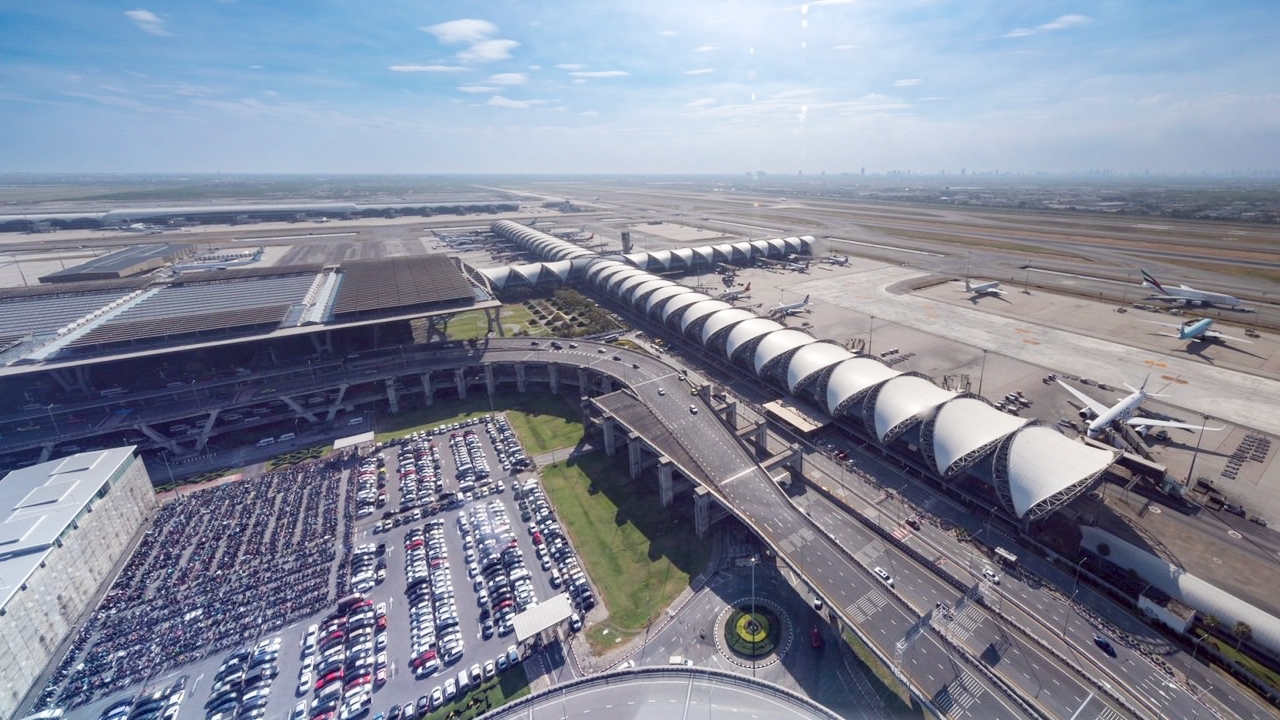
AOT is undergoing a major transformation with a plan to increase the Passenger Service Charge (PSC) for transit passengers, adopting an international model. The new outbound PSC of 1,120 baht per passenger is set to take effect around mid-2026, expected to increase revenue by 13 billion baht. This revenue will be invested in the South Terminal construction project, valued at over 200 billion baht, built in three phases. The approach aims to reduce borrowing and interest burdens, enabling Suvarnabhumi Airport to accommodate 120 million passengers annually. A new master plan for Suvarnabhumi will soon be submitted to the Cabinet to support elevating Thailand to an aviation hub.
Ms. Paweena Jariyathitipong, President of Airports of Thailand Public Company Limited (AOT), disclosed that at the Civil Aviation Board (CAB) meeting No. 3/2025 on 3 Dec 2025, chaired by Deputy Prime Minister and Minister of Transport Mr. Pipat Ratchakitprakarn, the board approved in principle AOT's proposal to raise the international departure Passenger Service Charge (PSC) from the current 730 baht per passenger to 1,120 baht, an increase of 390 baht. The implementation is pending approval from the Minister of Transport, who is also the CAB chair, and is expected to take effect by mid-2026.

The study results indicate that raising the PSC will not affect passengers' travel decisions compared to airfare or other expenses. It is projected that this PSC increase will boost AOT’s revenue by approximately 13 billion baht annually in fiscal year 2027. This additional income will support future investments, particularly in constructing the South Terminal, valued at over 200 billion baht. AOT emphasizes that the PSC adjustment is not aimed at maximizing profit but at rationalizing costs, reducing reliance on loans, and lowering long-term interest burdens.
Ms. Paweena added that internationally, over 90% of airports charge PSC fees for both departing and transit/transfer passengers, whereas Thailand is among a small group—only 5%—that charges PSC solely on departing passengers, resulting in missed revenue opportunities. As Thailand aspires to become an aviation hub, AOT plans to propose amendments to ministerial regulations to allow PSC collection from transit passengers, establishing a stable revenue foundation for the future. This step will follow after the new outbound PSC rate is implemented.
"Thailand is one of the few countries that charges PSC only on departing passengers, while leading global airports like Changi and Heathrow charge various passenger categories, including transit passengers," Ms. Paweena explained. "Comparing only outbound PSC rates does not reflect the true revenue picture. International studies confirm that PSC fees have no significant impact on travel decisions since they constitute a small portion of the total ticket price."
Ms. Paweena further stated that regarding the South Terminal construction project under the new Suvarnabhumi Airport master plan, AOT has informed the current Cabinet of the plan and will seek approval from the next Cabinet. The investment is valued at 200 billion baht. The South Terminal project has been revised for greater cost-effectiveness and flexibility, shifting from large immediate investments with high-interest burdens to phased investments aligned with actual passenger growth.
The new South Terminal investment plan is divided into three phases. The first phase, lasting about 2 to 2.5 years, focuses on building external road systems, electrical systems, utilities, and soil quality improvements, as the existing road lies on the planned path of the fourth runway. Terminal design will proceed simultaneously. The second phase involves constructing the first part of the South Terminal, which can accommodate 30 million passengers. Combined with the airport’s current capacity, this will bring Suvarnabhumi’s capacity to approximately 100 million passengers.
During the second phase, the main terminal building—which has been in service for over 25 years—can be closed for renovation without disrupting operations. The third phase will complete the remaining South Terminal construction and the fourth runway. Upon full completion in 10 to 12 years, Suvarnabhumi Airport will have four runways and a full capacity of 120 million passengers per year.
Ms. Paweena also mentioned that the East Expansion project remains awaiting Cabinet approval, delayed due to pending feedback from the Ministry of Finance. Recently, the Ministry responded, and the project is expected to be submitted soon. The plan involves budget and building size adjustments to align with current conditions, while maintaining the original approved budget framework from 2016.
Regarding passenger traffic, AOT closely monitors global changes and pursues proactive strategies. In 2025, over 126 million passengers used AOT’s six airports. This year, the target is 130 to 135 million passengers, representing 3 to 6% growth. In the first quarter of fiscal 2026, passenger numbers have already increased by more than 4% compared to last year. AOT’s operations and strategies represent a significant transformation, including investment restructuring, revenue management, and operational models to strengthen financial stability while enhancing safety standards and passenger experience to match leading global airports.
. . . State Policy . . .