

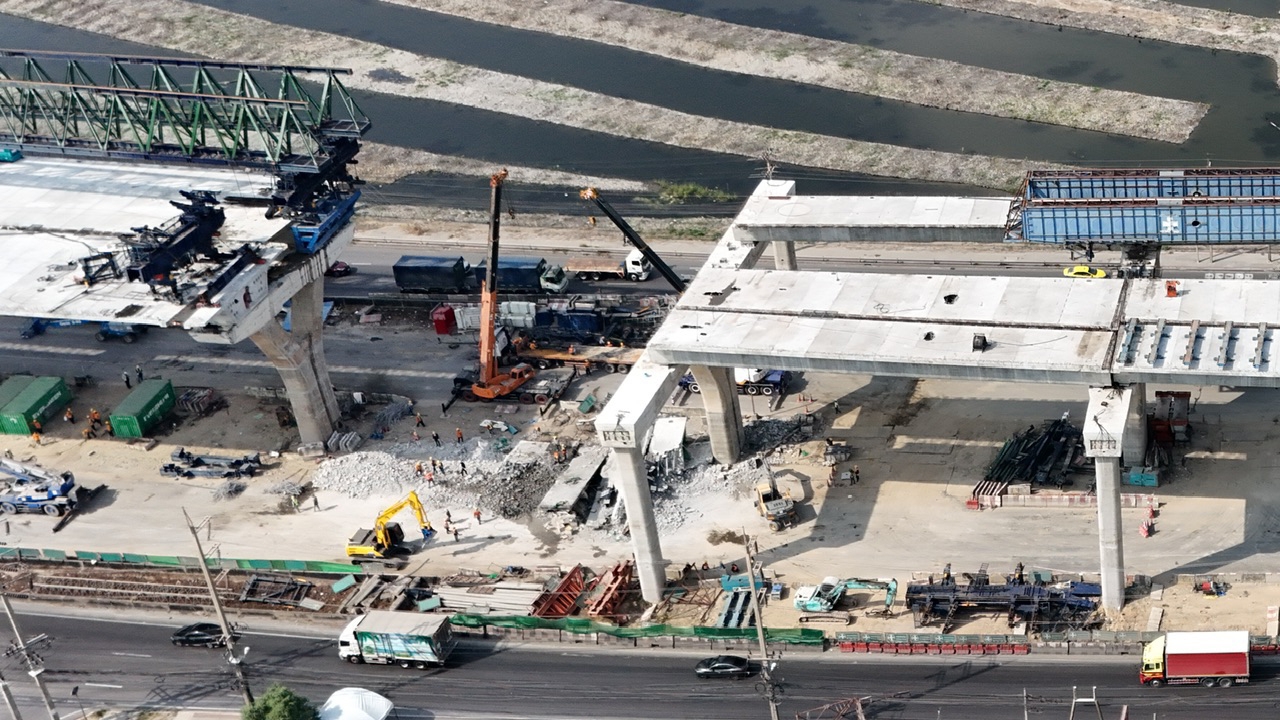
The Department of Highways reported progress during the first week of dismantling the M82 motorway bridge damaged by the LG crane collapse and completing concrete connections for the cantilever bridge beams over the Tha Chin River, stressing that public safety is the main priority, with close supervision by the Engineering Institute of Thailand (EIT). The tags are: [Department of Highways, bridge demolition, crane collapse, public safety, Engineering Institute of Thailand]

Piyapong Jiwattanakulpaisan, Director-General of the Department of Highways (DOH), provided an update on the M82 motorway project section 7 after the collapse of the Launching Gantry (LG) crane at Highway 35 (Rama 2 Road). He said the dismantling of the damaged bridge under the LG crane is underway with expert supervision from the Engineering Institute of Thailand (EIT) and strict safety measures to protect road users. Concrete work connecting cantilever bridge beams over the Tha Chin River has been completed at one point. Investigations into the incident's cause are being accelerated to inform strict contract compliance oversight.

Following the LG crane collapse on the M82 motorway section 7 construction on 15 Jan 2026, it became necessary to dismantle two spans of prestressed concrete bridge deck near the collapse site due to damage. Inspections found the bridge deck was punctured and the prestressed tendons damaged, with visible cracks on box girder components, compromising structural integrity. To ensure safety, the damaged sections must be removed systematically using the LG crane to lift separated box girder segments according to engineering procedures and strict safety protocols. All operations are supervised by EIT experts with controlled work zones to ensure public confidence. The approach covers five key aspects.
Aspect 1: Construction site safety – The entire work zone is fully closed to traffic where hazardous overhead work occurs, maintaining a strict safety zone to separate construction from traffic completely.
Aspect 2: Machinery and equipment safety – Engineering reviews of LG crane designs and installation methods for each bridge span have been conducted, including full recalculation. The crane equipment has been re-inspected, and an add-on Structural Health Monitoring (SHM) system with real-time sensors operating 24/7 has been installed to monitor structural behavior and mitigate accident risks.

Aspect 3: Use of expert LG crane operators – The previous LG crane team from ITD has been replaced with a specialist company recognized for high safety standards to perform the work.
Aspect 4: Independent safety inspection and supervision (Third Party) – Independent safety experts, invited from the Engineering Institute of Thailand (EIT), have joined to inspect and oversee safety at every stage throughout the operation.
Aspect 5: Transparent public communication – Engineering information is openly shared with the public, with continuous progress reports provided.

In the past week, the Department of Highways and EIT experts held joint meetings to establish maximum safety inspection measures before starting dismantling. They assessed the structural integrity of adjacent areas potentially affected by the LG crane collapse to verify dismantling plans and inspected the LG crane equipment to be used for lifting damaged bridge sections. As of 31 Jan 2026, two major operations have begun:
1. Moving the left-side LG crane: Release of PT-Bar restraints and repositioning the LG crane to a safe location to avoid obstructing bridge beam dismantling.
2. Adjusting the second LG crane set: Moving the crane from the right side into position to prepare for dismantling damaged beams. This includes installing main supports and drilling concrete for supporting frames. Work is ongoing following the plan.
For the coming week, engineers will review calculation documents and detailed method statements for LG crane movements used in dismantling. They will also install a real-time Structural Health Monitoring system to ensure continuous safety monitoring, alongside on-site inspections to verify machinery and equipment readiness before moving the LG cranes into operational positions for subsequent dismantling.

Regarding the concrete connection of the cantilever bridge beams crossing the Tha Chin River, three connection points remain incomplete and are progressing under strict safety controls. The current bridge structure is left as free cantilever beams supported temporarily by large scaffolding. To distribute loads as designed and allow removal of high-risk temporary supports, concrete closures must be completed promptly. As of 31 Jan 2026, concrete pouring and prestressing have been finished at one point (M3). Next week, work will proceed on the remaining two points (M4 and M5).
Concerning the fact-finding investigation into the LG crane collapse, the Department of Highways' committee—including senior civil engineers from the DOH, National Police representatives, the Council of Engineers, the Engineering Institute of Thailand (EIT), and legal experts—visited the incident site at km 30+300 on 31 Jan 2026. They collected key forensic and engineering evidence at nine locations, including steel truss components, motors, hydraulic systems, and damaged parts. The forensic police from Samut Sakhon province assisted in securing these evidences in a controlled area to prevent loss and prepare for detailed examination.

Additionally, the committee planned forensic engineering inspections starting the following week, involving visual inspections, dimensional measurements, and physical data collection of structures compared to design plans. Key parts will be selected for laboratory testing to determine actual material strength. All data will be used in computer simulations (Finite Element Analysis) to analyze the structural failure cause and reach clear, internationally accepted engineering conclusions.
The investigation results will inform whether the contractor complied with design, construction methods, and contract conditions. They will also serve as critical information to consider liability and the Department of Highways' contractual rights moving forward.

The Department of Highways affirms its highest commitment to public safety, conducting all procedures transparently, carefully, and strictly in accordance with the law.
." Government Policy " Additional