

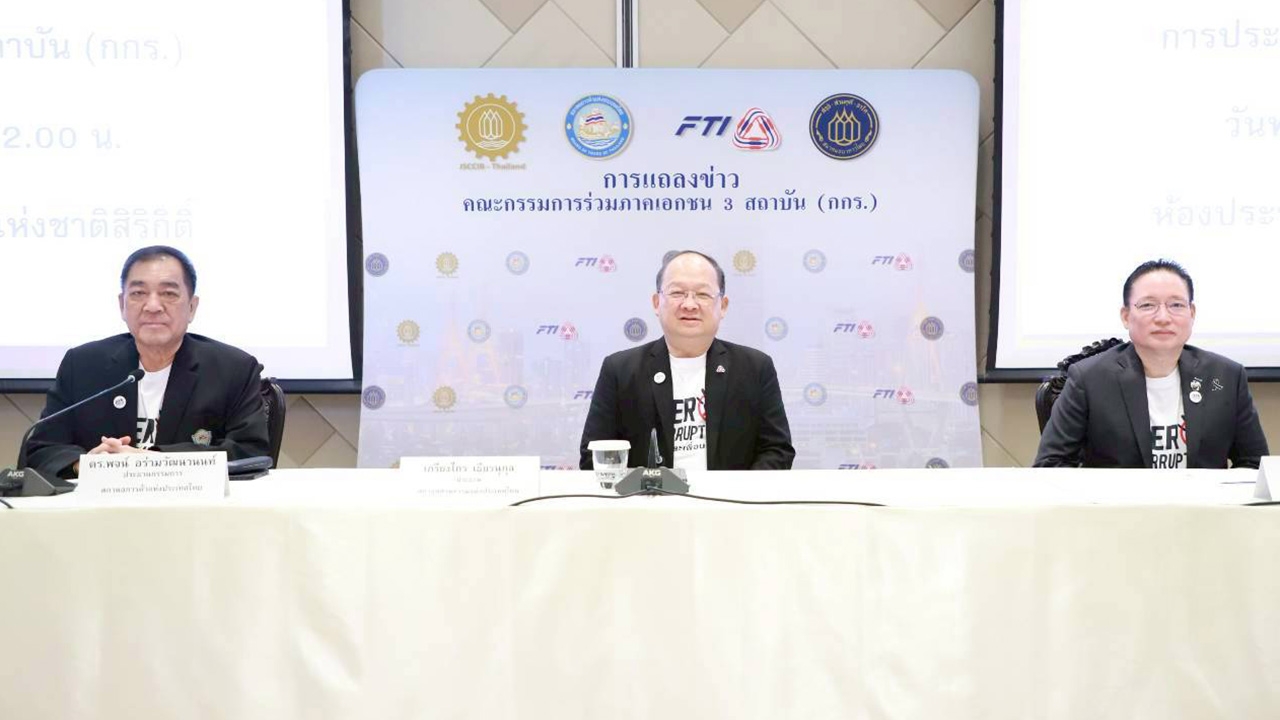
The Joint Private Sector Committee (JPC) is concerned that Thailand's economy in 2026 will grow less than 2%. It hopes for a smooth election and that the new government will select ministers with the right capabilities to swiftly address Thai household debt.
Mr. Kriangkrai Thianukul, Chairman of the Federation of Thai Industries, As chairman of the JPC meeting, he revealed that the Joint Private Sector Committee (JPC) is concerned about Thailand's economy in 2026, which is projected to grow less than 2%. There is added risk from potential delays in the 2027 fiscal budget preparation. Recently, the Fiscal Policy Office forecasted a decrease in government spending compared to the previous year, especially in investments. Data from the Comptroller General's Department showed that as of 31 Jan 2026, investment budget disbursement was 176 billion baht, or 21.57%, below the January target of 26%, reflecting delays in executing public investment projects.

Meanwhile, geopolitical factors and uncertainties from U.S. tax measures remain major risks to the global economy in 2026. Ongoing geopolitical events since early this year have caused volatility in financial markets, particularly currency and gold prices. This year, the U.S. plans to impose at least nine additional import tariffs affecting exports worth 45 billion dollars to the U.S., representing 63% of Thailand's exports to the U.S. in 2025, especially Semiconductors, which grew by as much as 53%.

Furthermore, the JPC is concerned about political parties' campaign policies, which mostly emphasize populist measures and short-term economic stimulus with high budgets, rather than long-term investment to restructure the economy. They also lack systematic and sustainable national income-generating policies. At the same time, political parties should be aware of fiscal policy space limitations due to rising public debt. As of December 2025, outstanding public debt was 12.45 trillion baht or 66.09% of GDP, approaching the fiscal discipline ceiling of 70% of GDP set by law, which constrains spending policy decisions.

. Mr. Phot Aramwattananon, Chairman of the Thai Chamber of Commerce and the Board of Trade of Thailand, said that after the election is complete, the Election Commission (EC) must certify the results, but the timing is unknown given current media issues. If discrepancies arise between voter rights and vote counts causing the election to be invalidated, it is unclear how that would be handled. However, if the problem is resolved, the cabinet must be formed as quickly as possible. The private sector greatly hopes the new government appoints ministers who possess sufficient expertise and capability to seriously manage each ministry. Currently, Thailand faces domestic and international problems, economic crises, geopolitical conflicts, and trade barriers that require true professionals to work. If ministers are appointed based on quotas, many problems will arise, and work will not proceed effectively. Therefore, it is hoped that truly competent individuals will be appointed because there is urgent work and issues to resolve already. Any solvable issues must be addressed promptly.


Read more news " Government policies " here