

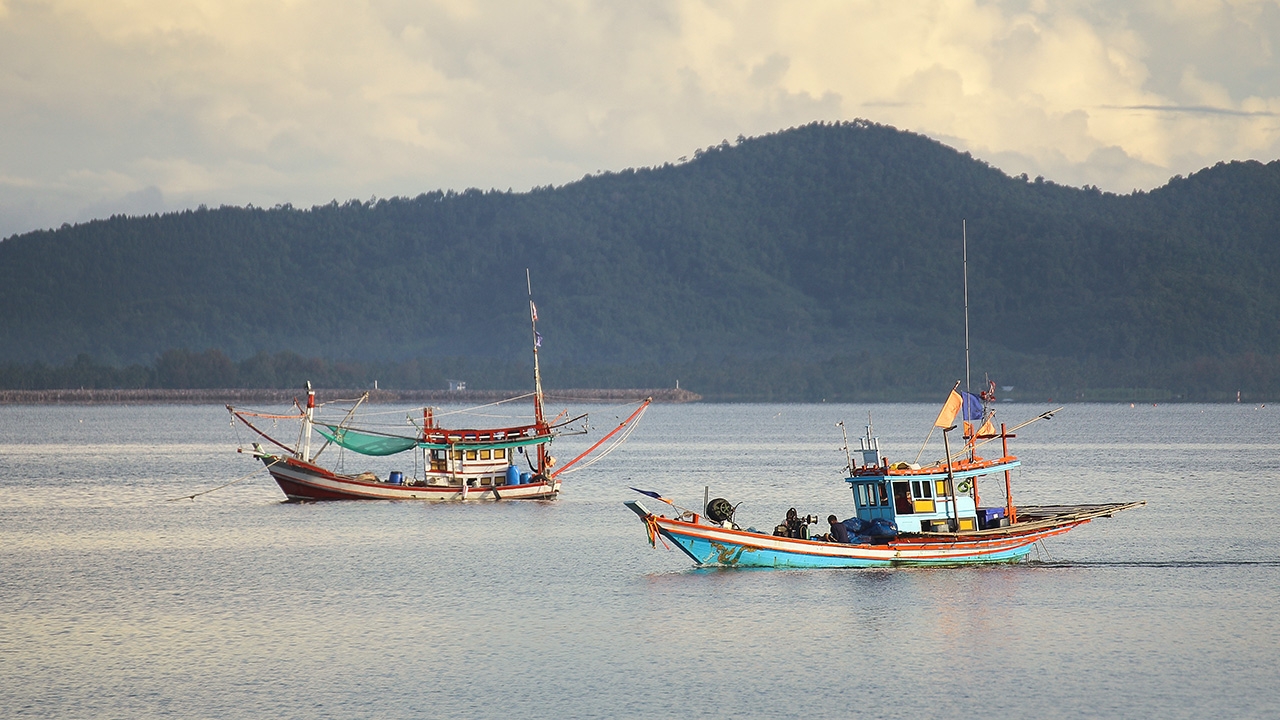
The Department of Fisheries is preparing to implement resource management measures for aquatic animals with eggs, spawning, and larval stages in 2026 in the central Gulf of Thailand, covering parts of Prachuap Khiri Khan, Chumphon, and Surat Thani provinces.
These measures are divided into two periods: the first from 15 February to 15 May 2026 and the second from 16 May to 14 June 2026, aiming to restore economic aquatic resources, create marine ecosystem balance, and support sustainable fishing practices.

Mrs. Thitiporn Laoprasert, Director-General of the Department of Fisheries, revealed that "The central Gulf of Thailand" is a critical area where the Department of Fisheries has long implemented resource management measures for aquatic animals with eggs, spawning, and larval stages, known as the gulf closure measures. This area serves as a habitat and breeding ground for various economically valuable aquatic species. The main goal is to conserve and manage aquatic resources sustainably, alongside continuous research and data collection to assess the suitability of the measures, including the scope, timing, and permissible fishing gear, ensuring alignment with current resource conditions and fishing contexts.

In 2025, the Department updated regulations regarding the length of gillnet mesh and fishing methods for the first period of the measures, as well as the use of encircling nets, scoop nets, or squid lift nets with electric generators (power units), clarifying fishing details. Consequently, four additional Department of Fisheries announcements were issued, including
1) Department of Fisheries announcement on defining areas and timing of spawning seasons for aquatic animals in parts of Prachuap Khiri Khan, Chumphon, and Surat Thani provinces, dated 22 January 2025.
2) Department of Fisheries announcement on defining areas and timing of spawning seasons for aquatic animals in parts of Prachuap Khiri Khan province, dated 22 January 2025.
3) Department of Fisheries announcement (No. 2) on defining areas and timing of spawning seasons for aquatic animals in parts of Prachuap Khiri Khan, Chumphon, and Surat Thani provinces, dated 10 February 2025.
4) Department of Fisheries announcement (No. 2) on defining areas and timing of spawning seasons for aquatic animals in parts of Prachuap Khiri Khan province, dated 10 February 2025.

The new announcements maintain the same areas and timeframes: three management zones over two periods as follows. Zone 1 (15 February - 15 May 2026) covers from the tip of Khao Mong Lai Cape, Prachuap Khiri Khan province, to Don Sak district, Surat Thani province, to protect breeding fish, allowing them to spawn and nurture larvae. Zone 2 (16 May – 14 June 2026) covers the area outlined in the attached map of the central Gulf closure announcement, protecting juvenile fish, especially mackerel, enabling them to grow in coastal areas to replenish breeding stock. Zone 3 is contiguous with Zone 2 and covers from Khao Mong Lai Cape to Hua Hin district, Prachuap Khiri Khan province, protecting juvenile fish, especially mackerel from the central Gulf closure area, giving them opportunity to move into the Gulf of Thailand.

Academic assessments show that in Zone 1 during the closure period, most mackerel caught were longer than the first maturity size, with an average gonadosomatic index above 80%, indicating readiness for spawning. This aligns with monitoring of juvenile mackerel and other economic fish species, which proliferated during the closure, with increased numbers of small mackerel detected after the closure ended. Additionally, catch-per-unit-effort (CPUE) data from permitted fishing gear before and after the closure showed increased catches—for example, encircling nets with power units caught 1,843 kg/day before the closure, increasing to 3,339 kg/day after. In Zone 2, post-closure surveys found mackerel sized 10-16 cm with relatively high CPUE, with encircling nets with power units, sonar encircling nets, and anchovy encircling nets catching up to 3,700, 2,233, and 3,750 kg/day respectively. Zone 3 showed mackerel sized 15-17 cm post-closure with high CPUE as well. These findings confirm the appropriateness of the zones, timing, and permitted fishing gear in relation to breeding and larval periods, effectively protecting breeding fish to spawn and rebuild sustainable aquatic populations.
"The Department of Fisheries thanks all fishermen for their cooperation and strict compliance with the law. We continue to coordinate with all relevant sectors to conserve and restore aquatic resources sustainably under the Fisheries Connect for Sustainability policy. We sincerely hope these measures will serve as a key mechanism to restore marine ecosystems, ensure food security, and improve the livelihoods of fishermen to be stronger and more secure in the long term," the Director-General concluded.
Read more news " State Policy " here.