

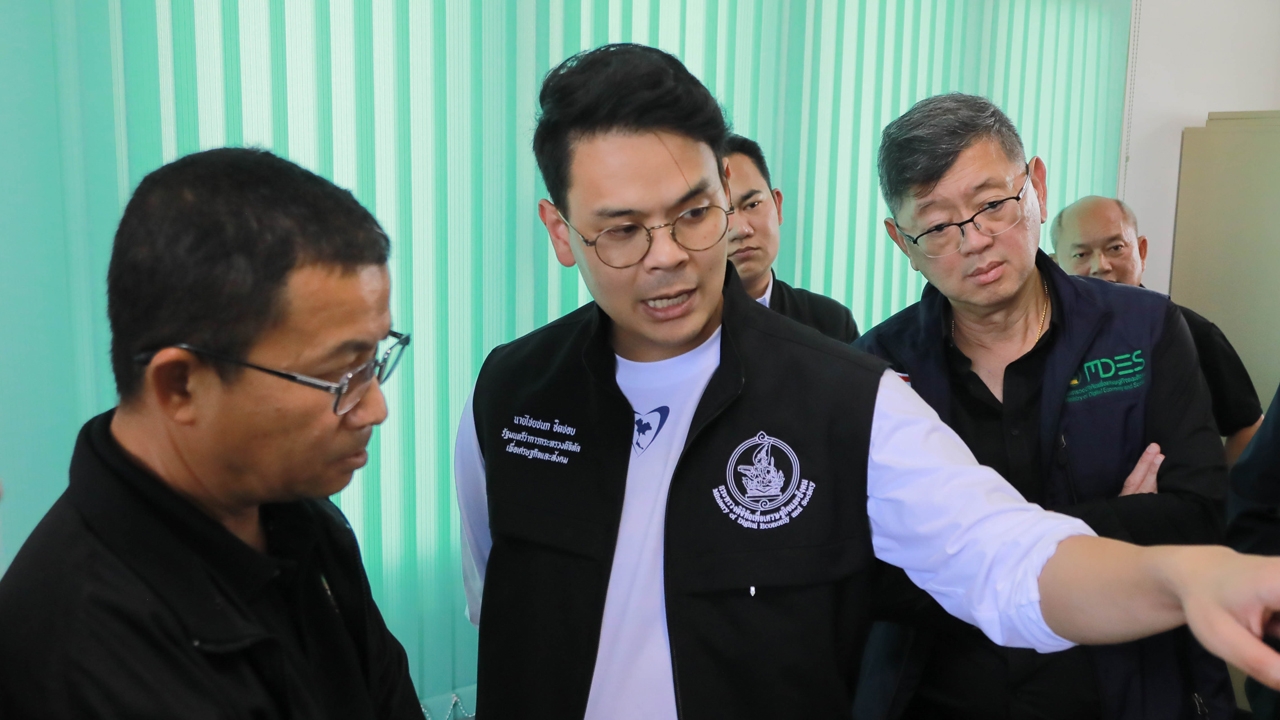
Chaiyachonok Chidchob, Minister of Digital Economy and Society (DES), along with Patchara Anantsilp, Permanent Secretary of DES, Chomphari Chomphurat, Deputy Permanent Secretary of DES, and Sukanyanee Yawichan, Director-General of the Meteorological Department, joined a meeting to discuss and monitor the pilot project (Proof of Concept -poc) to expand the high-accuracy weather forecasting system by using the Tomorrow.io satellite platform to enhance the meteorological satellite system. Present were Romdon Hai-awe, Deputy Governor of Songkhla Province, Supit Pitaktham, President of the Songkhla Provincial Administrative Organization, executives, government officials, and related agency staff at the Eastern Southern Meteorological Center, Hat Yai District, Songkhla Province.

Chaiyachonok said that since the governmentapprovedthe pilot project to upgrade the weather forecasting and disaster warning system by using the Tomorrow.io satellite platform alongside the Meteorological Department's system, weekly operational plans have been monitored over the 3-month pilot from December 2024 to February 2025. Today (10February 2025 GMT+7), he visited the site to follow up on the project’s progress, noting integrated data sharing among government agencies, private sector, civil society, and discussions on the needs of local community networks.

The Tomorrow.io system currently operates 11 Deep Sky satellites (Microwave Sounder) with 2 more being added, totaling 13 satellites to enhance forecasting accuracy. It can provide real-time data within one hour and includes a Flood Index adjustment function tailored to each locality, enabling specific subdistrict-level alerts and weather forecasts up to 7 days in advance. These featureswill helpboost the meteorological system’s forecasting and warning capabilities to an advanced level, expanding applications and developing real-time alert systemsto fitthe diverse regional contexts of Thailand.
Discussions revealed that user needs from local networks (Hat Yai Municipality, Pratong Municipality, Tha Hin Municipality, Songkhla Provincial Administrative Organization, and the Royal Irrigation Department) focus on weather management data and disaster alerts for response, prevention, and relief, such as hourly rainfall, rain intensity, and water levels. These data will be linked to water management by the Royal Irrigation Department.Beyond the primary goal of enhancing weather forecasting and disaster warnings, many stakeholders are interested in applying Tomorrow.io’s data in various fields. Prince of Songkla University aims to promote a One Data Center to provide accessible weather forecast data to the public, adaptable for universities across regions, encouraging academics, students, and youthto participate

in further development (Hackathon) to create innovations solving local problems effectively.Meanwhile, in disaster management, the pilot can be further adapted to warn about other hazards such as earthquakes, lightning, and PM2.5 pollution, as well as marine forecasts, enabling citizens to make informed decisions. It also supports building permanent "evacuation assistance centers" as infrastructure for disaster response or versatile use in normal situations.“The Tomorrow.io pilot is currently being tested by personnel in related agencies. I plan to extend the trial period to include other agencies and public use, linking warning data to platforms accessible to the public, such as alerts via Line, and dissemination through relevant local websites, enabling citizens

to access this data,

for example via hatyaicityclimate.org, which compiles weather forecasts and disaster warnings for Hat Yai District, Songkhla Province, with plans to expand to other areas,” Chaiyachonok said.Read more aboutgovernment policy
. . .