

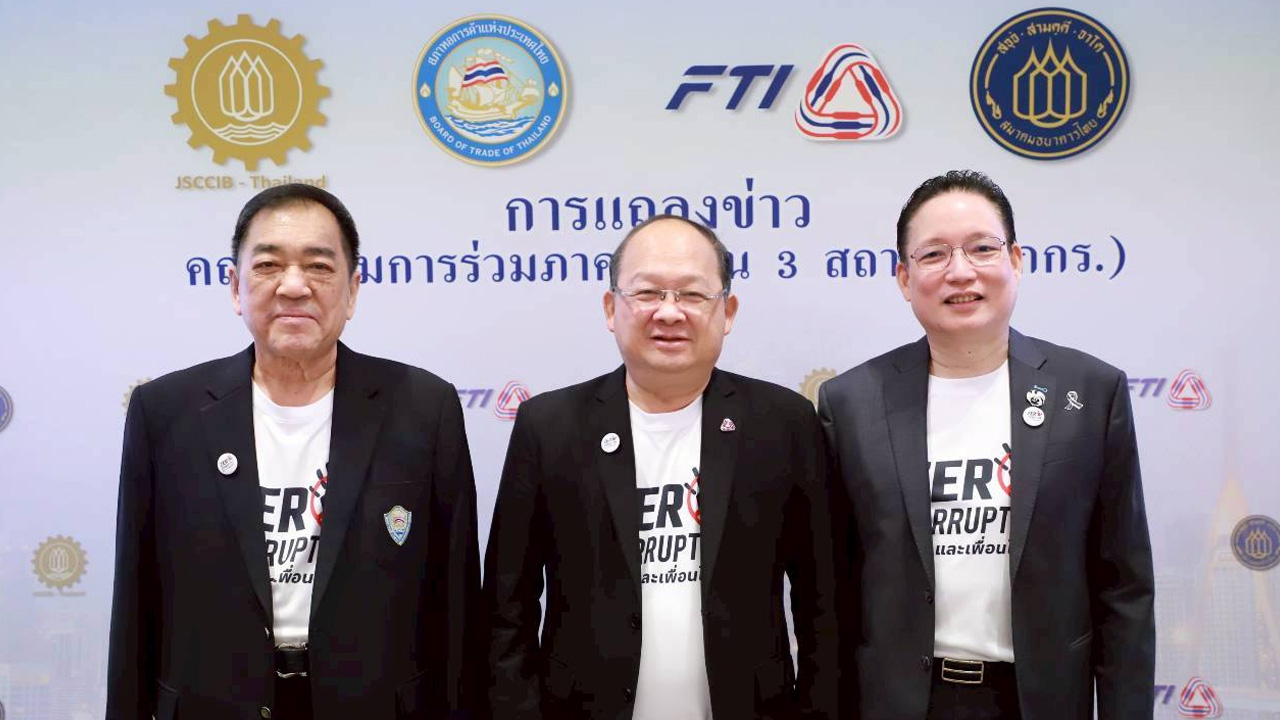
The JCCI and the 'Friends Won't Tolerate' network are concerned about Thailand's low CPI score, which affects investment confidence and the country's OECD membership goals. They urge the government and public agencies to take immediate action even while operating as a caretaker government.
According to Transparency International's 2025 Corruption Perceptions Index (CPI), Thailand scored 33 out of 100, ranking 116th globally — its lowest in 14 years and below the global average of 42. This reflects a significant deterioration in the country's transparency image.

The Joint Standing Committee on Commerce, Industry and Banking (JCCI) and the 'Friends Won't Tolerate' network worry that this trend will directly impact foreign investor confidence, Thailand's competitiveness ranking, and its long-term objective to join the OECD, which highly values good governance, transparency, and the rule of law.
Particularly, the drop in scores related to business and investor perspectives indicates that confidence in competitive systems, transparency in business operations, and justice processes remain critical issues requiring urgent and serious attention. This is a key matter that the JCCI and private sector partners have been actively addressing through the zero corruption task force since last year.

The JCCI and the network note that although the government currently serves in a caretaker capacity, it still holds the authority and responsibility to set policy directions and issue administrative orders to maintain the country's stability and image. Therefore, it should promptly enhance anti-corruption measures to align with international standards, strengthen the independence, transparency, and efficiency of the justice system, reduce inappropriate influence on policy decisions, and importantly, promote public participation and whistleblower protection.
Additionally, the JCCI and 'Friends Won't Tolerate' propose accelerating data integration across government agencies (Connect-the-Dots) to establish a Data Bureau enabling systematic law enforcement. They suggest coordination among relevant agencies including the Bank of Thailand, the Securities and Exchange Commission, Customs Department, Department of Business Development, National Anti-Corruption Commission, Anti-Money Laundering Office, and the Public Sector Anti-Corruption Commission to foster collaboration between regulators, enforcement bodies, and the private sector.

. . . though elections have been held and the private sector is pushing to stimulate anti-corruption efforts,corruptionand to ensure all political parties have clear policies and take genuine action rather than just making campaign promises.The JCCI and 'Friends Won't Tolerate'will continue implementing the "6 Anti-Corruption Pillars" framework announced last year, which includes:
1. Cultivating awareness – fostering an organizational and societal culture prioritizing the common good.
2. Anti-corruption policies – establishing clear standards covering personnel selection, evaluation, and whistleblower protection.
3. Risk management systems – analyzing and managing structural corruption risks.
4. Technology and data – utilizing Big Data and digital systems to detect irregularities.
5. Open government data – enhancing transparency and public access to information.
6. Safe complaint channels – convenient, prompt, and providing concrete protection for whistleblowers.

Moving forward, the JCCI and 'Friends Won't Tolerate' will address the issue uncovered in their election survey of the 10 bribes the private sector must pay. “Bribery has become an unfair additional cost, while lack of transparency in government agencies forces businesses to pay under the table for licenses and approvals, resulting in unfair business competition.”
Finally, the JCCI and the 'Friends Won't Tolerate' network call on all sectors to recognize that corruption is not merely a moral issue but a “structural factor affecting the country's competitiveness.”
Without urgent and serious action, Thailand risks losing investment opportunities, failing to raise standards to international levels, and missing its chance to join the OECD in the future.

The private sector is ready to collaborate with the government and regulatory bodies to restore confidence in Thailand and promote “transparency” as a fundamental basis for domestic trade, investment, Thai business competitiveness, increased income for Thai people, and quality, sustainable growth.
Read more news " State Policy "