

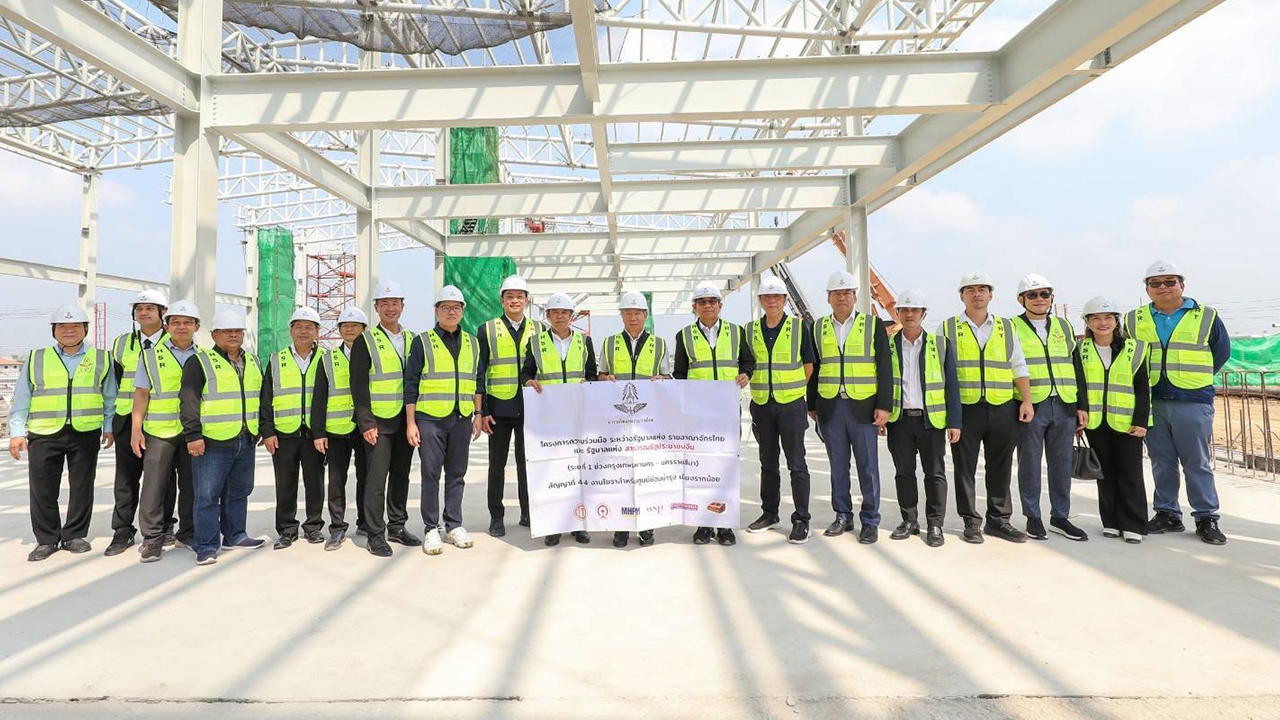
The Senate Transport Committee visited Chiang Rak Noi railway station to monitor the construction progress of the first phase of the Thai–Chinese high-speed rail project between Bangkok and Nakhon Ratchasima. The State Railway of Thailand (SRT) reported a progress rate of 51.74%."},

On 13 February 2026, Mr. Wuttichat Kalyanamitra, Chairman of the Senate Transport Committee, along with committee members from the Eastern Economic Corridor Policy Committee and the Department of Rail Transport, visited Chiang Rak Noi Station to monitor the progress of the first phase of the Thai–Chinese high-speed rail project between Bangkok and Nakhon Ratchasima. Mr. Anan Phonimdaeng, Deputy Governor of the State Railway of Thailand acting as Governor, and SRT executives welcomed the delegation and reported on the project's progress.

Mr. Anan Phonimdaeng He revealed that the purpose of this site visit was to review the project's performance, identify obstacles, and discuss ways to accelerate construction to meet the scheduled timeline, while ensuring the project is conducted with carefulness, transparency, and the highest safety standards.
Currently, the project is 51.74% complete. Two civil engineering contracts have been completed: Contract 1-1 from Klang Dong to Pang Asok and Contract 2-1 from Sikhio to Kutjik. Ten other contracts are under construction, while two contracts—Contract 4-1 from Bang Sue to Don Mueang and Contract 4-5 from Ban Pho to Phra Kaeo—have yet to be signed. SRT has instructed contractors to strictly adhere to deadlines and closely monitor engineering standards and safety.

The first phase of the Thai–Chinese high-speed rail project from Bangkok to Nakhon Ratchasima has a total investment of 179.41 billion baht over 250.77 kilometers. It includes 14 civil engineering contracts and one system contract. Most of the route is elevated, spanning 188.68 kilometers to reduce railway crossings and enhance safety. Ground-level track covers 54.09 kilometers, with two tunnels near Muak Lek and Lam Takhong totaling approximately 8 kilometers. The line includes six stations: Krung Thep Aphiwat Central Terminal, Don Mueang, Ayutthaya, Saraburi, Pak Chong, and Nakhon Ratchasima, with planned service opening in 2030.
Regarding phase two, from Nakhon Ratchasima to Nong Khai, the Cabinet approved the project on 4 February 2025, and the Environmental Impact Assessment (EIA) has been approved. The total investment is 256.40 billion baht, including 12.42 billion baht for land acquisition, 237.45 billion baht for civil works, and 6.53 billion baht for construction supervision. The route spans 357.12 kilometers, with 202.48 kilometers elevated and 154.64 kilometers at ground level. The main stations include Bua Yai Junction, Ban Phai, Khon Kaen, Udon Thani, and Nong Khai. Bidding and contract signing are expected by 2026, with a construction period of around 48 months and completion anticipated in 2031.
Mr. Anan He added that the Thai–Chinese high-speed rail project is a strategically important transportation infrastructure for the country. It not only modernizes Thailand’s rail system to be faster and safer but also plays a key role in connecting regional transport networks, which will benefit the economy, investment, and quality of life for citizens in the long term.
Read more " Government Policy " here.