

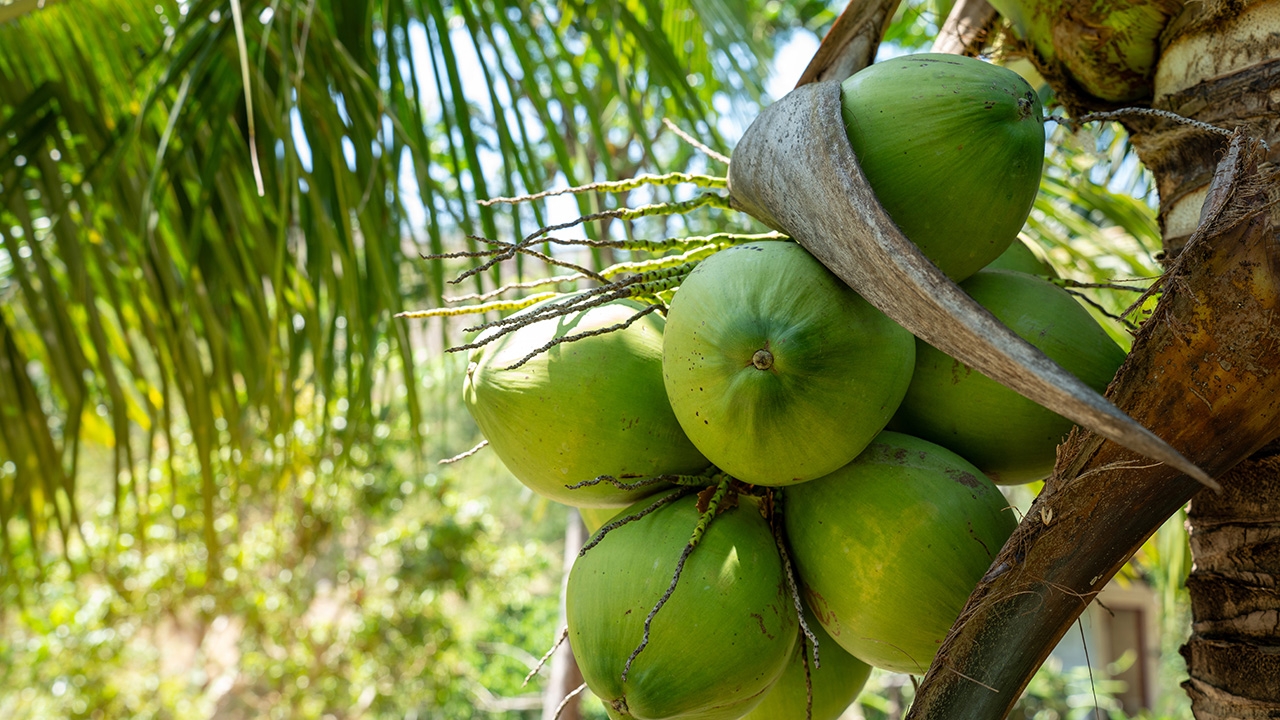
The Department of Business Development held discussions with 10 agencies to resolve the problem of nominees in the aromatic coconut sector, targeting 15 companies that use Thai nationals as nominees. It was found that these companies operate from leasing plantations and growing coconuts themselves to processing and exporting, while suppressing purchase prices. Ten Thai individuals were identified as supporting these companies. Relevant authorities have been immediately tasked with legal proceedings. The efforts will continue, including investigations into fruit warehouses in the eastern and southern regions.
Mr. Poonpong Nainapakorn Director-General of the Department of Business Development, Ministry of Commerce He revealed that a joint meeting with 10 agencies was held to discuss solutions to the falling price of aromatic coconuts and to investigate foreign capital groups operating fruit warehouses. It was discovered that 15 companies are at risk of using Thai nominees as shareholders: 11 companies in Ratchaburi, and one company each in Samut Prakan, Pathum Thani, Samut Sakhon, and Bangkok. Ten Thai individuals are believed to support these companies, serving as shareholders or directors. Some companies have been established for five to six years, while others are newly formed.

After the investigation, the department has referred the cases to the relevant authorities to take action within their jurisdiction: the Central Investigation Bureau, the Department of Special Investigation (DSI), and the Anti-Money Laundering Office (AMLO). If found guilty, penalties under the Foreign Business Act B.E. 2542 (1999) include imprisonment up to three years and fines ranging from 100,000 to 1 million baht.
“The department had to intervene because unfair business practices were found, including leasing coconut plantations for cultivation, complete processing and exporting operations, and suppressing purchase prices. This caused abnormal price declines in aromatic coconuts locally. Therefore, management action is necessary. This effort will continue beyond aromatic coconuts to other fruits such as durian and mangosteen in the eastern and southern regions, which is the planned next step,” he said.Mr. Poonpong said.

. . . . . . Mr. Poonpong explained that the drop in aromatic coconut prices is due not only to competition from fruit warehouses operated by foreign businesses acting non-transparently but also due to increased production volumes. Cultivated area rose from 235,903 rai in 2021 to 305,706 rai in 2025, and production increased from 532,942 tons in 2021 to 877,681 tons in 2025, a 49.80% rise. Export value also declined from 9,888.92 million baht in 2023 to 6,456.52 million baht in 2025. The export market lost share to competitors, with 70% of aromatic coconuts exported, 80% of which go to China. Market share in China dropped from 75% in 2023 to 50% in 2025, contributing to price decreases.

Measures to address illegal foreign capital operations include registering fruit warehouses, checking labor practices, tax evasion, and investigating business operations along the entire supply chain. Authorities will conduct in-depth inspections and strictly enforce laws to ensure fairness for farmers and legitimate businesses.
Read more news " Government Policy " updates