

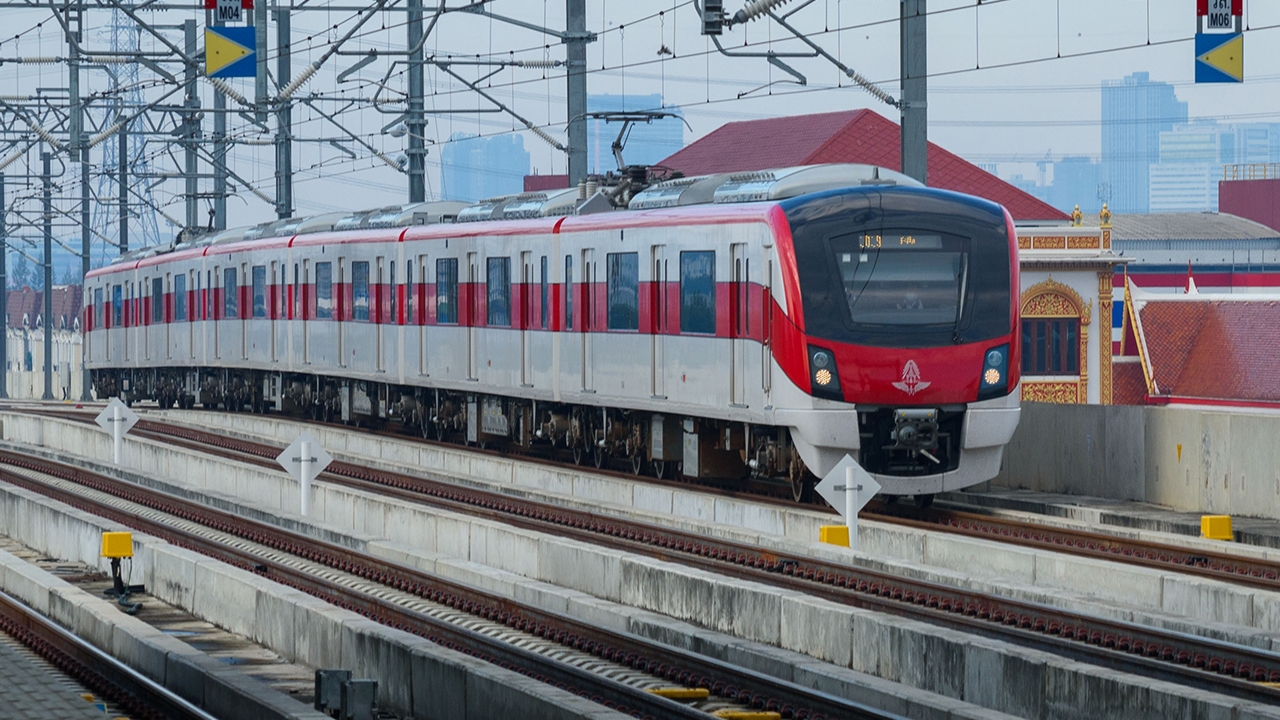
The Department of Railis moving forwardwith a study of a new fare structure for the entire electric train system, covering both "zone-based" and "travel-time-based" models. The conclusion is expected by late 2026 to support the government's policy of reducing living costs for citizens. The study will also consider plans to buy back electric train concession contracts, aiming to set appropriate fares without increasing the government's budget burden.
Mr. Pichet Kunathamrak, Director-General of the Department of Rail Transport (DRT), revealed after chairing the first subgroup meeting to gather opinions on the study of zonal fare rates aligned with congestion charge zones that the government’s key policy is to reduce living expenses, especially travel costs, which are a major daily expense for urban residents.Currently, the governmenthas started implementing a flat 40 baht all-day fare on some routes, such as the Red Line electric train, to help ease public expenses. There is also an idea to expand this measure to cover all electric train lines serving Bangkok and its metropolitan area in the future.
However, implementing a flat fare system across all lines faces limitations due to differing concession contract structures and management approaches among each line. Thus, the government is considering gradually buying back some electric train concessions to enable state management of the overall fare structure more efficiently.
The government wants to reduce fares for citizens without increasing public debt or excessive budget subsidies. Therefore, the Ministry of Transport and the Department of Rail Transport have been tasked with studying appropriate fare structures to find a balanced option that aids the public while ensuring financial sustainability of the transport system.

Mr. Pichet said that the Department of Rail Transport is currently exploring various fare structure options. One key approach is a "zone" or Zone Fare system, which divides travel areas into sections according to city zones. This approach aims to reduce government subsidies because a flat 40 baht all-day fare on all routes could require substantial state funding, whereas the zone system could help lower the budgetary burden to some extent.
Under the zone system concept, short-distance travelers, such as those within inner-city zones or traveling no more than about 8–10 stations, could still pay fares close to 40 baht, experiencing little impact from the new fare structure. Meanwhile, long-distance passengers, who currently sometimes pay over 100 baht per trip, might see fares reduced to approximately 50–80 baht per day, significantly easing their travel costs.
Additionally, another option under study is a time-based fare system. This would set travel periods during which passengers can ride for 40 baht, but if travel time exceeds the set limit, additional charges would apply. This system is used in several European countries, such as Italy.
Current passenger travel behavior data shows an average trip length of about 8 stations, or approximately 11.25 kilometers, with an average travel time of about 20 minutes per trip. Therefore, setting a travel time window of, for example, 60 minutes could cover the majority of passengers. Long-distance travelers represent no more than about 10% of total passengers.
Mr. Pichet said that currently,the study is in the phase of gathering feedback from relevant agencies and sectors alongside financial impact analyses for each fare model to assess long-term suitability. The Department of Rail Transport aims to have preliminary study results by late 2026 before submitting them to the Ministry of Transport to determine the appropriate fare policy.
However, implementing this policy must be coordinated with the plan to buy back electric train concession contracts, which is a critical condition for establishing a new overall fare structure. If the contracts are not fully bought back, the government may need to subsidize fares partially. Therefore, careful and thorough study is required before official policy is set in the future.
Read more news " Government Policy "