

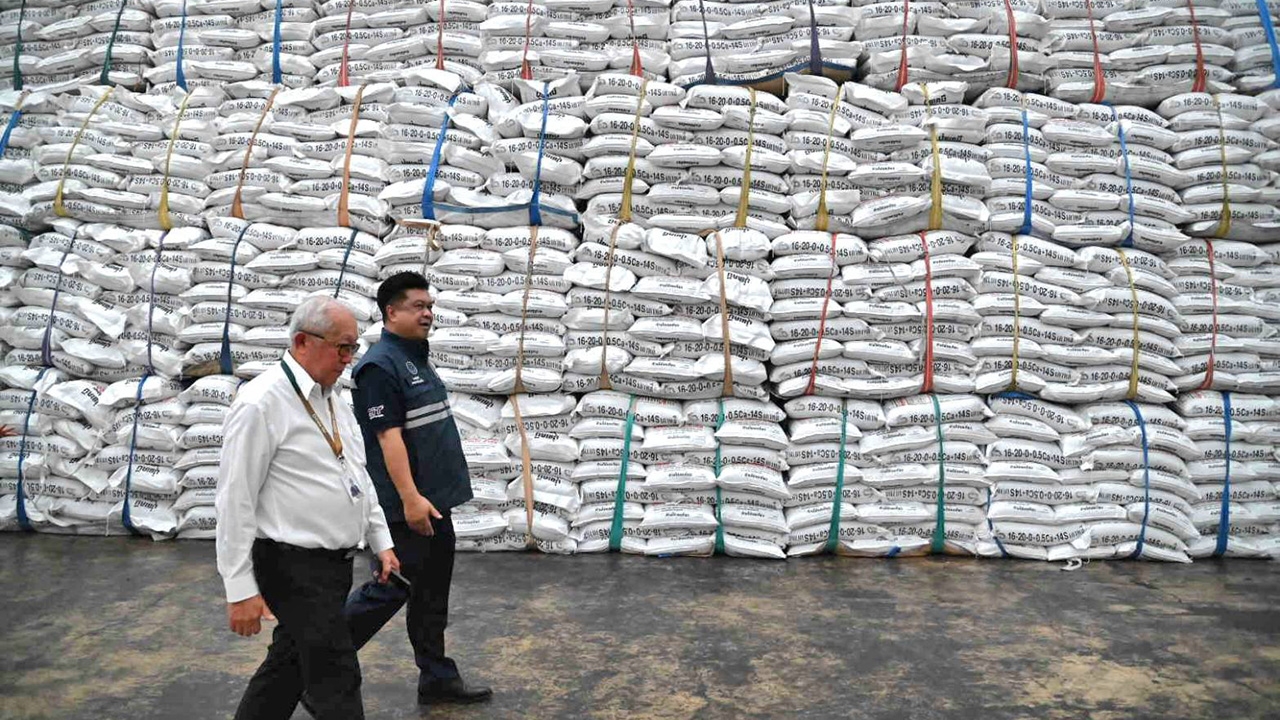
The Department of Internal Trade conducted an on-site inspection of fertilizer warehouses in Ayutthaya, reaffirming sufficient stock. It is accelerating efforts to find new import sources, monitoring price structures, and ensuring farmers are protected from adverse effects.
Mr. Witthayakorn Maneenet, Director-General of the Department of Internal Trade, revealed that the department has been closely monitoring the chemical fertilizer situation continuously following rising tensions in the Middle East region, which could affect global trade and shipping. They have expedited management measures concerning product volume, import sources, and price supervision to ensure farmers have adequate access to fertilizers at fair prices with minimal impact.

The Director-General of the Department of Internal Trade said he had assigned Mr. Jirawut Suwanart, Deputy Director-General of the Department of Internal Trade, to lead officials on March 11, 2026, to inspect the chemical fertilizer situation at a major fertilizer distributor's warehouse in Bang Sai District, Phra Nakhon Si Ayutthaya Province. This warehouse is one of the country's largest chemical fertilizer storage facilities, to monitor stock levels and product distribution during the planting season.
The inspection found that the warehouse still holds a large quantity of chemical fertilizers, especially urea formula 46-0-0. Operators also plan to continue importing additional products to replenish stock gradually. Overall, the fertilizer volume in the country remains sufficient to meet agricultural demand during both the preparation and upcoming production seasons. The Department of Internal Trade urges farmers to be confident in the product situation and avoid rushing purchases or hoarding.

Mr. Witthayakorn stated that the department has held discussions with three fertilizer associations: the Thai Fertilizer and Agricultural Business Association, the Thai Fertilizer Manufacturers Association, and the Thai Agricultural Business Association. They also engaged major fertilizer producers, importers, and distributors to jointly manage supply and prepare measures to address global market volatility. They confirmed that current fertilizer stocks in factories and warehouses remain sufficient, and orders for raw fertilizer materials are proceeding normally.

Furthermore, the department is accelerating efforts to diversify import risks by expanding and identifying additional fertilizer import sources from multiple countries to reduce dependence on the Middle Eastern market. Currently, urea fertilizer imports continue from Saudi Arabia and Malaysia. Meanwhile, Malaysia and Brunei are able to deliver products normally. Thailand also has import sources from various regions including Oman, China, Russia, Canada, South Korea, as well as European and ASEAN countries, providing a highly flexible procurement system capable of substituting import sources if the situation prolongs.

Additionally, the Department of Internal Trade has coordinated with the Department of International Trade Promotion, assigning the 58 overseas trade promotion offices to expedite surveys and seek new potential fertilizer import sources, especially within ASEAN countries. They are also increasing imports from Malaysia and Brunei and accelerating negotiations with Chinese authorities to ease measures and increase phosphate fertilizer exports to Thailand to ensure continuous fertilizer imports.

Regarding price monitoring, the department is closely overseeing fertilizer price structures from origin to retail. It has ordered provincial commerce offices nationwide to conduct strict inspections of fertilizer sales after some retailers raised prices by 50–100 baht per sack. Producers confirmed that existing stock is still sold at the original prices. The department has firmly prohibited sales restrictions, hoarding, and bundling of fertilizers.

The Director-General of the Department of Internal Trade emphasized that the department will closely monitor global trade and cost developments, manage import sources, and regulate domestic prices to maintain fertilizer market stability and reduce farmers' cost burdens. He urged farmers to be confident that fertilizer supplies are sufficient and warned operators against unjustified price increases. Violators will face penalties under the Price of Goods and Services Act B.E. 2542 (1999), with imprisonment up to 7 years, fines up to 140,000 baht, or both.

If the public or farmers encounter unfair sales practices, they can report complaints to the Department of Internal Trade hotline at 1569 or to provincial commerce offices nationwide.
Read more news " Government Policy " here