

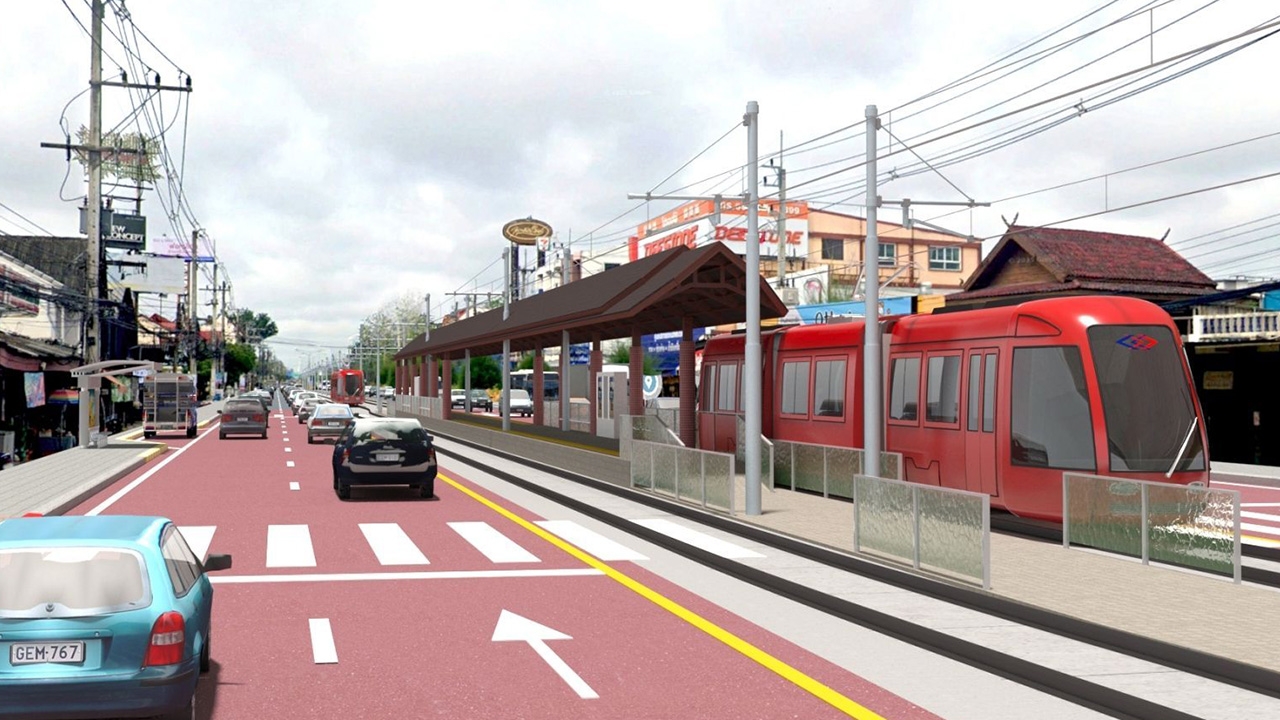
The Mass Rapid Transit Authority of Thailand (MRTA) is advancing detailed feasibility studies and design for a 5-kilometer Chiang Mai tram linking Mae Hia and Ratchaphruek. The auction is targeted for 2027, with construction planned from 2028 to 2031, aiming for service launch in 2032. This aims to boost Chiang Mai tourism, facilitate travel, ease traffic congestion, and reduce pollution.
Mr. Saroj Tosuwan, Deputy Governor (Strategy and Planning) of the Mass Rapid Transit Authority of Thailand (MRTA) / and Mr. Nakprat Chaiyanon, Chief of Chiang Mai Provincial Office, representing the Chiang Mai Governor, co-chaired the second public consultation meeting (project study summary) on the feasibility and design study for Chiang Mai’s mass transit Red Line, covering the Mae Hia Saman Samakkhi Intersection to Luang Ratchaphruek Park segment. The meeting aimed to explain study results, design details, route alignment, project format, environmental impacts, and mitigation measures, while gathering feedback from all sectors for project improvement.

The study found the project suitable to develop as a street-level electric tramway system (Tramway) covering approximately 5 kilometers, with the following route alignment:
Starting point: At Mae Hia Saman Samakkhi Intersection, running along Highway 108 for 2.3 km, then turning right at the Phuet Saun Lok Intersection onto Rural Road CM3028, crossing Highway 121 at Ratchaphruek Intersection.
End point: Luang Ratchaphruek Park

The project plans for five passenger stations, namely:
Two Park & Ride facilities will be provided at Phuet Saun Lok Intersection (inbound side) and Ratchaphruek Intersection to enhance convenience for users and encourage modal shift.


MRTA has been assigned by the Land Traffic Management Committee to implement the project under a public-private partnership (PPP) model, alongside preparing the Environmental Impact Assessment (EIA). The plan is to start private sector selection in 2027, construct from 2028 to 2031, and open for service in 2032. Upon completion, the project will offer a convenient, fast, and safe travel option for residents and tourists in Chiang Mai, reduce private car use, alleviate traffic congestion, and decrease air pollution from fuel combustion, thereby improving the long-term quality of life and urban mass transit systems.


Read more news " Government Policy " here