

The Ministry of Commerce confirms that following the deregulation of diesel fuel prices, no businesses have applied to raise product prices. It emphasizes that nine major companies are committed to continuing price controls under the Central Committee on Prices and Services (CCPS). Five measures have been approved to strictly regulate 59 product items, including initiatives such as Thai Help Thai and Blue Flag programs to support consumers.
Mrs. Supachai Suthamphan, Minister of Commerce, disclosed the plan to manage product and service prices after the government allowed diesel prices to float freely.:She said that currently no business operator has submitted any request to raise product prices to the Ministry of Commerce. Discussions with nine major consumer goods companies— Unilever, Sahapat, P&G, Neo, Osotspa, BJC, F&N, Nestlé, and Dutch Mill— show that stock levels remain sufficient and prices can be maintained for the time being.for a certain period.

Regarding the management of 59 controlled products and services under the Price of Goods and Services Act B.E. 2542 (1999), there are three categories: :
1. Essential products for living expenses, which include eight items: instant noodles, canned fish, ready-to-drink milk, pesticides, milk powder, animal feed, tin-plated and chromium-coated steel sheets, and chemical fertilizers. Manufacturers and sellers must obtain permission before raising prices. Other products in this group must provide advance notice before price changes. So far, no abnormal price increase requests have been found.
2. Another 20 products and two services require notifying the Department of Internal Trade before adjusting prices,such as detergent powder, laundry detergent, shampoo, dishwashing liquid, bar soap, liquid soap, toilet paper, sanitary napkins, medicine, medical supplies, and medical services.
3. Products whose price movements must be closely monitored, including bagged rice, seasoning sauces, fish sauce, coffee, soft drinks, bottled drinking water, ironing liquid, and fabric softener.

Regarding raw materials and packaging that may have quantity constraints, such as plastic pellets, sulfur, and solvents, the Department of Internal Trade has consulted with businesses to reduce operational procedures and restrictions. This aims to allow prices to reflect proper market mechanisms and ensure adequate plastic pellet supply through May 2026. They are also preparing negotiations with South Korean authorities for export exemptions on solvents and are actively seeking alternative raw material sources.
Meanwhile, for chemical fertilizers, the Ministry of Commerce has conducted on-site stock inspections and consulted with three fertilizer associations: the Thai Fertilizer Trade and Agricultural Business Association, the Thai Fertilizer Producers Association, and the Thai Agricultural Business Association, as well as major producers, importers, and distributors to jointly manage supply and prepare response measures. They confirmed that fertilizer stocks remain sufficient and orders for raw fertilizer materials continue as normal.
However, on 25 March, I chaired a meeting of the Central Committee on Prices and Services (CCPS) to review products and measures to oversee price and supply situations. Given ongoing cost uncertainties, legal mechanisms are necessary to intensify control over regulated products appropriately. This enables the Department of Internal Trade to monitor costs and promptly prevent unfair price adjustments.

The meeting prepared five measures to address issues and alleviate public hardship:
1. Enhance product regulation, by urgently adding essential items such as sanitary napkins, toilet paper, shampoo, liquid and bar soap, dishwashing products, and detergents to the controlled goods list. This aims to prevent unfair price hikes that do not reflect true cost mechanisms during the crisis.:"
2. Collaborate with major manufacturers under the “Thai Help Thai” program, encouraging large producers to offer house brands, alternative brands, or secondary brands to consumers at lower prices, including items like soap, shampoo, detergent, toothpaste, rice, sugar, fish sauce, cooking oil, seasoning sauces, instant noodles, and canned food. This initiative is expected to start in April and run for two months. :
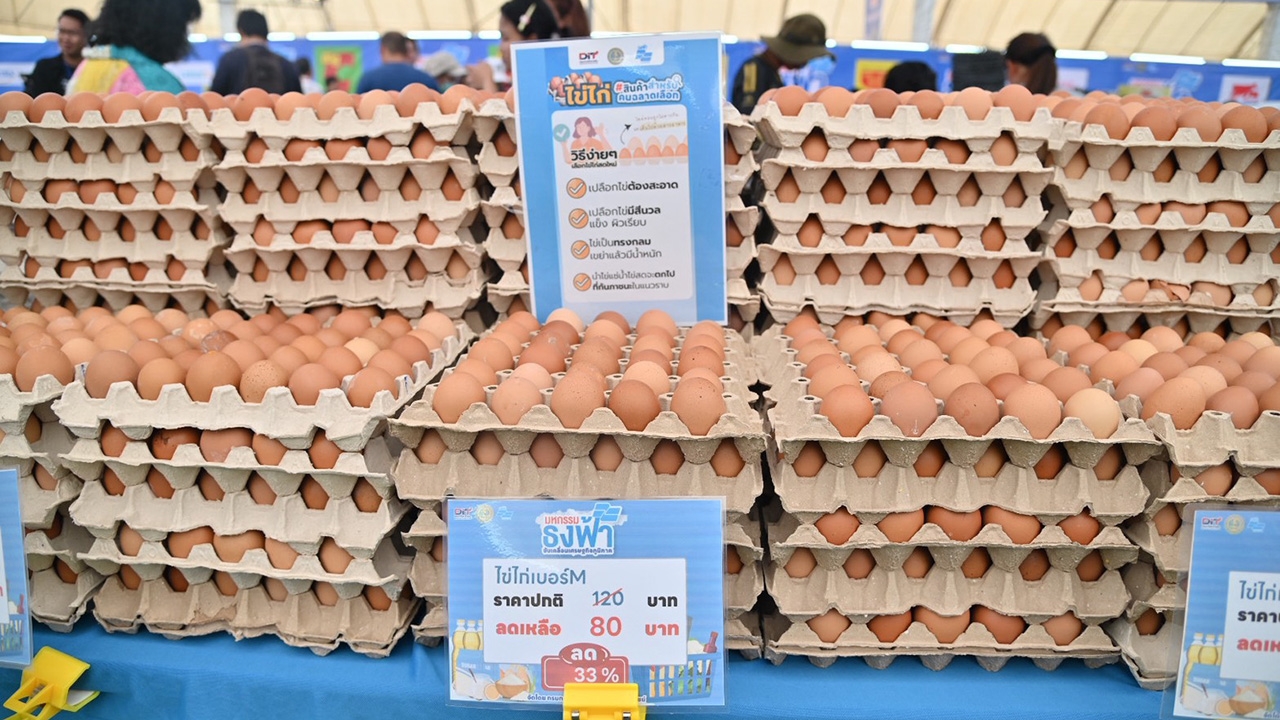
3. Organize Blue Flag sales events nationwide offering affordable products, running from March to August this year.
4. Implement measures to support vulnerable groups, such as additional assistance through the State Welfare Card to mitigate living cost impacts during the crisis.
5. Reduce agricultural costs by expanding the Green Flag affordable fertilizer program into “Green Flag Plus,” covering farmers during key planting seasons and the upcoming production season. It offers a 200 baht discount per fertilizer sack for up to five sacks (totaling 1,000 baht). Farmers holding the Land Quality Card from the Department of Land Development receive an extra 200 baht, plus an additional 200 baht coupon for organic fertilizer purchases, providing up to 1,400 baht in support per farmer. This will be implemented from May to June 2026.
Additionally, fertilizer formulas are being adjusted to reduce import reliance, such as changing from 46-0-0 to formulations using more domestic raw materials.Efforts include promoting organic fertilizer use with coupon or financial support and encouraging agricultural cooperatives to buy fertilizer directly from factories at lower prices.These measures will be carried out from April to July 2026.:

Read more about " State Policies "