

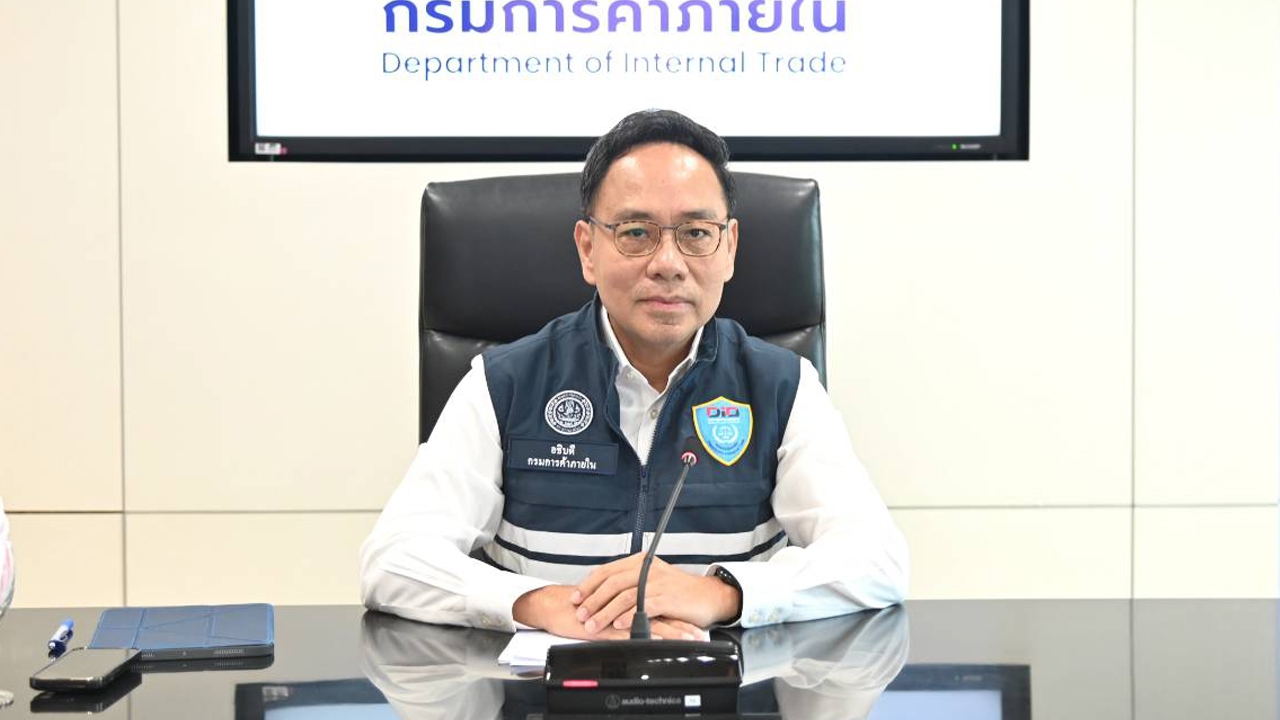
The Department of Internal Trade, Ministry of Commerce, is addressing the Middle East crisis by expanding the Blue Flag and Green Plus programs to reduce living costs, working with the private sector to expedite fertilizer sourcing, and managing the entire palm oil system to prevent adverse effects on farmers.
Mr. Witthayakorn Maneenet, Director-General of the Department of Internal Trade, said the conflict in the Middle East has broadly affected energy prices, transportation costs, and product expenses in many sectors, including agricultural goods related to processing and exports. Increased transport restrictions have caused product backlogs domestically, some producers have slowed output, and prices have fluctuated. The government is therefore intensifying measures to closely monitor the situation to prevent excessive burdens on the public and farmers under the concept of “2 Ps”: sufficient quantity and reasonable prices, enabling all parties—citizens, businesses, and farmers—to sustain livelihoods.
To reduce living costs, the Department of Internal Trade focuses on ensuring public access to essential goods both in price and availability. Blue Flag products are sold on average 30–60% below market prices, covering over 200 essential consumer items such as rice, eggs, palm oil, and sugar, helping save households an average of at least 500 baht monthly. The program’s operations have been expanded for wider reach, with plans to hold 518 Blue Flag events from April to August, up from 62. These include 12 large events with 200 booths, 76 medium-sized events with 50 booths, 380 mini Blue Flag events in provinces (5 per province), and 50 events across Bangkok’s 50 districts.
Additionally, goods are distributed via over 5,000 mobile Blue Flag vans and street vendors using established local networks to reach communities and remote areas. The “Back-to-School Blue Flag” project is also underway in 1,000 remote schools, offering essential goods, school uniforms, and supplies at affordable prices. Agricultural products are linked to fresh markets, central markets, fairs, gas stations, and post offices—totaling 1,000 locations—to help clear produce and generate income for farmers. Special-priced goods are also distributed through 150 retail, wholesale, and convenience stores.

Simultaneously, the “Green Plus” project helps reduce input costs, especially agricultural production factors, so farmers can access reasonably priced products while creating opportunities for community stores and small businesses to expand, generate income, and circulate the local economy.
Regarding price regulation, the Department has increased the number of products requiring price adjustment approval from 8 to 15 items. This decision is based on actual costs, including production, management, and transportation costs, which have been affected by high diesel prices. This may lead to price increases ranging from 0.7% to 44.4%, depending on the product category: food and beverages 1.6–12.1%, daily necessities 1.4–16.2%, agricultural inputs 44.4%, construction materials 1.5–2.1%, and fresh food 0.7–3.2%. However, no price increases have been authorized yet, as the Department is carefully reviewing the situation and urges gradual, reasonable adjustments.
For chemical fertilizers, a key cost for farmers, the Department is actively working with the private sector, especially the Fertilizer Association, to procure additional fertilizer and manage supplies to meet demand. Stock levels and import plans have been confirmed by private partners to reflect the market reality. Currently, about 64% of Thailand’s fertilizer supply is unaffected by the situation due to imports from other sources. However, urea fertilizer, comprising about 36% of supply, depends on imports and has seen cost increases from around 500 to 800 US dollars per ton.
There is currently a total fertilizer stock of approximately 900,000 tons, including about 343,000 tons of urea fertilizer, with plans to import an additional 234,650 tons to support the planting season. The Department is promoting the use of mixed fertilizers such as 40-0-0, 21-0-0, and 18-8-8 to reduce reliance on pure urea and mitigate price risks. The Green Plus project has increased subsidies for farmers from 200 to 300 baht per person, along with additional benefits.
Regarding supervision, inspections of 1,079 fertilizer retailers found 48 violations, with legal action taken for failure to display prices and overcharging, to prevent exploitation of farmers.
On the palm oil situation, the Department of Internal Trade emphasizes prioritizing farmers, as their income depends on product prices. Measures focus on supporting farmers primarily.
Mr. Witthayakorn reiterated that palm oil management, under the committee’s announcement, does not ban exports but balances domestic consumption and energy sector usage to ensure sufficiency. In 2026, biodiesel use (B7 and B20) is projected to rise to about 140,000 tons per month, resulting in exports of approximately 43,600 tons monthly.
Currently, palm fruit prices average about 8 baht per kilogram, the highest in several years. The Department acknowledges increased costs and will maintain prices at levels that provide farmers with appropriate income.
.Bottled stock (existing inventory)is priced at 42–50 baht per bottle, whilenew stock priced at current CPO pricesis likely to rise. The Department will manage this with all sectors to prevent palm oil consumer pricesfrom becoming excessively high, which would impactthe public.
At the same time, milling yards and extraction plants must clearly display purchase prices. Exploitative practices such as price suppression or dropping fruit to reduce quality are prohibited. Reporting of stock, product movements, and export permits is strictly enforced.
Additionally, the Department has added “plastic pellets” as controlled goods, covering PE, PP, and PET types, which are essential raw materials for consumer packaging, fertilizer sacks, and medical supplies. A special task force has been established to monitor and regulate the entire system.
The Department of Internal Tradewill closely monitor the situation and adjust measures appropriately to ensure adequate supplies at reasonable prices, enabling farmers to sustain their livelihoods and preventing undue living cost burdens on the public during this uncertain period.Mr. Witthayakornsaid.
Read more news " Government Policy " here.