

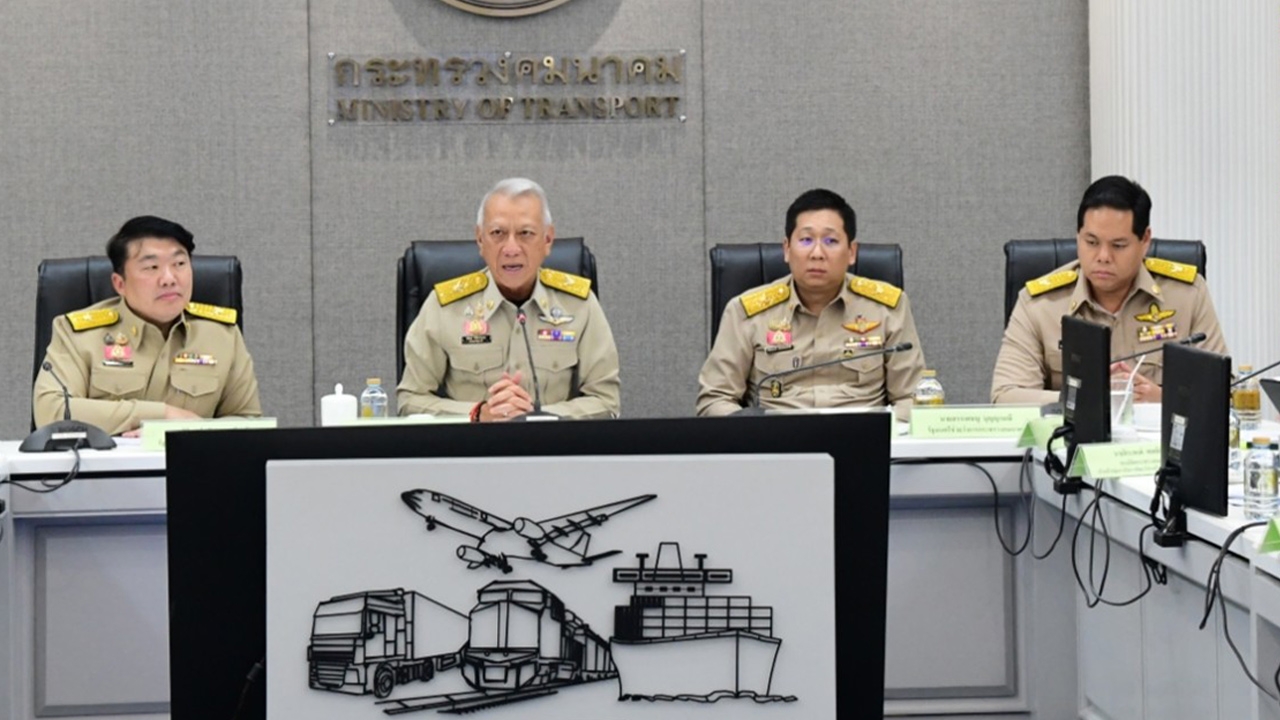
Phiphat Ratchakitprakarn divides duties among three deputy ministers of the Ministry of Transport to drive the seamless mass transit strategy. He plans to lease 800 electric buses to enhance public service and accelerate legislation for unified ticketing to eliminate redundant initial fees, aiming for full system operation as a New Year's gift in 2027.
Phiphat Ratchakitprakarn, Deputy Prime Minister and Minister of Transport. He revealed after assigning work to the three deputy ministers that the Ministry of Transport has set urgent policies and strategic projects to advance the nation's mass transit and infrastructure systems. Responsibilities are clearly divided by agency and region to ensure flexible and integrated management across land, water, air, and rail transport, aligned with the government's policy to upgrade connectivity seamlessly.
Regarding Siripong Angkasungkiat oversees land transport. This includes the Department of Land Transport (DLT), Bangkok Mass Transit Authority (BMTA), Transport Company Limited (TC), and rail transport entities like the Department of Rail Transport (DRT), State Railway of Thailand (SRT) Electric Train Limited, Red Line Electric Train, and the Rail System Research and Development Institute (Public Organization). He also supervises the northeastern region.Patthapong Patraprasit manages air transport, including the Department of Airports (DOA), Aeronautical Radio of Thailand Limited (AEROTHAI), Civil Aviation Training Center (CATC), and Suvarnabhumi Airport Hotel Company Limited, overseeing the central and northern regions.Sanphet Boonyamanee is responsible for water transport, including the Marine Department (MD), Port Authority of Thailand (PAT), and SRT Asset Company Limited (SRTA). He manages areas from Samut Songkhram, Samut Sakhon, Phetchaburi, Prachuap Khiri Khan, and all 18 southern provinces.. All southern provinces.

Phiphat said that a key policy assigned by Prime Minister Anutin Charnvirakul is to accelerate the energy transition in transport from oil to electricity (EV). Specifically, the BMTA plans to purchase 1,520 electric buses, expected to be gradually delivered by late March. Meanwhile, to address immediate needs, the ministry is negotiating to lease an additional 800 electric buses from Thai Smile Bus for temporary service. The main goal is to replace traditional diesel buses with electric ones as quickly as possible. Simultaneously, the water transport sector has private operators ready to participate, such as the EA Group's electric boat project, to support future connectivity.
Regarding strategic projects, the ministry prioritizes the land bridge project, which will be a crucial infrastructure connecting the Indian Ocean with the Pacific Ocean. This will provide a new global shipping route option, reducing risks from geopolitical issues in key areas such as the Strait of Hormuz, Red Sea, and Strait of Malacca. The project aims to create at least 200,000 Thai jobs and will be fully open for private investment. Global experts will be brought in to manage the ports. At the same time, efforts are accelerating the dual-track railway project connecting the south to the Malaysian border. Currently, the route extends to Chumphon Province, and contracts are being prepared for the next segments: Chumphon–Surat Thani, Surat Thani–Hat Yai, and Hat Yai–Padang Besar, to enhance transport capacity and border economic integration.

On mass transit reform, the ministry is fast-tracking the preparation of about 20 subsidiary laws under the Unified Ticket Act, expected to be completed by June. Additionally, 77 subsidiary laws under the Rail Transport Act are being developed, some ready for immediate implementation after policy committee approval. Key measures include abolishing duplicate initial fees to reduce citizens’ burdens, adjusting children's fare eligibility to age up to 7 years or height under 120 cm for free travel, halving fares for seniors, free service for persons with disabilities, and requiring operators to provide passenger insurance coverage of at least 500,000 baht per person.
Furthermore, the ministry aims to promote a Single Ownership policy where the state owns the main network exclusively. This will enable effective zone-based fare management and reduce redundant costs. Negotiations with major private operators in the electric train system, including Bangkok Expressway and Metro and BTS Group Holdings, are planned to start in May. Alongside, development of last-mile connectivity systems will facilitate easier travel for the public from communities to main transport stations. The key goal is to fully launch the unified ticketing system as agiftto the public for New Year 2027, covering all travel modes — buses, electric trains, boats, and other rail systems — under a single card or payment system valid all day.
However, the ministry acknowledges budget limitations, especially for fiscal year 2025, which must be adjusted to economic conditions. There are also technical challenges with the unified ticketing system, such as some providers’ EMV systems still operating offline. Testing and development must be accelerated to enable integration with the central system, particularly collaboration with Krung Thai Bank, to ensure full future functionality.
Read more " State Policy " updates