

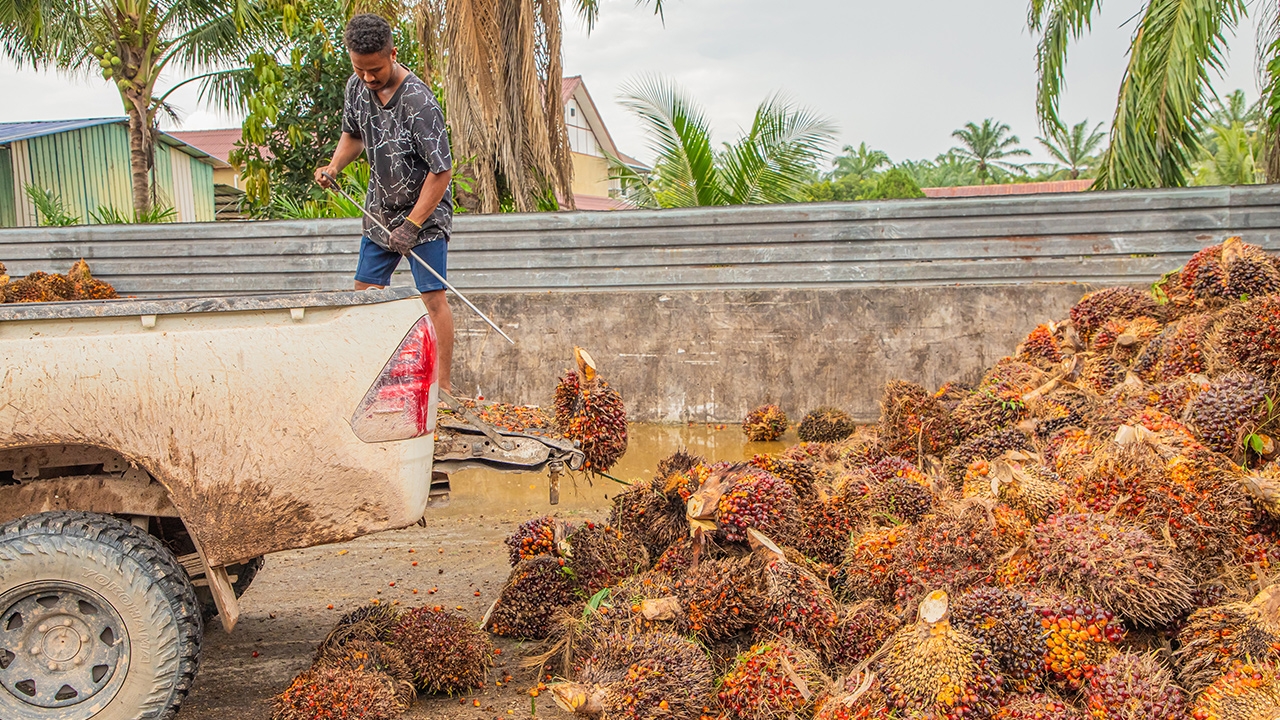
The Department of Internal Trade has instructed the Provincial Price and Services Committees (PPSC) across the country to inspect the entire palm oil supply chain following farmers' complaints about market distortions causing daily price declines. The department is confident that policies to increase the production share of B7-B20 biodiesel will help support prices. Meanwhile, palm oil farmer representatives are proceeding to file a lawsuit against five government agencies at the Administrative Court, accusing them of neglecting their duties and causing harm to farmers.
Mr. Witthayakorn Maneenet, Director-General of the Department of Internal Trade, disclosed regarding the case of the southern palm oil farmers’ network and collection centers submitting a letter demanding solutions to the issue of falling palm fruit prices. He said the department has coordinated with the provincial price and services committees (PPSC) in production areas to urgently inspect the entire supply chain to ascertain whether market distortions have occurred at any point. This year, palm oil production has dropped significantly compared to last year, yet purchase prices have fallen to only 6.60 to 7.20 baht per kilogram.
The department requests cooperation from buyers and palm oil mills to purchase produce at fair prices consistent with quality and the standard oil content of 18%, without taking advantage to suppress farmers’ prices.

The Director-General of the Department of Internal Trade added that the government is urgently managing the balance of crude palm oil (CPO) usage covering consumption, energy, and export sectors. Particularly, the policy to increase the proportion of CPO used to produce diesel fuels B7 and B20 will raise demand from 70,000 tons per month to 110,000 tons.
At the same time, coordination with the Ministry of Energy is underway to expand fuel stations selling both types of fuel from about 100 stations currently to 200 stations by April, which is expected to help raise palm fruit prices. Regarding the measure requiring export permits for crude palm oil, it is affirmed that this is not a trade barrier but a tool to monitor the situation and maintain domestic supply balance.

Mr. Kriangkrai Naksuwan, a palm oil farmer from Nakhon Si Thammarat province, reflected on the problem that purchase prices have been steadily decreasing daily by 40-50 satang per kilogram. This does not align with the global CPO market price or the quality of the palm fruit. For example, on 16 April 2026, the CPO price was 40.13 baht per kilogram, but palm fruit with an oil content as high as 22% was sold for only 6.60 baht per kilogram, whereas it should have been no less than 7.70 baht.
Furthermore, farmers feel unfairly treated because buyers do not assess the price of oil in the kernel (CPKO) and palm shells as is done in Malaysia, resulting in lost income. Recently, farmer representatives have filed lawsuits against five related government agencies (including the Department of Internal Trade) at the Administrative Court, accusing them of neglecting their legal authority to oversee fair palm purchases, causing severe damage to farmers.
Read more news " State Policy " updates