

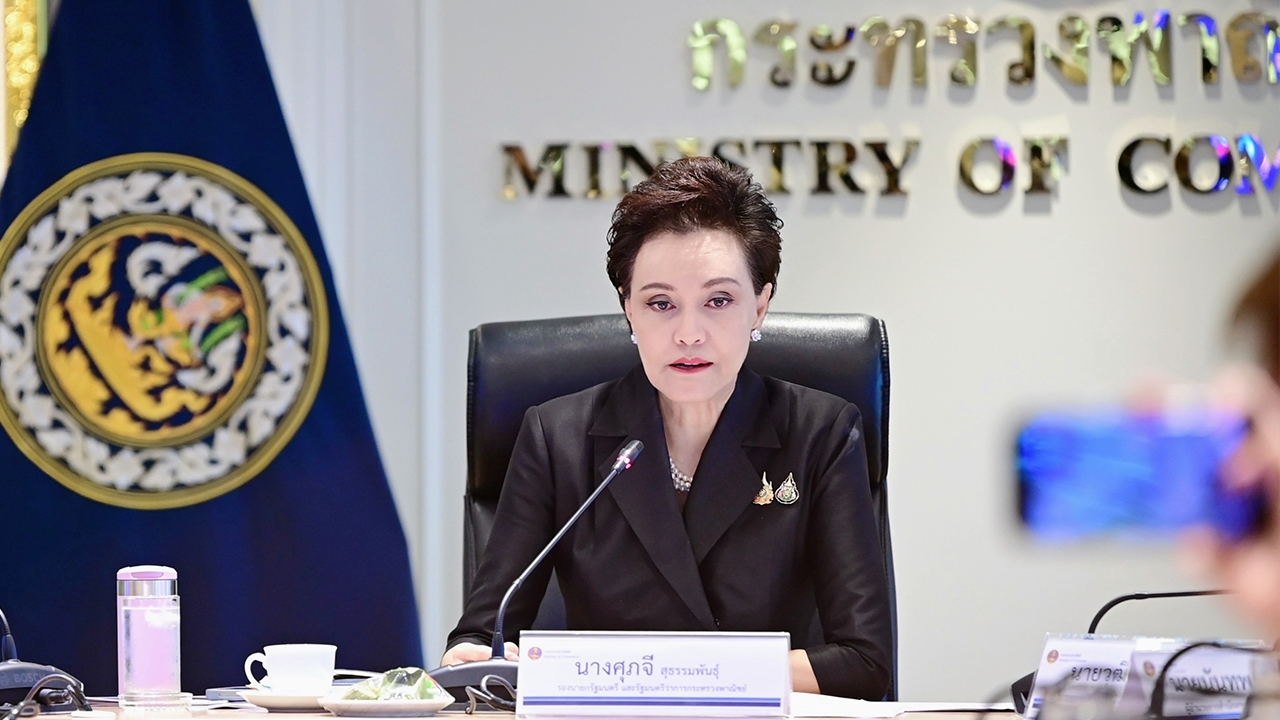
The Ministry of Commerce announced the advancement of five key policies to address the "crisis within crisis" situation, focusing on lowering living expenses, increasing income, and distributing opportunities to the public. It also revealed the first six months' achievements, driving over 73 billion baht in economic circulation, and plans to enhance AI use and systematically restructure the economy in the long term.
The Ministry of Commerce outlined its future operational direction under the new government, highlighting five main policies covering both short-term problem-solving and long-term economic restructuring to confront the simultaneous "crisis within crisis" affecting global economy, geopolitics, and energy. These challenges impact all aspects of Thailand's economy, with a key goal to "save expenses, increase income, and distribute opportunities" widely among the public and businesses.
Simultaneously, the Ministry plans to elevate its operational mechanisms toward cluster-based integration, focusing on issue-centered problem-solving, and inviting experts from all sectors to participate in policy design through co-creation. This aims to make policy implementation efficient, targeted, and responsive to rapidly changing global circumstances.

23 Apr 2026 GMT+7 Supachai Sutthumpun, Deputy Prime Minister and Minister of Commerce, revealed that Thailand is currently facing a "crisis within crisis" marked by complex, interconnected challenges across multiple dimensions. These include geopolitical tensions in regions such as the Middle East and strategic shifts by major powers like China's five-year economic development plan, which affects the global supply chain structure. At the same time, the energy crisis has increased production costs, product prices, and transportation expenses, impacting Thailand's competitiveness and exports.
“Today's policymaking cannot consider only one dimension but must integrate economy, geopolitics, and energy simultaneously, while understanding the contexts of key trading partners such as China, the U.S., Europe, and India. This is essential for Thailand to maintain a stable position within the global supply chain,” Supachai said.
In the past six months (October 2025 – March 2026), the Ministry of Commerce has driven policies under the “Quick Big Win” concept, focusing on urgent measures that deliver tangible short-term results while laying foundations for the long term.
Operations covered seven main policies, 19 key projects, and over 80 activities, including maintaining agricultural product price stability, managing living costs, strengthening SMEs, overseeing the Thai-Cambodia border economy, responding to U.S. tax measures, negotiating FTAs, and developing technology and regulations. These efforts generated a combined economic value exceeding 73 billion baht, benefiting over 6 million farming households and more than 193,000 entrepreneurs.
In reducing living costs, the "Suk Kai Sabai Krapao" pharmacy project eased public burden by over 5.6 billion baht and stimulated the economy by more than 16.65 billion baht. Promotion of franchises and SME loans created business value of over 1.5 billion baht and expanded businesses overseas.
Additionally, managing the Thai-Cambodia border economy amid tensions circulated more than 325 million baht. Meanwhile, exploring new markets and international trade negotiations added over 34 billion baht in value and sustained export growth.

The Ministry promotes the “Thai Helps Thai” project to reduce living costs for the public while simultaneously increasing income for entrepreneurs. Initially, it will cover essential consumer goods and over 3,000 house brand items, offering discounts of 25–58% through more than 4,500 modern trade outlets and over 300 local wholesale-retail stores nationwide. The ministry also plans to collaborate with the Ministry of Interior to expand sales points to district levels, community markets, and over 1,000 flea markets.
SMEs are invited to register for the project, starting with 2,000 participants, supported by online sales platforms. At first, SME products will be supported without charging commission fees (GP), alongside subsidies for shipping costs and issuance of 500,000 discount coupons worth 100 baht each to buyers. In the next phase, the "Thai Helps Thai" product range will expand via platforms including Thailand Postmart, Nexgen, Shopee, LINE, TikTok, and Lazada. The project will integrate with government economic stimulus mechanisms, especially the Co-Payment Plus program and the state welfare card, to ensure effective and widespread impact.
Regarding structural management of production input costs, the ministry addresses upstream issues like fertilizer, seeds, and plastic pellets. Short-term measures include the “Green Flag Plus Fertilizer” project to reduce farmers' production costs. Long-term plans involve the “Half Fertilizer” project and adjusting fertilizer formulas to suit soil conditions per area, in cooperation with related agencies such as the Ministry of Agriculture and Cooperatives, the Ministry of Finance, and the Bank for Agriculture and Agricultural Cooperatives. These efforts aim to enhance production efficiency and lower farmers' costs over time, while seeking new import sources and promoting alternative raw materials to strengthen and mitigate risks in Thailand's industrial supply chains.
Develop and upgrade agricultural products across the entire supply chain, from upstream to downstream, especially key economic crops like rice and fruits. The Ministry emphasizes processing to add value, reduce price volatility risks, and extend product shelf life. It promotes establishment of central and community packing houses to enable farmers to group together, build strength, and raise product standards. Additionally, the ministry supports GI products and branding to gain recognition in global markets.
To position SMEs as vital economic drivers, seven main measures are implemented: (1) upgrading entrepreneurs' skills (Upskill & Reskill); (2) expanding networks and creating entrepreneurs via franchising; (3) developing community economies with GI; (4) enhancing competitiveness through intellectual property; (5) preventing and suppressing nominee representation; (6) curbing influx of imports and counterfeit Thai-origin products; and (7) supporting access to formal financing using inventory, machinery, or intellectual property as collateral.
Achieved by balancing operators, products, markets, and service trade. The strategy links Thailand's supply chain with global supply chains, reducing dependence on main markets and expanding into new markets such as India, the Middle East, Africa, and Latin America. Accelerating FTA negotiations with the EU and South Korea runs alongside enhancing domestic capabilities (Local Content) through innovation in processing and value addition. It also expands service trade, particularly wellness tourism and the aging economy.
Driving the Ministry of Commerce toward a “Digital Commerce” under MOC Plus by developing an all-in-one service platform offering “one-stop, real completion.” Currently, the Department of Business Development links data from 180 legal entities and plans to expand to 140 more agencies to reduce procedures, save time, and increase transparency. Starting 1 July 2026, paper documents will no longer be issued for government agencies.
AI and Big Data will be employed to manage agricultural product dashboards, forecast production in advance, and propose lifting regulations on nine targeted business types to exempt foreign operators from licensing requirements. This aims to facilitate business operations and foster a favorable investment environment.
Supachai stated that the Ministry of Commerce will use the “crisis” as an opportunity to restructure Thailand's economy, emphasizing cross-ministerial integration, data-driven decision-making, and inclusive participation from all sectors.
“The key goal is to enable people to save expenses, increase income, and widely distribute opportunities across communities, small entrepreneurs, and large businesses, so that Thailand's economy can overcome the crisis within crisis and grow sustainably in the long term.”
Read more news " Government Policies " additional