

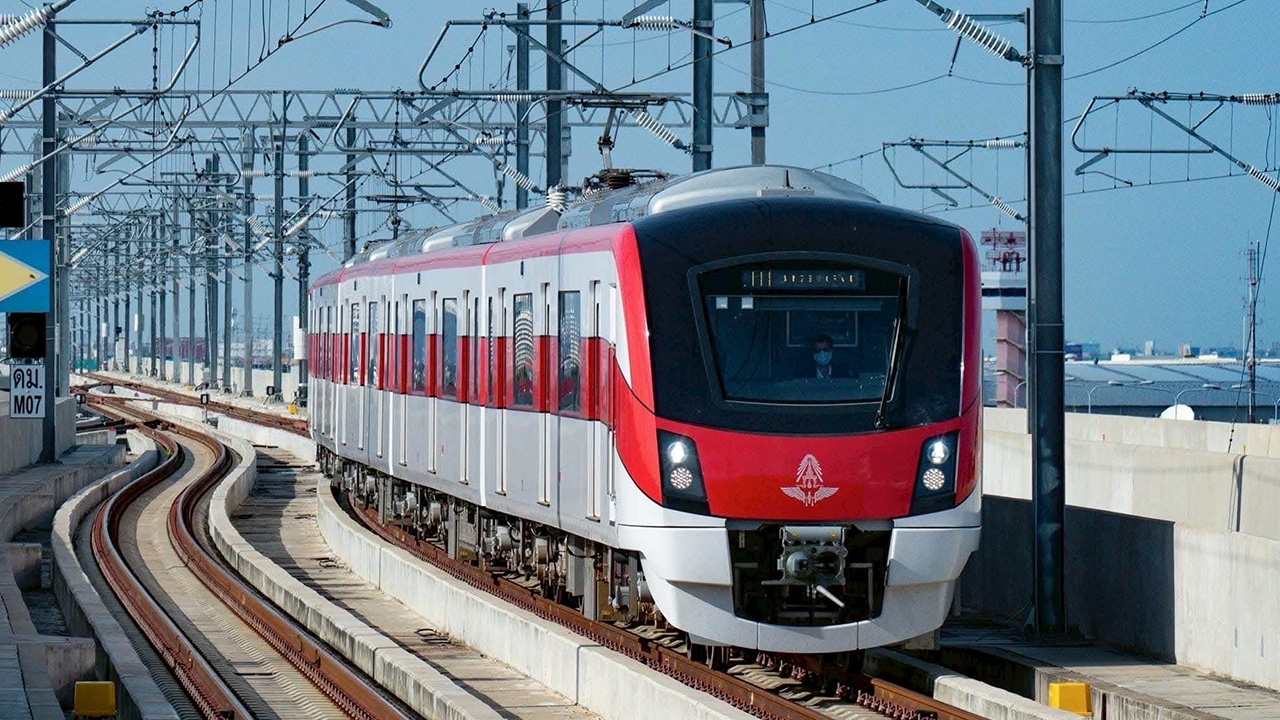
“Siripong” Gives directives “Department of Rail Transport” Accelerate budget disbursement for fiscal year 2026 on schedule while opening new investment opportunities through PPP and TFF to keep major projects running smoothly Unveils plan for all-day 40-baht electric train fare policy aiming for launch on 1 Jan 2027 Prepares to negotiate contract changes with private train operators, affirming no borrowing or public debt creation; plans to propose a policy board to reduce living costs by May, and launches idea to let private firms lease State Railway tracks to operate trains starting July 2026
Mr. Siripong Angkasugkrit, Deputy Minister of Transport, revealed after visiting and giving policy guidance to the Department of Rail Transport (DRT) that he has instructed the DRT to expedite the disbursement of the 2026 budget as planned to avoid impact on overall project implementation and to prepare an efficient 2027 budget focused on value and maximum public benefit. He also urged consideration of adjusting investment models for other rail projects, exploring private sector participation via PPP or funding through the Thailand Future Fund (TFF). Additionally, he tasked the DRT with designing future Thai railway and electric train stations to fit community contexts and be multi-use, such as incorporating activity spaces along railway lines.

He also assigned the DRT to push forward concrete implementation of policies, especially following the enactment of the Rail Transport Act 2025, aiming to reduce living expenses and enhance public safety. He emphasized overseeing fare rates to ensure fairness, reasonableness, and alignment with energy price trends. The Ministry will continue the policy to lower electric train fares, pending completion of Single Ownership management restructuring before negotiating with private concessionaires, since there are two private concession holders with different contract expiry dates requiring separate negotiations.
Regarding electric train fare structures, the DRT is currently studying appropriate new fare models. The existing policy offers a flat 40-baht all-day fare on the Red and Purple Line electric trains. The Ministry proposes that fares should reflect the local cost of living, provide convenience and safety, and not burden the public or government finances, minimizing impact on public debt. Furthermore, the Ministry highlighted opening opportunities for private companies to lease tracks from the State Railway of Thailand (SRT) to operate both passenger and freight services.

Mr. Siripong added that the DRT has been instructed to reduce unnecessary expenses and expedite urgent projects (Quick Wins), such as fast-tracking double-track rail projects and those under construction to open services promptly, improving rail freight efficiency, and developing the Lat Krabang ICD to lower logistics costs. The Ministry will also speed up high-speed rail projects and other large-scale plans, promote integrated inter-agency work, and accelerate digital government development to enhance speed, transparency, and accountability. At the same time, it supports clean energy use in rail transport, encouraging concrete adoption of electric power in rail systems to reduce fossil fuel dependence, air pollution, and PM2.5 dust, aligning with the country’s long-term greenhouse gas reduction goals.
Additionally, the DRT must expedite key projects per the master plan, such as phase 2 of double-track railways, high-speed rail, regional networks, and cross-border connections with neighboring countries. The Ministry aims to stimulate the rail industry, recognizing current price increases have caused issues delaying contract signings on some projects. Therefore, the DRT must speed up bidding, select winners, and finalize contracts to avoid disrupting overall plans.

Meanwhile, Mr. Pichet Kunathamrak, Director-General of the DRT, said the DRT prioritizes raising safety standards and fair fare regulation. Since the all-day 40-baht fare policy on the Red and Purple Line electric trains was introduced, there is no longer compensation paid as passenger numbers have increased under this policy. Regarding the Deputy Prime Minister and Minister of Transport, Mr. Phiphat Ratchakitprakarn’s goal to implement the 40-baht all-day fare policy on all lines starting 1 Jan 2027, the DRT will expedite this. For lines not yet ready, negotiations with private operators will continue under Single Ownership guidelines. He confirmed that this effort will not involve budget spending to buy back concessions, no borrowing, and no impact on public debt.
Negotiations will not use budget to purchase concessions but will restructure contracts from PPP Net Cost, where private firms invest and operate services collecting revenues, to PPP Gross Cost, where the government assumes all revenue risk and contracts private firms to operate and maintain trains. The government will set fares to keep electric train prices affordable. This will be presented to the Rail Transport Policy Board chaired by Mr. Phiphat on 30 Apr 2026, then proposed to the Cabinet for approval, after which the Prime Minister will appoint a committee to reduce public travel living costs, chaired by the Deputy Prime Minister, by May 2026.
Subsequently, the proposal will go to the Mass Rapid Transit Authority of Thailand (MRTA) board for consideration and then to the Section 43 Committee for negotiations with private operators before contract amendments and re-submission to the Cabinet. Single Ownership will transfer fare collection and train operation payments authority to the MRTA, separating asset ownership from management. The government will reclaim rights to set fares and collect revenues to control prices according to policy, while train operations will continue to be contracted to the existing private operators.

Initially, the DRT is studying a flat-rate fare structure based on travel distance as follows:
Travel up to 10 stations per trip: flat 40 baht all day (unlimited rides)
Travel over 10 stations per trip: flat 60 baht all day (unlimited rides)
For short trips where the actual fare is less than 40 baht, fares will be charged according to actual distance traveled.
There may be an annual fare increase of 5 baht for six years (up to a maximum of 90 baht all day). Public consultations will be held again around September 2026.

Meanwhile, Mr. Panya Chupanich, Deputy Permanent Secretary of the Ministry of Transport, stated that the policy allowing private companies to lease State Railway of Thailand (SRT) tracks enables investors to operate their own trains without needing to lease carriages or locomotives from the SRT to run on available routes. Existing SRT trains will continue to serve the public as usual, but private operators will add travel options, benefiting both citizens and the SRT. This policy will be presented at the Rail Transport Policy Board meeting on 30 Apr 2026. Meanwhile, the SRT must prepare a Network Statement by July 2026 to allocate train slots, indicating available times and routes for private operators. If only one party is interested, contracts will be granted at set rates; if multiple parties compete, a fair selection process will be used.

This policy aligns with the SRT’s business rehabilitation plan, which has limited budget, especially for purchasing new locomotives and engines to serve existing SRT routes. Leasing tracks to private operators is aimed at servicing new double-track lines, such as the Northern route Den Chai–Chiang Rai–Chiang Khong (322 km) and the Northeastern route Ban Phai–Maha Sarakham–Roi Et–Mukdahan–Nakhon Phanom (355 km), to enable faster service commencement and reduce government budget burdens.
Read more news " Government Policy " updates