

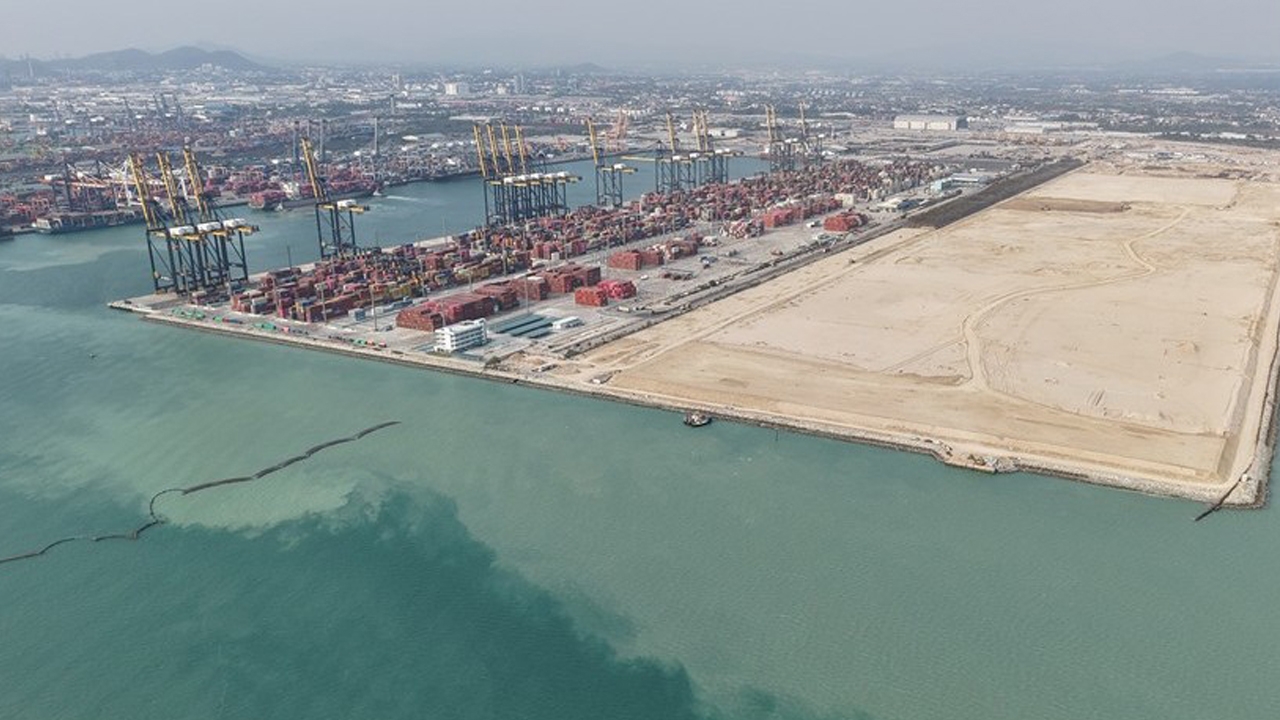
Sanphet ordered the Port Authority of Thailand (PAT) to expedite development of Laem Chabang Phase 3, addressing the six-month delay in land reclamation at Berth F1. He directed the formation of a tripartite working group with a 60-day deadline to resolve the issue. Meanwhile, the GPC consortium submitted a letter demanding 4 billion baht in damages and requested a two-year extension of the construction period, insisting on transparency and prioritizing national interests. Regarding the S1 expressway project, the goal is to submit it to the Cabinet for approval this year and begin pile driving in 2027. Additionally, six policies were handed down to develop the region into a logistics hub, advancing Smart Port, Green Port, and Dry Port concepts, integrating rail, road, and water transport seamlessly to upgrade Bangkok and regional ports, strengthening global trade competitiveness. The appointment of a new PAT board and director is targeted for completion within 90 days. Tags: Laem Chabang Port, Port Authority of Thailand, infrastructure development, logistics hub, construction delay, government policy, GPC consortium, S1 expressway project, port management, transportation planning

Sanphet Boonyamanee, Deputy Minister of Transport, revealed after visiting and giving directives to the Port Authority of Thailand (PAT) today (30 Apr 2026) that, as the official assigned to oversee PAT, he came to deliver policies and set operational directions aligned with the Ministry of Transport and government policies. He emphasized that operations must proceed with a unified approach in both planning and short- and long-term development to enhance organizational efficiency. As in the past, PAT has continuously developed its capabilities to become an international port and a regional water transport hub.Tags: Sanphet Boonyamanee, Port Authority of Thailand, Ministry of Transport, organizational efficiency, port development, government oversight, regional transport hub

He assigned PAT to focus on six key areas to effectively advance major missions, including: 1. Developing and enhancing port infrastructure capacity to efficiently handle increased cargo volumes, with a focus on accelerating the Laem Chabang Port Phase 3 project—particularly reaching a resolution on the operation of Berths F1 and F2, designated as urgent tasks. Currently, Phase 1 land reclamation has been completed by the CNNC joint venture, comprising N.T.L. Marine Co., a subsidiary of Primate Marine Public Company Limited, Nothalin Co., and Zhonggang Construction Group Co. (China). The contracted work is finished and the area has been handed over to PAT. However, technical issues remain to be resolved before handing over Berth F1 to the GPC consortium, which includes Gulf Energy Development Public Company Limited, PTT Tank Terminal Co., and China Harbor Engineering Co. Ltd.Tags: Port infrastructure, Laem Chabang Phase 3, land reclamation, CNNC joint venture, GPC consortium, construction management, port expansion
The handover of Berth F1 has been delayed by approximately six months. Originally, PAT was to transfer the area to the private concessionaire in November 2025, but the deadline has been extended to June 2026 due to technical issues concerning the land reclamation density specifications. These discrepancies exist between the joint venture contract and the construction contract. Meanwhile, land reclamation work at Berth F2, contracted to the CNNC joint venture, is over 89% complete. It is anticipated that CNNC will hand over the F2 reclaimed area to PAT around mid-2026.Tags: Berth F1 delay, land reclamation specifications, contract discrepancies, CNNC joint venture, Berth F2 progress, project timeline

Sanphet further explained the technical issue regarding land reclamation density: the design contract requires the contractor to ensure settlement over 30 years does not exceed 20 centimeters, whereas the contract between PAT and the GPC consortium specifies a minimum relative density of 75%. Therefore, GPC must inspect and accept the area before handover under the concession agreement. Because PAT has been unable to deliver the area to GPC, GPC sent a letter on 1 April 2026 demanding over 4 billion baht in damages, including opportunity costs from the delay and additional expenses to improve the site. They also proposed extending the construction period by two years—from two to four years—while maintaining the overall project management term at 33 years, totaling 37 years instead of 35. Negotiations are ongoing, with no resolution yet on who will bear these costs.Tags: land reclamation density, contract terms, GPC consortium, damage claim, construction extension, negotiation, project management
Therefore, Sanphet instructed PAT to resolve the problem promptly by establishing a tripartite working group involving relevant agencies, experts, and the private sector. Deputy Permanent Secretary of the Ministry of Transport, Panya Chupanich, will chair the group to find a suitable, transparent, and fair solution for all parties. The target is to reach a conclusion within 60 days before submitting the information to Phiphat Ratchakitprakarn, Minister of Transport. Concurrently, discussions are underway with the Council of Engineers to explore engineering solutions such as additional pile driving to strengthen soil density, possibly using technology that could reduce costs by about 50%, from 2 billion baht to 1 billion baht.Tags: problem resolution, tripartite working group, Ministry of Transport, engineering solutions, cost reduction, soil stabilization, negotiation process

"The development project for Laem Chabang Port Phase 3 is an urgent matter requiring identification of responsibility and swift resolution. I am not here to assign blame but to solve organizational problems. The working group must carefully consider responsibility with transparency, accuracy, and national benefit as priorities. I am here not for position but to take responsibility for resolving this issue," Sanphet said.Tags: leadership statement, responsibility, organizational problem solving, transparency, national interest
Sanphet added that the policies he gave PAT include accelerating development of the automated port project at Bangkok Port, optimizing container yard management for maximum benefit, and enhancing the efficiency of distribution centers and warehouses. Regarding regional ports, studies will be conducted on the feasibility of developing Ranong Port as a key trade gateway on the Andaman Sea, linking transport to BIMSTEC countries. Efforts will also accelerate infrastructure, management, and service improvements at Chiang Saen and Chiang Khong commercial ports to serve as vital mechanisms driving economic growth in the Greater Mekong Subregion.Tags: automated port, Bangkok Port, container yard management, distribution centers, regional ports, Ranong Port, BIMSTEC, Chiang Saen Port, Chiang Khong Port, economic development
2. Accelerate seamless integration of the country’s transport systems—road, rail, and waterways—through development of multimodal systems and modal shift initiatives. Expedite the project connecting Bangkok Port with the Bangna–At Narong Expressway (S1). Negotiations with the Expressway Authority of Thailand (EXAT) are ongoing regarding suitable investment models and revenue sharing. The goal is to submit the project for Cabinet approval within 2026 and begin construction in 2027. Additionally, PAT is tasked with advancing development of Dry Ports at studied locations to achieve tangible results. 3. Enhance port management with technology and innovation to evolve into a Smart Port. 4. Address traffic congestion issues at main ports, including Laem Chabang and Bangkok Port. 5. Define clear, concrete directions to develop Green Ports aiming for Net Zero targets. 6. Strengthen organizational capabilities to adapt to global economic fluctuations.Tags: multimodal transport, modal shift, S1 expressway, expressway negotiations, dry ports, smart port, traffic management, green port, net zero, organizational resilience
"The Port Authority’s mission is vital to boosting Thailand’s competitiveness in global trade. Operations must comprehensively meet the needs of users and stakeholders by improving service efficiency, solving transportation and traffic problems, incorporating technology and innovation, and rapidly developing infrastructure to ensure seamless transport connectivity. Simultaneously, efforts will continue to develop green ports and support surrounding communities to ensure port development grows in harmony with urban and social environments," Sanphet said.Tags: competitiveness, service efficiency, transportation challenges, technology adoption, infrastructure development, green port, community relations
Regarding the appointment of the Port Authority’s board, Sanphet said preparations are underway to submit nominations to the Cabinet within 1–2 weeks. Once approved and the new board is appointed, the process to select a new PAT director will commence. A selection committee will be established to set criteria and qualifications and transparently accept applications from suitable candidates. The entire process aims to be completed within 90 days.Tags: board appointment, Port Authority of Thailand, director selection, transparent recruitment, government process
. . .Tags: [] Government PolicyTags: government policy . . .Tags: []