

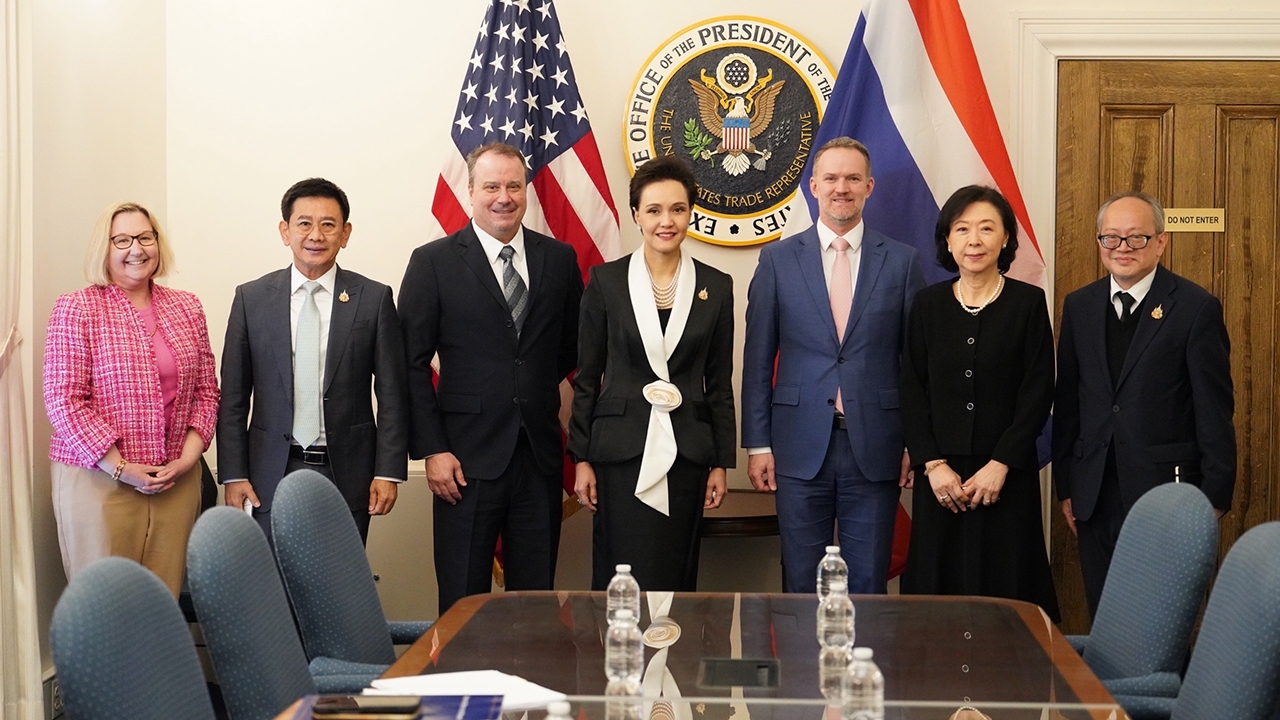
Supachai revealed the results of talks with the US Trade Representative (USTR). Both sides agreed to advance negotiations on the Agreement on Reciprocal Trade (ART) aiming to build economic confidence, reduce tariff pressures, and met with Senator Tammy to exchange views on enhancing the Thai-US supply chain.
Supachai Sutthumpun, Deputy Prime Minister and Minister of Commerce, disclosed the outcomes of discussions with Jamieson Greer, US Trade Representative, and Rick Switzer, Deputy US Trade Representative, on 4 May 2026 GMT+7. The talks were constructive and reflected the shared commitment of Thailand and the US to expedite progress on the Agreement on Reciprocal Trade (ART) negotiations to quickly reach conclusions that strengthen economic, trade, and investment confidence while reducing US pressures to impose trade measures on Thailand.
The US emphasized the importance of trade balance adjustments and welcomed Thailand's proactive role in expanding investments in sectors where both countries share strengths, such as processed agriculture and energy. They also discussed US exports to Thailand of goods that Thailand currently cannot produce domestically. Thailand confirmed readiness and shared plans to expand Thai private sector investments in the US, which received a positive response from the US side and is viewed as a key component of mutually driven cooperation.
Meanwhile, Thailand took the opportunity to advance key issues, particularly advocating for US tariff exemptions on Thai goods that the US cannot produce domestically. The US expressed openness and willingness to consider this further, reflecting flexibility and readiness to find mutually beneficial solutions.
Regarding ART negotiations, Thailand emphasized the importance of achieving a practical and implementable agreement. The US showed understanding and readiness to discuss clear timelines and detailed agreement points to improve Thailand's internal processes. The US also expressed interest and encouraged Thailand to play a larger role in increasing the use of US raw materials within supply chains.
On timing, both Thailand and the US agreed to accelerate negotiations with the goal of quickly finalizing key elements of the agreement. This aims to affirm Thailand's status as a strategic trading partner of the US and reduce the risk of future tariff measures.
"This discussion reflects the confidence and shared commitment of Thailand and the US to strengthen and concretize economic relations. Thailand is ready to work closely with the US to ensure that the ART negotiations yield balanced and sustainable mutual benefits in the long term," Supachai said.
Supachai said that during the visit to the US, she met with Senator Tammy Duckworth to exchange views on economic cooperation, investment, and opportunities to elevate supply chains between the two countries. The US side proposed cooperation in promising sectors such as clean energy, carbon reduction technology, small modular nuclear energy, food innovation, public health collaboration, and infant food industries, all areas of interest to the Thai private sector.
Furthermore, both sides agreed to promote cooperation among private sectors, educational institutions, and US government agencies, especially in Illinois state, which has strengths in energy, technology, and advanced agriculture. This aims to expand investments and add value to long-term supply chains. Thailand requested support in sending positive signals to the US administration that Thailand is ready to be a reliable strategic partner and to promote concrete trade cooperation.
However, the Ministry of Commerce plans to send a Thai delegation to clarify and answer questions from the US Trade Representative's office regarding the Section 301 investigation on 13–14 May 2026 GMT+7, to foster accurate understanding of Thailand's trade and production structure.
In 2025, the US was Thailand's second-largest trading partner, with total trade valued at 93.65 billion US dollars. Thai exports to the US amounted to 72.5 billion dollars, covering key products such as computers, rubber products, gemstones, automobiles, and air conditioners. Imports from the US totaled 21.14 billion dollars, including crude oil, machinery, aircraft and parts, chemicals, and electrical machinery, resulting in a trade surplus of 51.36 billion dollars for Thailand.
. . . Government policy Additional