

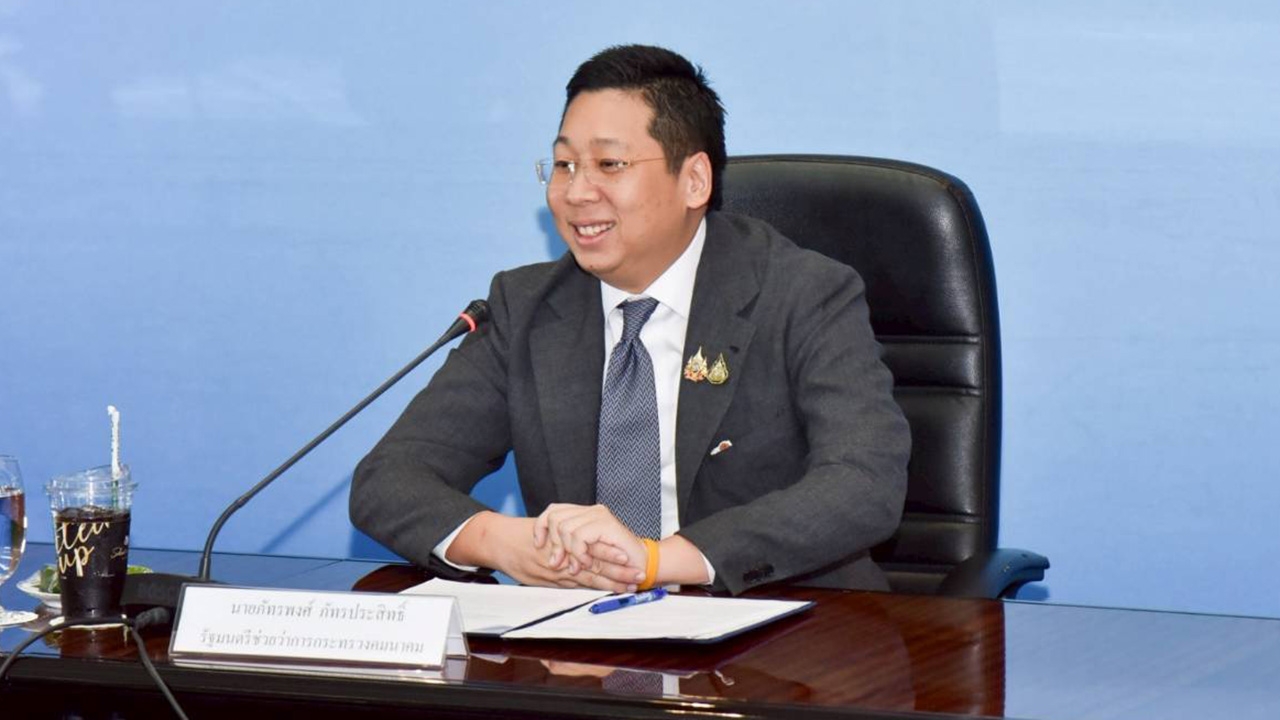
Patthapong is accelerating the upgrade of regional airports by unlocking space for commercial development and runway expansion, introducing biometric systems at eight airports, and postponing the transfer of three regional airports to Airports of Thailand (AOT) management due to concerns about the Department of Airports' (DOA) financial standing.
Mr. Patthapong Pataraprasit Deputy Minister of TransportHe revealed after giving policy directives to the Department of Airports (DOA) that the Ministry of Transport is currently accelerating upgrades to regional airports nationwide in terms of infrastructure, facilitation systems, and commercial potential. This aims to enable DOA airports to more effectively accommodate tourists and air transport. He acknowledged that many airports were originally developed for national security reasons, which has limited commercial development. Now, he has tasked DOA to expedite runway expansions at airports that cannot yet accommodate large aircraft, create unique identities for each airport, and introduce new activities to boost revenue such as logistics, cargo businesses, and tourism promotion within airport areas.

Regarding ongoing investment projects, Patthapong said there is currently a plan to extend the runway at Chumphon Airport with a budget of about 1.5 billion baht, progressing continuously during fiscal years 2025-2026. Meanwhile, Ranong Airport is under development, and Phrae Airport will begin land surveying and expropriation in fiscal year 2026 to study appropriate runway length and assess assets and land requiring compensation to local residents.
Patthapong also spoke about the policy concerning the transfer of three airports: Krabi Airport, Udon Thani Airport, and Buriram Airport, which are currently managed by the DOA but planned to be transferred to Airports of Thailand Public Company Limited (AOT). He personally disagrees with transferring them to AOT, believing regional airports can still be managed to provide services and generate income. Profitable airports support those operating at a loss. Although the Cabinet previously approved the transfer, he emphasizes the need for caution and suitability.in the current situation,he has instructed DOA to discuss with AOT since a joint study is ongoing. The government must carefully consider all factors, particularly the economy and AOT’s obligations to shareholders regarding investment returns.
Patthapong admitted thatlarge DOA airports, especially Krabi, are significant revenue sources supporting many smaller airports nationwide, most of which serve strategic security roles and are not self-sufficient. Therefore, if major revenue airports are transferred out, the government must develop a new management model to ensure the remaining 28 airports can continue operations under a unified standard. He emphasized the current approach is “large airports subsidize smaller ones” to avoid excessive burden on the national budget.
A key reason the airport transfer cannot be finalized is that DOA and AOT use different study assumptions. AOT focuses on business returns of the three airports, while DOA considers the national airport system as a whole, leading to differing evaluations. They must reach a joint conclusion before proposing recommendations to the Ministry of Transport and Cabinet. If the final proposal is not to transfer the airports, the Cabinet's previous resolution will need to be revoked.

Regarding service efficiency improvements, the Deputy Minister of Transport has ordered DOA to expedite the installation of biometric and automated systems at eight regional airports, including:
Krabi,
Surat Thani,
Ubon Ratchathani,
Khon Kaen,
Nakhon Si Thammarat,
Trang,
Phitsanulok,
and Udon Thani.
Pilot implementations will begin at Krabi and Udon Thani airports first, as they have international flights. Full operation is expected by 2027 to enhance passenger screening speed and security.

Meanwhile, DOA is studying construction of additional new airports. The most advanced project is Bueng Kan Airport, which has completed an Environmental Impact Assessment (EIA) and is surveying real estate, land, trees, and structures to prepare construction budget estimates. The investment is projected at 4-5 billion baht. If approved by the Cabinet, construction could start in 2029, making it DOA’s 29th airport after Pak Phanang Airport was transferred to the Royal Rainmaking and Agricultural Aviation Department.
Additionally, four other airports are under feasibility study: Mukdahan, Satun, Phayao, and Phatthalung, currently in the EIA review phase awaiting expert and agency feedback.
Patthapong also outlined revenue enhancement measures, saying the Ministry of Transport and Ministry of Finance are drafting a new Memorandum of Understanding (MOU) to increase flexibility in using state property within airports. Lease terms will be extended from a maximum of three years to five to ten years for indoor areas and possibly up to 30 years for some outdoor business types, encouraging private investment in large projects such as hotels or commercial zones around airports. The MOU is expected to be signed within one to two months.
At the same time, DOA is preparing to develop transport links connecting airports to city centers or feeder systems to facilitate public convenience and reduce travel costs. They will promote public buses to stop directly in front of passenger terminals at airports with lower traffic. Larger airports will gradually develop transport hubs, such as at Surat Thani and Ubon Ratchathani Airports, allowing convenient transfers between planes, buses, and taxis. He confirmed that taxis at DOA airports do not charge additional fees beyond the meter fare.

Regarding airline support during the fuel price crisis and international uncertainties, DOA plans to reduce aircraft parking fees by 50% for six months for affected airlines needing to park planes. They can use parking spaces at nearly all DOA airports to reduce operator costs during flight disruptions. This measure can be implemented immediately, although most airlines are still operating normally.
Read more news " State Policy " updates