

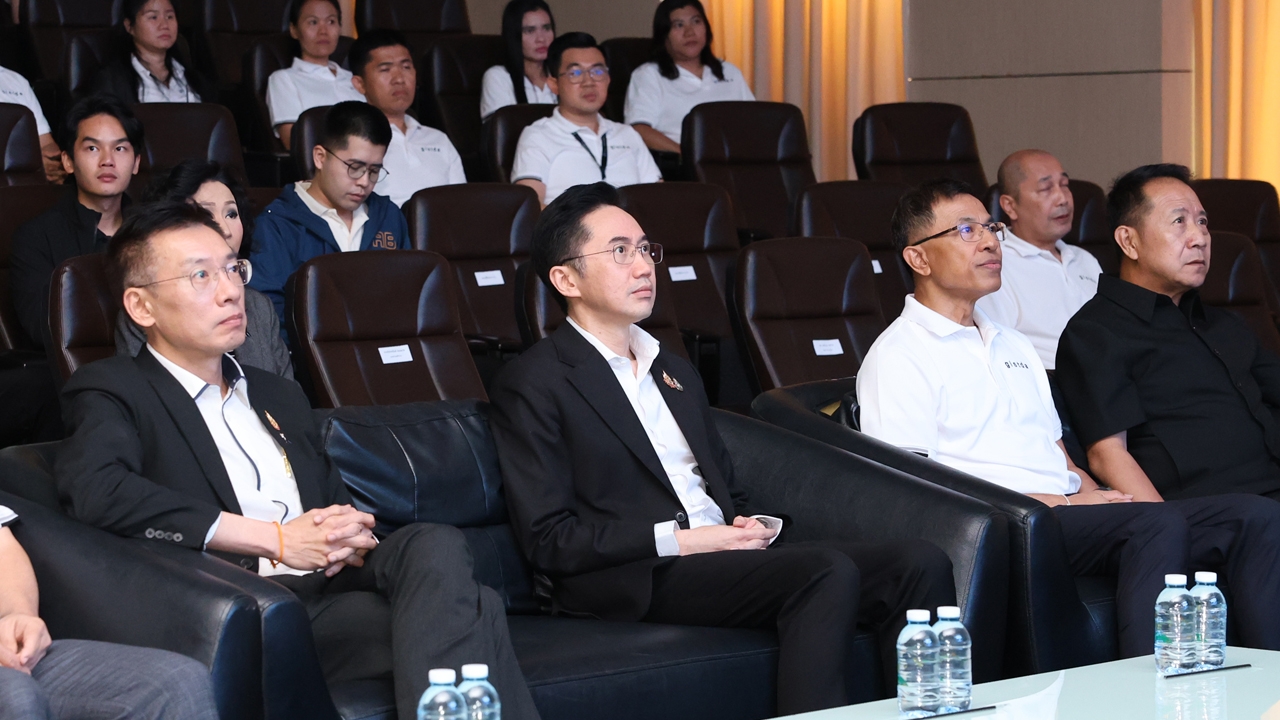
Deputy Prime Minister Prof. Dr. Yossanan Wongsawat and Minister of Higher Education, Science, Research and Innovation, accompanied by Ms. Piyarat Tiyapairat, Deputy Minister of Agriculture and Cooperatives, led a delegation to visit GISTDA at the Space Innovation Park in Si Racha District, Chonburi Province, to review advances in space and geoinformatics technology for managing national crises.
The key agenda of this visit was the launch of the “Drought Check System,” an intelligent tool that uses earth observation satellite data combined with artificial intelligence (AI) to monitor water risk down to local areas. This system can predict in advance which agricultural crops are at risk and how much water certain areas require, enabling the government and farmers to respond promptly to drought and dry spell crises in 2026.

Additionally, the management team toured the National Assembly and Integration Test Center (NAIT), Thailand’s standard satellite assembly and testing facility, and reviewed progress on the “THEOS-3” earth observation satellite, the latest model reflecting Thailand’s vision for self-reliance, notable for:
- Designed by Thai experts – developed by a team of Thai engineers with expertise in all phases.
- Supporting Thai businesses – using key parts and systems produced by domestic manufacturers.
- Fully made in Thailand – assembled and tested entirely at NAIT in Thailand.
The THEOS-3 project is more than proof of Thai capability on the global stage; it marks a critical turning point to propel Thailand as a key player in the global space economy market, including advanced research such as space traffic management and space weather forecasting. This will create new opportunities for Thai industries and confirm that space technology is no longer distant but a core element to support national policy planning, especially for preparing for severe disasters and developing high-value industries under the Space Innovation Thailand policy.
Deputy Prime Minister Prof. Dr. Yossanan Wongsawat stated that GISTDA’s ability to develop both software and hardware in space technology using Thai expertise, especially the THEOS satellite project which now has over half of its key components developed domestically, clearly reflects Thailand’s concrete progress in space technology.
He emphasized that “geoinformatics data” is a crucial core that can be expanded for practical use in many sectors, including disaster management, agriculture, resource management, research, and new application development. GISTDA is advancing to become a “space platform” offering opportunities for startups, researchers, and the private sector to use data and innovate together to drive the country’s space economy.
Furthermore, the government is preparing to develop a complete space ecosystem by supporting personnel, connecting universities, attracting investors, developing spaceports, and enacting space business laws to create new opportunities for Thailand on the global stage.
The Deputy Prime Minister stressed that space work is challenging and time-consuming but represents a significant opportunity for the country because it is a high-potential industry with few competitors. The goal is for Thailand to gain world-class expertise in software, hardware, and space services, building new national strengths for the future.
Dr. Pakorn Arphapan, Director of GISTDA, said that within the next three years, GISTDA aims to make Thailand a Data Driven Nation by utilizing spatial data to benefit both economic and social sectors, thereby enhancing the country’s sustainable long-term competitiveness.
Read more " Government Policy " updates