

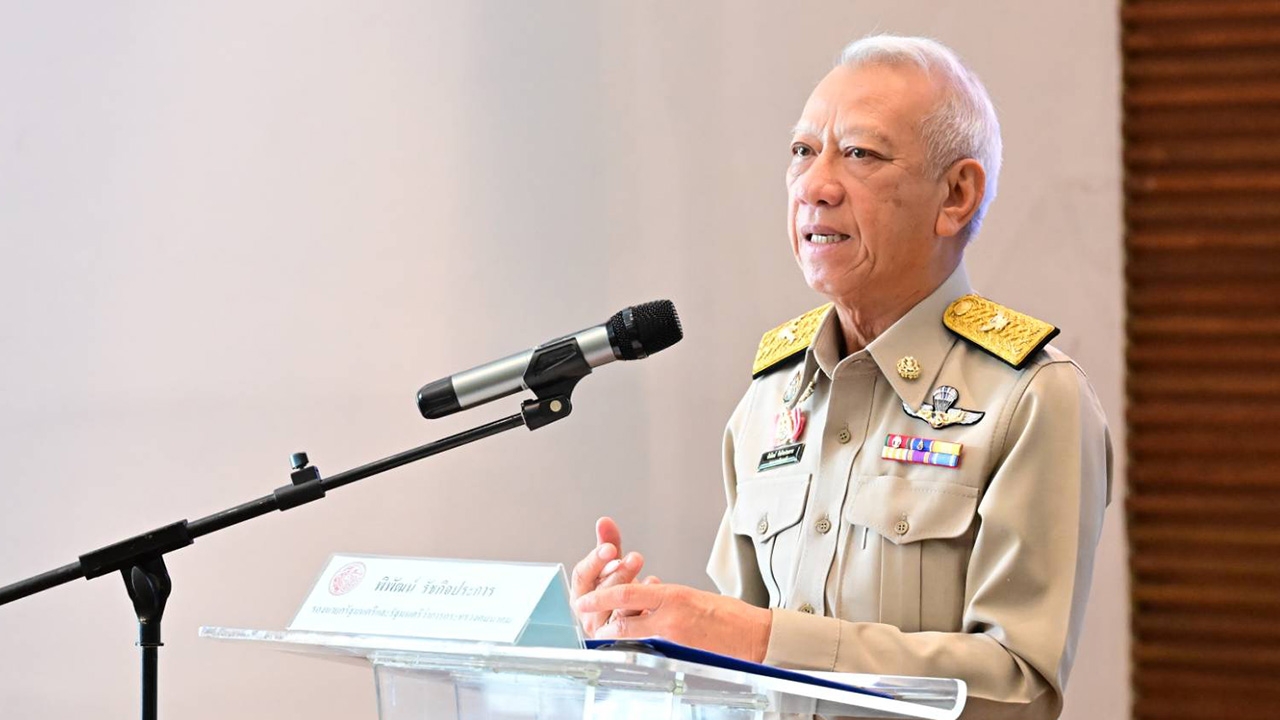
Phiphat revived the policy of using rubber barriers to reduce accidents, ordering the Department of Rural Roads to implement 3 Quick-Win projects to expedite the Koh Lanta-Songkhla bridges and the Thailand Riviera road.
Mr. Phiphat Ratchakitprakarn, Deputy Prime Minister and Minister of Transport, revealed this after chairing the policy and operational direction handover to the Department of Rural Roads (DRR) to accelerate infrastructure development to meet the needs of people across all regions.
Mr. Phiphat stated that the Ministry of Transport has a policy for the Department of Highways (DOH) and Department of Rural Roads (DRR) to reuse natural rubber sheets on concrete barriers (Rubber Fender Barrier: RFB), natural rubber guide posts (Rubber Guide Post: RGP), and rubber-covered guardrails to reduce impact severity at hazardous locations.
However, to implement this policy, the Ministry of Transport will appoint a working group chaired by Mr. Jirapong Theppitak, Deputy Permanent Secretary of the Ministry of Transport, to define responsibility details, operation lengths, budget allocation, and coordinate with 29 rubber cooperatives under the Cooperative Promotion Department, Ministry of Agriculture. They will procure rubber following standards studied by Prince of Songkla University to maximize effectiveness and aim to finalize within 3 months. Although the fiscal year 2027 budget may not be ready in time, leftover funds might pilot some sites, focusing on high-accident areas. The project will be a main policy in fiscal years 2028-29.

Mr. Phiphat further said that foreign tests, especially in South Korea, align with research from Prince of Songkla University showing that rubber-covered barriers reduce injury severity by 10-20%. Using rubber sheets on steel guardrails, particularly on curves, can reduce injury severity by nearly 40%. Thus, the Ministry of Transport sees this policy as beneficial not only for safety but also for supporting rubber farmers.
Currently, rubber prices are about 80 baht per kilogram due to low market supply, while the average price for smoked rubber sheets grade 3 in normal seasons is around 55-58 baht per kg, matching the project's rubber procurement cost, making it a worthwhile investment. It also helps generate income and distribute work to rubber cooperatives nationwide. The Ministry of Transport, DOH, and DRR will invite 29 rubber cooperatives, already equipped with machinery and production capacity, to discuss readiness and concrete implementation plans.

Additionally, DRR was instructed to advance three urgent Quick-Win projects, including:
speeding up ongoing construction projects to open them quickly,
accelerating bidding for projects ready to be constructed,
and expediting cabinet approval for new projects.
Highlighted projects that have already selected contractors include: the Songkhla Lake Bridge (Songkhla-Phatthalung) and the Koh Lanta Connecting Bridge (Krabi). Currently, the Public Debt Management Office (PDMO) is negotiating a loan with the World Bank for 141.51 million USD (approximately 4.5 billion baht), with contract signing expected by June 2026 GMT+7. Construction will take 3 years, aiming for completion in 2029.
Simultaneously, DRR was instructed to accelerate large projects included in the master plan, especially the Southern Coastal Road Project (Thailand Riviera) and the Andaman Coast Road, which DRR has been tasked to complete quickly to support tourism under government policy and stimulate the national economy effectively.

Mr. Phichit Hunsiri, Director-General of the Department of Rural Roads (DRR), explained the progress of the Southern and Andaman Coastal Road Project (Thailand Riviera), dividing it into five phases:
Additionally, in fiscal year 2027, DRR will allocate 20 million baht to survey and design the Thailand Riviera section from Sichon to Tha Sala, approximately 30 km.
Read more news " State Policy " updates