

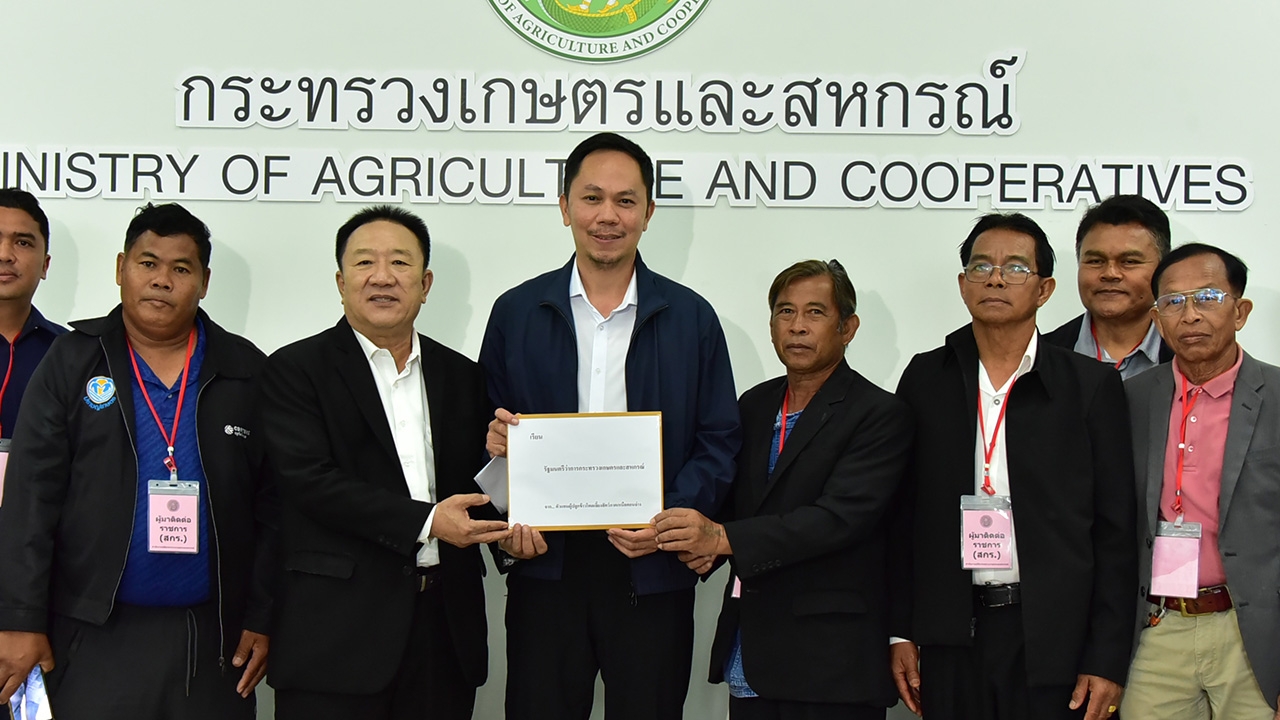
Representatives of the Crop Trade Association farmers petitioned the Ministry of Agriculture to oppose the import of 1 million tons of GMO corn from the United States, pointing out rising costs and urging a review of agricultural insurance prices.
At 10:00 a.m. on 20 May 2026, at the Ministry of Agriculture and Cooperatives, Mr. Porntep Pupprasert, Vice President of the Crop Trade Association, represented corn farmers raising demands for the government to review the agricultural insurance price structure, with Mr. Sarawut Nueangjamnong, Secretary to the Minister of Agriculture and Cooperatives, receiving the petition. The representatives sought fairness and alignment with actual costs, noting that the government-guaranteed prices were set before the Middle East conflict, but production costs have since risen significantly.
This aims to enable farmers to be self-reliant and build strengthsustainablyfor Thailand's future economy. They also pointed out that the Office of Agricultural Economics reported Thailand produces 5 million tons of corn annually, which is insufficient for domestic demand exceeding 9 million tons; this data is inaccurate since farmers can produce more than 5 million tons per year.

Additionally, they proposed that the animal feed industry switch to domestic raw materials such as rice husks and cassava to help raise prices and support the grassroots economy, replacingimported animal feed cornfrom abroad.
Mr. Sarawut stated that he and Mr. Songsak Soemprom Udomchai, Advisor to the Minister of Agriculture and Cooperatives,listened to the demands of corn farmers from lower northern and upper northeastern regions. The farmers' group requested the government reconsider the import resolution for 1 million tons of U.S. animal feed corn because the imported corn is genetically modified (GMO), raising long-term food safety and environmental concerns. They also noted that production costs in the exporting country are lower than in Thailand, with no controls on agricultural chemical use. Domestic farmers face increased production costs due to the Middle East conflict andcalled for suspension of the draft agricultural good practice standard for dry corn collection centers without burning, issued by the National Bureau of Agricultural Commodity and Food Standards (ACFS), seeing it as discriminatory and an obstacle to corn farmers.. (Note: This part is a fragment and redundant continuation of previous part.). (Note: This part is a fragment continuing the previous statement about production cost differences and chemical controls.)

The Ministry of Agriculture will bring the issue to relevant agencies and coordinate with the Ministry of Commerce to establish clear, balanced import mechanisms that do notaffect domestic product prices.Currently, fresh corn with 14.5% moisture sells at about 11-12 baht per kilogram, higher than the government-guaranteed price under existing policy. The government emphasizes that the hardship and income of upstream farmers are paramount and will seek ways to manage price stability fairly for both producers and consumers.
Read more news " Government policy " here.