

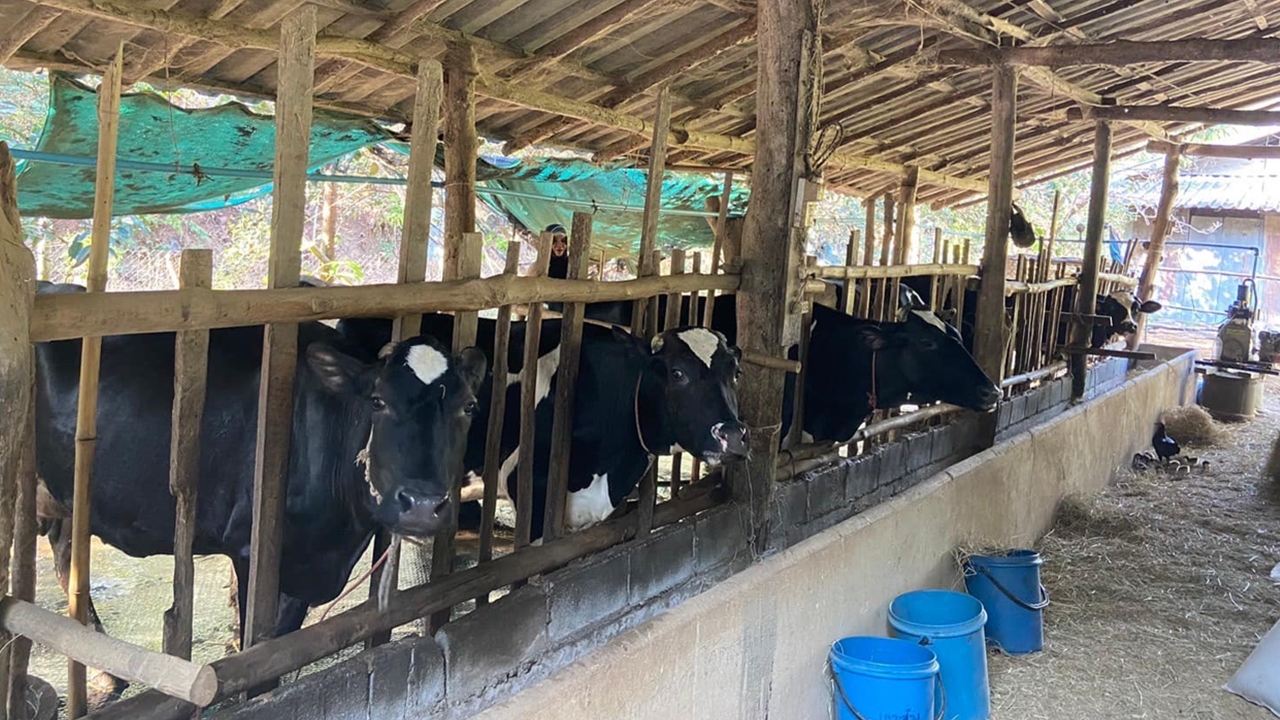
Mae On Dairy Cooperative highlights its success in producing raw milk that meets full GAP standards. The chairman appeals urgently for government assistance after a major private company defaults on payments exceeding 70 million baht, severely affecting members' cash flow.
Mr. Niran Moolthida, Director-General of the Department of Cooperative Promotion, said after Ms. Piyaratch Tiyapairat, Deputy Minister of Agriculture and Cooperatives, visited Mae On Dairy Cooperative in Mae On District, Chiang Mai Province, that upon inspecting the cooperative’s operations and listening to the problems faced by dairy farmers in the upper northern region, they found that the cooperative operates fully to standard across all production processes from the source to the end product. In particular, all member farmers’ dairy farms have GAP certification.
“Both the cattle farms and the grass cultivation plots for cattle feed meet GAP standards. There is an in-house feed mixing center and a center producing standard concentrated and roughage feeds. The cooperative network is linked with private sector partners regarding raw materials for feed production, such as corn and rice straw, sourced locally and from nearby provinces for use during shortages,” the Director-General of the Department of Cooperative Promotion revealed.

Regarding support from the Department of Cooperative Promotion, Mr. Niran emphasized that the department has provided a concentrated feed mixer worth 1.47 million baht, a tractor worth 1.64 million baht, and also a corn pellet press machine for cattle feed costing over 300,000 baht.
“In fiscal year 2027, we allocated a budget to purchase a 10-wheel truck with a full stainless steel body for transporting raw milk, valued at 3.8 million baht. This includes working capital from the Cooperative Development Fund, which the Chiang Mai Provincial Cooperative Office has proposed to the department to assist with,” said the Director-General of the Department of Cooperative Promotion.

: Mr. Sanan Jaikamool, Chairman of the Mae On Dairy Cooperative, expressed gratitude to the Department of Cooperative Promotion for providing the corn pellet press to the cooperative, with the minister presiding over the handover. Currently, the raw milk produced by member farms is of high quality because all 102 member farms have GAP certification.
“Currently, there are 102 members, with 94 actively supplying raw milk, averaging 24 tons per day from a total of 2,600 milking cows. Since our cooperative only sells raw milk without processing, we have an MOU to sell 19 tons per day to private companies including Chiang Mai Fresh Milk, CP, and Dutch Mill at a price of 22.75 baht per kilogram. Another portion is sold to Foremost,” the cooperative chairman explained.
Mr. Sanan highlighted the current major issue as the cooperative’s liquidity shortage causing delayed payments to members. This is due to a major raw milk buyer, especially Chiang Mai Fresh Milk, which is severely cash-strapped and has not paid the cooperative for raw milk. Currently, Chiang Mai Fresh Milk owes about 70 million baht, causing a ripple effect. The cooperative’s working capital comes from other buyers such as CP, Dutch Mill, and Foremost, who continue to pay every 15 days as usual.
“The problem now is liquidity shortage. Chiang Mai Fresh Milk, which buys milk from us, has accumulated unpaid debts of about 70 million baht, but we still have to supply them as per our MOU. This causes a domino effect. Since they are private companies, the government has no policy to support them with budgets like the Dairy Farming Promotion Organization (DPO) or cooperatives that process products themselves,” the cooperative chairman explained, pleading for government agencies to support private sector operators who buy raw milk from dairy cooperatives, possibly by providing low-interest loans to restore liquidity so these companies can pay members.
Chiang Mai Fresh Milk is a major buyer of raw milk from nearly all upper northern dairy cooperatives, including Mae On, San Kamphaeng, Mae Wang, and Pha Tang cooperatives, using the milk to process UHT milk, pasteurized milk, milk tablets, and school milk.
Read more news " Government Policy " updates