

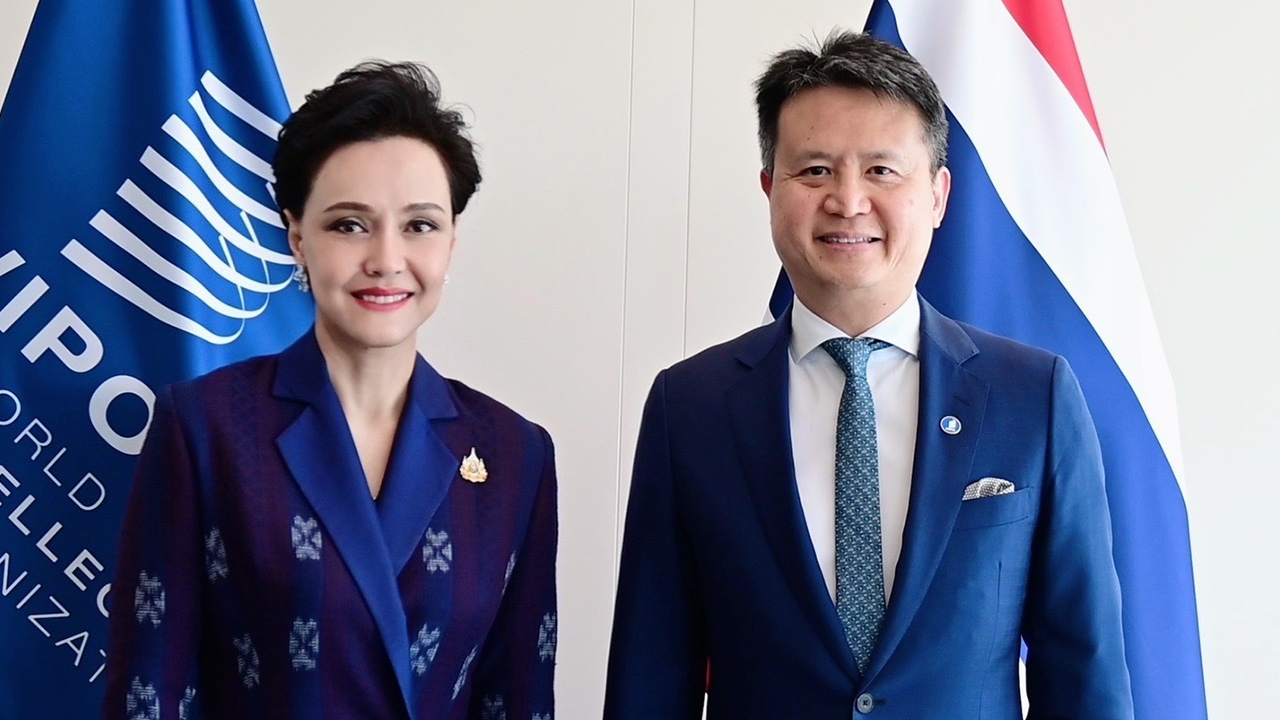
"Supachai" held bilateral talks with the Director General of WIPO in Geneva to accelerate the promotion of IP Finance and Geographical Indication (GI) products as tools to increase economic value, while preparing Thailand to join the Hague Agreement.
On 28 May 2026 at 11:00 local time in Geneva, Switzerland, Ms. Supachai Suthumpun, Deputy Prime Minister and Minister of Commerce, accompanied by Mr. Wutthikrai Leewirapant, Permanent Secretary of the Ministry of Commerce; Ms. Pimchanok Pittfield, Thailand's Permanent Representative to the World Trade Organization and WIPO; Ms. Oramon Sapthaweetham, Director-General of the Department of Intellectual Property; and senior Ministry of Commerce officials, held bilateral talks with Mr. Daren Tang, Director General of the World Intellectual Property Organization (WIPO) at WIPO headquarters in Geneva, Switzerland, to enhance intellectual property cooperation between Thailand and WIPO and to promote Thailand’s role on the international intellectual property stage.
On this occasion, Ms. Supachai congratulated Mr. Daren Tang on his reappointment as WIPO Director General for a second term, emphasizing Thailand's commitment to cooperation with WIPO as the leading global intellectual property organization. She noted that knowledge sharing, experience exchange, and international collaboration are key factors in promoting intellectual property as a mechanism driving the economy, innovation, and sustainable development.

Ms. Supachai revealed that the discussions covered many important issues. The Thai side highlighted policies to establish an ecosystem promoting the use of intellectual property as financial assets (IP Finance) to increase opportunities for entrepreneurs, creative businesses, and innovative enterprises to access more funding sources. The Ministry of Commerce, through the Department of Intellectual Property, plans to hold capacity-building training on intellectual property valuation from 17-18 June 2026, and to launch the “Pilot Project IP Finance Thailand” during October–November 2026 to lay a foundation for the long-term use of intellectual property as a financial tool in the country.
The WIPO Director General praised Thailand's approach and expressed full readiness to support academic and technical cooperation, including knowledge transfer and sending experts or mentors to assist with the development of the IP Finance Thailand pilot project. He also observed that with integrated cooperation from relevant agencies, especially in finance, Thailand’s system has the potential to become a regional model for applying IP Finance in the future.
Regarding Geographical Indications (GI), both sides discussed ways to use intellectual property to add value to products, culture, and community economies. The Thai side shared experiences using GI to promote Thai products through dimensions of food, culture, fashion, and design, as well as employing cultural diplomacy and nation branding to elevate the international image of Thai goods.

Ms. Supachai stated that the Ministry of Commerce prioritizes linking intellectual property protection with grassroots economic development and sustainability. When communities and producers adapt, develop products, or upgrade standards to meet market demands, the government must play a role in creating trade opportunities and finding markets to ensure tangible and sustainable development results.
She added that GI should not be limited to rights protection alone but should connect with trademarks, design, marketing, branding, and packaging design to enhance competitiveness in the global market—especially for community and handicraft products that carry stories, identity, and cultural value. Proper development can elevate these products to premium status. She cited WIPO’s successful collaborations with several countries in developing GI alongside branding and design to increase economic value.
Additionally, both sides discussed using intellectual property as a tool to support community development through design, creativity, and cultural heritage—especially by adapting local knowledge to modern market needs under sustainability principles, using natural materials, reducing chemical dependency, and creating outcomes communities can sustain long term. The Thai side reaffirmed readiness to work with government agencies of partner countries and WIPO to exchange development models and expand results internationally in the future.
They also discussed Thailand’s preparations to join the Hague Agreement on the International Registration of Industrial Designs. Currently, Thailand is revising its Patent Act to comply with this agreement. Thailand requested WIPO’s support for on-the-job training with intellectual property offices of member countries with similar examination systems, such as South Korea and Vietnam, and technical assistance to translate the Hague system manual into Thai to build understanding among relevant personnel and the public for effective use of the system.
The World Intellectual Property Organization (WIPO) is an international organization under the United Nations, established in 1967. Its mission is to promote the protection of intellectual property worldwide. WIPO currently has 192 member states, including Thailand, which joined in 1989. WIPO administers 26 international intellectual property treaties covering key areas such as patents, trademarks, geographical indications, industrial designs, and copyrights.
." State Policy Additional