

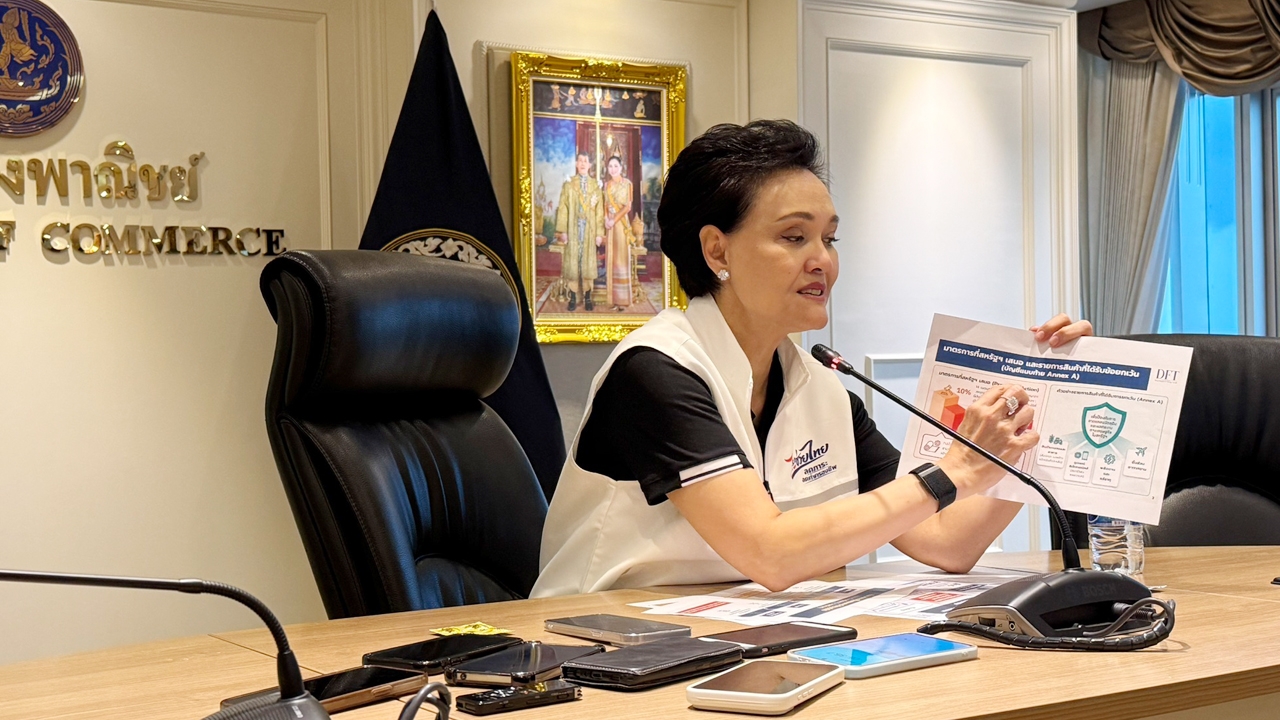
The Ministry of Commerce revealed that Thailand will press on despite the USTR's announcement of preliminary findings under Section 301 concerning forced labor, which imposes a 12.5% import tariff on Thai products. It reiterated that the USTR repeatedly highlights the issue, while Thailand is preparing comprehensive human rights legislation throughout the supply chain, aiming to reduce the tariff to below 12.5% in the final determination.Final stage investigation.However, the outcome regarding excess production capacity remains uncertain, and negotiations on the ART will continue.
Supachai Sutthumpun, Deputy Prime Minister and Minister of Commerce, disclosed that the U.S. Trade Representative (USTR) announced preliminary findings from investigations of 60 trading partners, including Thailand, under Section 301 trade law regarding imports from countries using forced labor. The USTR will impose a 12.5% tariff on imports from Thailand. This announcement categorized the 60 countries into three groups. The first group includes six countries with laws banning imports made with forced labor: Canada, Ecuador, the European Union, Indonesia, Mexico, and Pakistan. This group faces a 10% import tariff.
The second group includes eight countries with partial laws or regulations banning imports made with forced labor or those that have signed the Agreement on Reciprocal Trade (ART) with the U.S.: Argentina, Bangladesh, Cambodia, El Salvador, Guatemala, Malaysia, Taiwan, and the United Kingdom. They face a 10% tariff. The third group includes 46 countries without enforced laws banning imports made with forced labor, such as China, Japan, Vietnam, India, the Philippines, Australia, New Zealand, Norway, Singapore, and Thailand. They face a 12.5% tariff.
Nevertheless, the U.S. proposed exemptions and special mechanisms, especially for textile products, where the U.S. will reduce tariffs based on quotas linked to the volume of textile raw material imports from the U.S. The list of exempted products includesimport tariff exemptions.A total of 1,655 items to prevent raw material shortages and economic impact in the U.S., divided into four groups: agricultural and food products (pineapples, coconuts, tapioca starch), electronic devices (smartphones, circuit boards), energy and minerals, and aircraft parts.
Among these, Thailand stands to benefit most from processed tapioca, rubber sheets/latex, and data storage units, as well as other products including tapioca starch, durian and tropical fruits, processed pineapples, coconut products, spices such as turmeric and ginger, curry ingredients, natural latex, smoked rubber sheets, rubber blocks,portable computers,hard disks, smartphones, combined circuit boards, display panels, gold, and silver bars,turbojet engines,airplane tires, and airplane seats.
Regarding the next steps, on 22 Jun, the U.S. will open for countries to submit requests to participate in public hearings; on 6 Jul, written comments can be submitted, including appropriate tariff rates,product lists,products to add or remove, and the appropriateness ofexempted tariff products.Thailand must submit various data to the U.S. Subsequently, public hearings will begin on 7 Jul, and five days after the hearings conclude, submissions of rebuttals will be allowed.
"From now on, we will explain to the U.S. to reduce the tariff from 12.5% to at least no more than 10%, matching key competitors. We will argue that regarding labor standards, Thailand has promoted multilateral negotiations through the International Labour Organization and emphasized the effectiveness of current labor laws. At the same time, we will demonstrate commitment to enforcing laws banning imports made with forced labor in the future, proposing clear operational plans with measures and regulations to prevent such imports in certain industries. Regarding exempted tariff products, we will clarify that Thai products are essential raw materials; if the U.S. imposes tariffs, it may cause shortages in the U.S. production supply chain."
Supachai added that the Ministry of Commerce will consult with the private sector to prepare rebuttal information and review relevant laws on banning imports produced by forced labor together with government agencies, such as the Ministry of Labour and Customs Department. Concerning the Section 301 investigation into excess production capacity in three industries,namely automobiles and parts, rubber products, and machinery, where the USTR has yet to announce preliminary findings, Thailand has previously informed the U.S. that major exporters' production capacity is at 70-95%, not below 60% as alleged, and has coordinated with the Ministry of Industry to update the Manufacturing Production Index (MPI) data.. (Note: This part appears to be a continuation of part 20 and is fragmentary; translation is merged with part 20.)
Arada Fuengthong, Director-General of the Department of Foreign Trade, stated that although the preliminary findings have been announced, Thailand will continue negotiations to persuade the USTR to lower the import tariff rate from Thailand. She emphasized again that Thailand is currently conducting a public hearing on the draft HRDD Law, prepared by the Ministry of Labour and Ministry of Justice, to elevate the business sector’s capability to comprehensively verify human rights and trace the supply chain to prevent human rights violations and forced labor. It is hoped that in the final investigation stage, the tariff rate imposed on Thailand will be reduced below 12.5%.Public hearing on the draft law.The draft "Promoting Responsible Business Conduct (HRDD Law)" prepared by the Ministry of Labour and Ministry of Justice aims to enhance the business sector’s ability to conduct thorough human rights due diligence, traceability throughout the supply chain, and prevent human rights abuses and forced labor. Thailand hopes that in the final stage of the investigation, the tariff rate imposed will be reduced below 12.5%.
However, Thailand still awaits results on the Section 301 investigation concerning excess production capacity, expected soon or before 24 Jul 2026, when the 10% tariff collection under Section 122 of trade law, replacing invalidated countervailing tariffs, will expire.
"Although the U.S. has canceled countervailing tariffs on trading partners, Thailand continues to negotiate the Thailand-U.S. reciprocal trade agreement intensely. Several detailed issues remain, including market access for U.S. goods, tariff exemptions on U.S. imports, reduction or removal of trade barriers, labor standards as requested by the U.S., including bans on imports from countries using forced labor, intellectual property protection, and increasing imports of certain U.S. products."
Read more news " Government policy " additional