

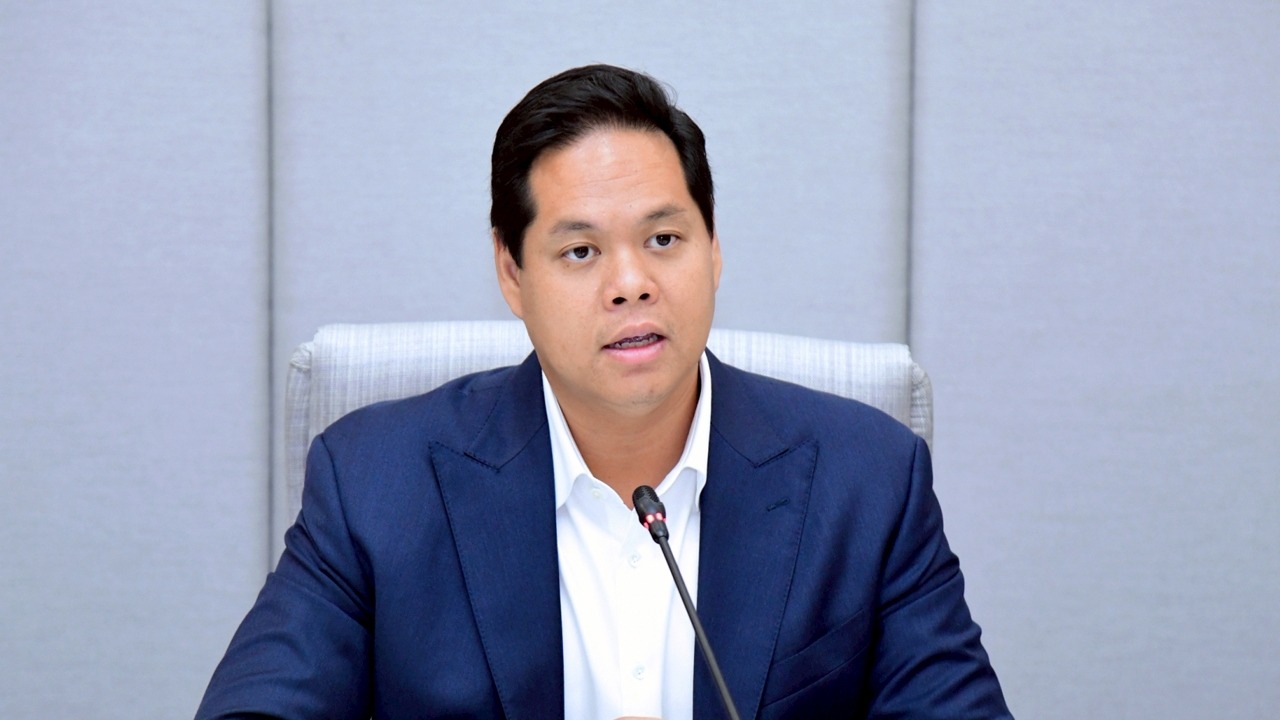
Sanpetch held discussions with TICTA to present proactive plans to upgrade Laem Chabang Port, reflecting actual costs and removing logistics obstacles, with the goal of becoming a world-class port.
Sanpetch Boonyamanee, Deputy Minister of Transport, revealed after chairing a meeting to discuss development plans for the port and transportation system with the Thai International Cargo Terminals Association (TICTA). The meeting aimed to hear private sector proposals and set development directions for Laem Chabang Port (LCP). He stated that Laem Chabang Port is the main trade gateway and the most important cog in Thailand's logistics system. Today's meeting with the private sector was a proactive integration effort to promote sustainable growth and elevate Laem Chabang to a world-class port. The meeting considered proposals to adjust port fees, with the Port Authority of Thailand (PAT) suggesting an average increase of 16–29%, depending on container type and size. This covers loading/unloading fees, terminal usage fees, container handling fees, and container storage fees, aligning with current operational costs. The new rates adhere to the principles and do not exceed the maximum ceiling set by the Cabinet's 1991 resolution.

Additionally, the meeting accelerated efforts to solve transshipment cargo transport issues. It was noted that the proportion of transshipment cargo has steadily declined from 1.0% in 2019 to only 0.7% in 2025, despite total container volume growing over 25%. The main cause is legal restrictions and complex permit procedures. In response, the PAT is pushing to amend 17 related laws, prioritizing six key laws initially. The approach will shift from a "permit application" system to a "notification" system to reduce redundant steps, with plans to present this to the Cabinet by September 2026. The plan also addresses long-stay containers, currently totaling 1,248 units. The PAT plans to develop an additional 5 rai (about 0.8 hectares) of storage space with a budget of 26 million baht to handle up to 1,000 TEUs per year, expected to be completed by fiscal year 2027.

Lieutenant Rattakorn Khiewpaisarn, Deputy Director and Acting Director of the Port Authority of Thailand (PAT), added that the overall progress of Laem Chabang Port Phase 3 development stands at 68.89%. The marine construction (Contract Part 1) is 95.57% complete, while building and utilities construction (Contract Part 2) is at 19.82%. Railway system installation and machinery procurement (Contracts Parts 3 and 4) are in the procurement phase, with construction expected to start by late 2027. The consolidation project for the B-side berths (B1–B2 and B3–B4–B5) is expected to select a private operator in 2027 and sign contracts with the new operator in 2028.

Sanpetch further discussed traffic management strategies, stating that during peak times, more than 22,000 trucks enter the port daily. He assigned PAT to manage over 127 rai of buffer zone as a truck parking area before entering the terminal, aiming to reduce queueing on main roads. He emphasized that contracted terminals must maintain a throughput standard of at least 50 trucks per hour through sub-gates and use the SRTO area to handle outbound containers to alleviate congestion in private yards. A working group has been assigned to integrate staff, operators, Customs Department, Department of Land Transport, Department of Highways, local authorities, and police to manage traffic 24/7. This is alongside implementing information technology systems such as Truck Queue Booking and Smart Port standards to enhance overall management efficiency.

"The Ministry of Transport will seriously consider all proposals and concerns from the private sector. We will expedite coordination with relevant agencies to achieve tangible results quickly, focusing on improving service efficiency, raising safety standards, enhancing competitiveness, and building investor confidence to support Thailand's sustainable development as a regional transportation and logistics hub," Sanpetch concluded.
/ State Policy Additional