

The Department of Intellectual Property is leading Thai GI products into Shanghai, matching businesses with Chinese importers to expand the quality GI fruit market to Chinese consumers, alongside discussionswith Huawei.Using AI to enhance intellectual property management.
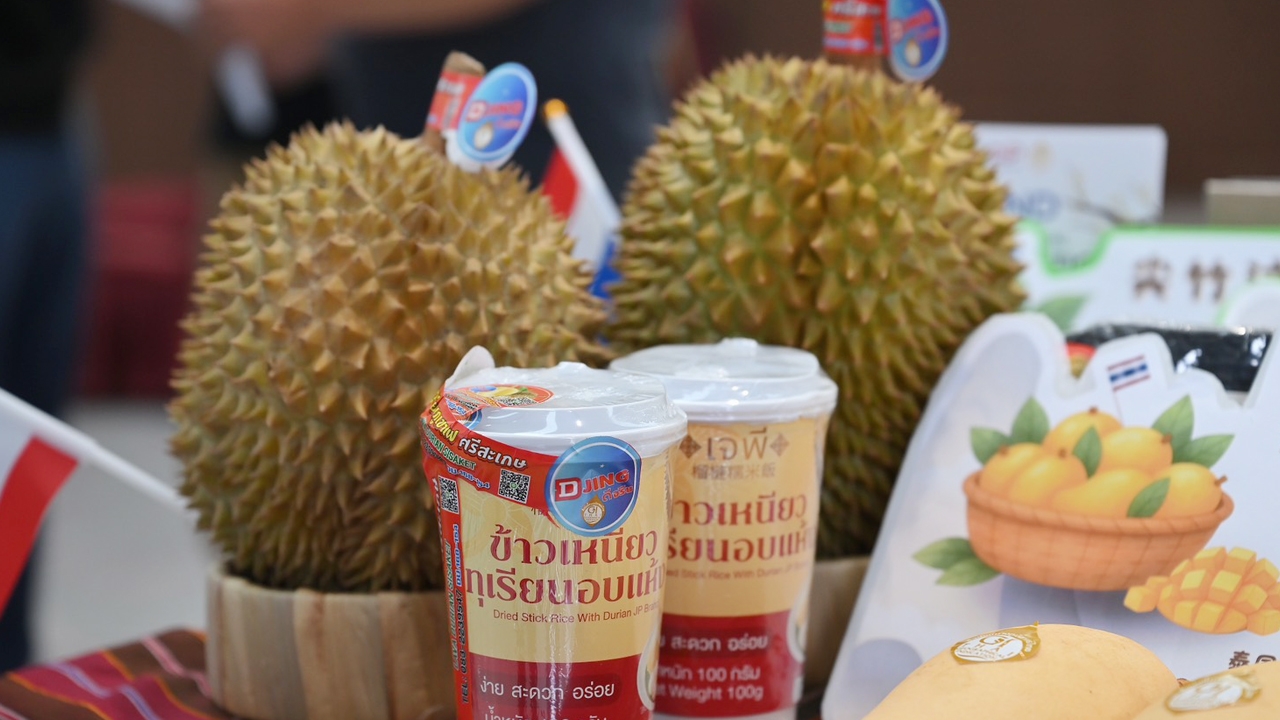
On 9 June 2026, the Department of Intellectual Property under the Ministry of Commerce continued expanding trade opportunities and promoting Thailand's Geographical Indication (GI) products to international markets. It brought Thai GI entrepreneurs to Shanghai, People's Republic of China, to participate in business matching activities with fruit importers at the Huijian wholesale fruit market, creating opportunities to expand Thai GI products to Chinese consumers. An immediate deal was closed for 500 tons of Sisaket volcanic durian, with plans to further develop future trade cooperation. In addition, talks were held with Huawei Technologies Co., Ltd., a global leading company, on applying digital technology and artificial intelligence (AI) to elevate intellectual property management and enhance Thailand's competitiveness.

Mrs. Oramon Sapthaweetham, Director-General of the Department of Intellectual Property, revealed that the department aims to leverage the potential of GI products into trade and export opportunities to add value to agricultural and local products, thereby increasing incomes for farmers and entrepreneurs. This aligns with the Ministry of Commerce's policy to enhance the competitiveness of Thai products and promote agricultural goods with distinctive identity and quality to reach premium consumer markets, especially China, which is a large and highly potential market for quality agricultural and food products from Thailand.
Currently, Thailand has registered over 260 GI products, generating an economic value exceeding 116.253 billion baht. Among these, 118 items, or about 45% of all Thai GI products, are fruits, demonstrating the potential of GI products to add value, raise incomes of local communities and entrepreneurs. At the same time, Thailand places importance on protecting its GI products abroad to build consumer trust, increase product value, and expand trade opportunities for Thai businesses. Presently, 11 Thai GI products are protected in 33 countries, and three Thai GI items are under consideration by the China National Intellectual Property Administration (CNIPA): Thung Kula Rong Hai jasmine rice (Roi Et, Yasothon, Surin, Maha Sarakham, and Sisaket), Pak Phanang Ruby Pomelo (Nakhon Si Thammarat), and Sweet Tamarind from Phetchabun.

Mrs. Oramon said Thai fruits have consistently been popular in the Chinese market, especially durian, mangosteen, aromatic coconut, and mango, which Chinese consumers recognize for their quality and taste. However, presenting products through the GI mechanism still has much room to grow because GI products are distinguished by their identity, origin, and unique local quality. This matches modern consumer behavior that values quality, safety, and traceability of product origins. Participating in the event at Huijian market is not just a product showcase but also provides Thai entrepreneurs the opportunity to meet and negotiate directly with major Chinese importers, wholesalers, and distributors, helping to understand market demand and potentially leading to future trade cooperation.

At the Huijian wholesale fruit market event, Mr. Liu Xiangjie, General Manager of Huijian market, welcomed the Department of Intellectual Property delegation and Thai GI entrepreneurs, guiding them through market management operations. The market is a key import and distribution center for fruit in East China, covering all districts of Shanghai as well as Zhejiang, Jiangsu, and Anhui provinces. It also serves as a hub for imported fruits from many countries worldwide, currently handling trade valued at over 100 billion baht annually.

The department used this opportunity to showcase the potential and identity of Thai GI products to Chinese importers, wholesalers, and market operators to raise awareness and expand trade opportunities for Thai GI products. Six GI products from six provinces were presented: 1) Sisaket volcanic durian; 2) Pak Phanang Ruby Pomelo (Nakhon Si Thammarat)
3) Ratchaburi aromatic coconut; 4) Bang Khla golden flower mango (Chachoengsao); 5) Chanthaburi durian; and 6) Phitsanulok golden flower mango. These products were exhibited and negotiated with over 16 Chinese importers. This event yielded immediate trade results, with Sisaket volcanic durian entrepreneurs signing a memorandum of understanding (MOU) with Huijian market for the advance purchase of 500 tons of durian. Additionally, Thai GI product entrepreneurs exchanged information with Chinese partners about market demand, import standards, and trends for high-quality fruit consumption. This will support product development, expand distribution channels, and build business networks to support long-term exports. Huijian market executives are scheduled to visit Thailand in early July 2026 to tour production sites of Sisaket volcanic durian and Pak Phanang Ruby Pomelo (Nakhon Si Thammarat), reflecting Chinese business interest in Thai GI products and offering significant opportunities to deepen trade cooperation.

After the Thai GI product business matching with Chinese importers, the Director-General of the Department of Intellectual Property and delegation visited Huawei Technologies Co., Ltd., one of the world's leading technology companies, to discuss and exchange knowledge on applying AI, cloud systems, and digital innovation in intellectual property management. Discussions covered ways to use technology to support government services, big data analysis, and digital system development to improve operational efficiency and public service. They also explored cooperation in applying AI technology to support Thailand's intellectual property tasks, especially in examining trademark and patent applications and providing information and consultation services to the public in the future.
During the discussions, the department also learned about Huawei's intellectual property management approach and its research and development (R&D) drive, as a company that continuously invests in innovation. Huawei employs over 114,000 R&D personnel out of more than 213,000 total employees and invests

over 192.3 billion yuan in R&D, accounting for 21.8% of its total revenue. The company holds more than 165,000 patents worldwide. Additionally, in 2024, Huawei filed the highest number of international patent applications under the Patent Cooperation Treaty (PCT), totaling 6,600 applications. This demonstrates the role of intellectual property in driving innovation and business growth, offering valuable insights for developing Thailand's innovation and intellectual property ecosystem.
Mrs. Oramon concluded that this discussion was an important opportunity to learn from a leading global technology company's successful intellectual property management and innovation driven by research and IP. This will benefit the enhancement of Thailand's intellectual property system and strengthen the country's long-term competitiveness.
Read more news " State Policy "