

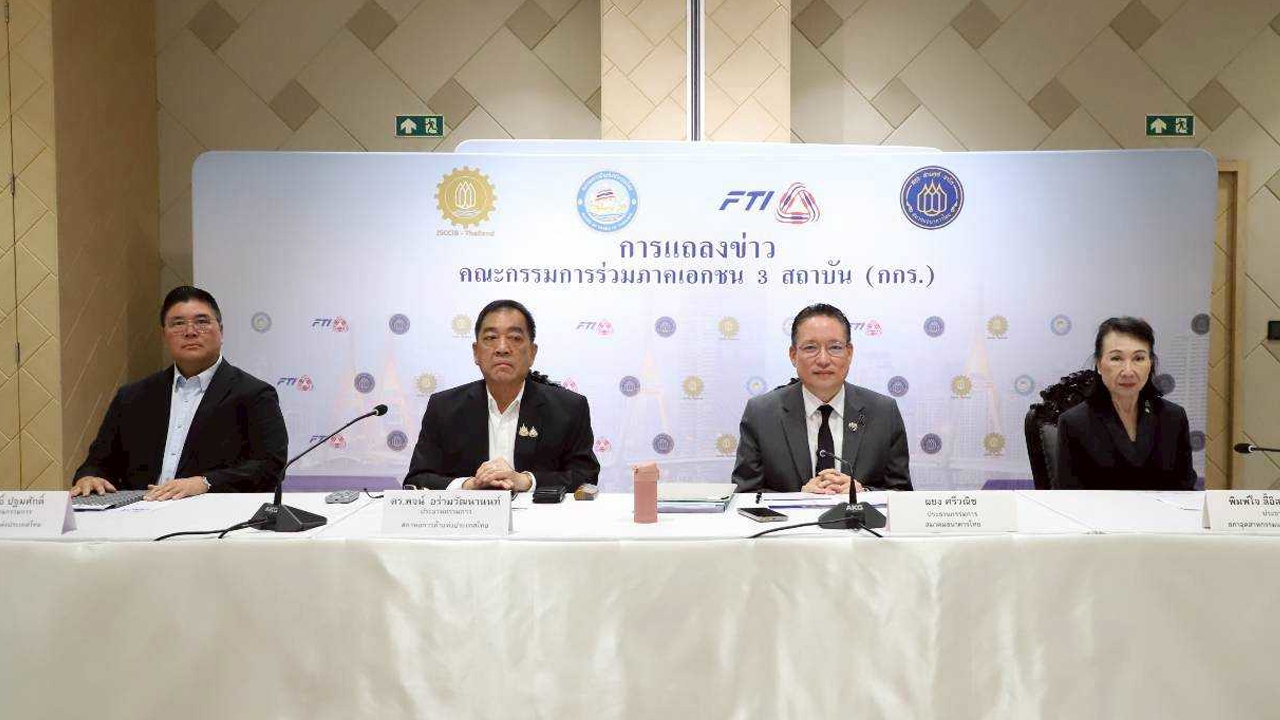
The Joint Private Sector Committee (JPC) announced it has raised Thailand's GDP growth target for this year to 1.6-2.0%, highlighting the support from the "Thai Chuey Thai Plus" program, while also expressing concern over a K-shaped economy and the global energy crisis in the second half of the year. "K-shaped" refers to uneven economic recovery where some sectors grow while others decline.

Mr. Payong Srivanich, Chairman of the Thai Bankers' Association and chair of the JPC meeting, revealed that Thailand's economy this year benefits from the "Thai Chuey Thai Plus" project, injecting about 170 billion baht to stimulate domestic spending. As a result, the JPC revised the economic growth forecast upward to 1.6-2.0% from the previous 1.2-1.6%. Inflation is forecast at 2.5-3.0%, up from 2.0-3.0%, and exports are expected to grow by 8-10%, versus a prior outlook of no growth, driven by strong technology product exports. However, the JPC remains concerned about the K-shaped economic situation because the growth in technology exports has not yet broadly benefited the Thai economy due to reliance on imported raw materials. Therefore, economic restructuring is urgently needed to turn the upper leg of the "K" into a key driver that adds value, channeling foreign direct investment (FDI) into Thailand’s real economy to create jobs and benefit Thai businesses more.

The JPC meeting discussed Thailand's energy situation amid ongoing uncertainty from conflicts in the Middle East, where peace negotiations remain inconclusive. They confirmed there are no signs of energy shortages. Meanwhile, oil refinery industries have been actively managing supply risks by reducing dependence on Middle Eastern crude oil from about 55% to approximately 27%, while increasing procurement from other sources to about 73%. This diversification aims to enhance energy flexibility and security, mitigate geopolitical volatility, and support the country's supply chains and manufacturing sectors to operate continuously.

Additionally, the JPC expects the Power Development Plan (PDP2026) to be announced by August, providing a critical framework for Thailand’s long-term energy structure. This plan will address energy security, promote biofuels to reduce import reliance, manage electricity costs at appropriate levels, and increase the share of renewable and clean energy. These measures will enhance the competitiveness of Thailand's industrial sector in the future.
When asked about purchasing power trends after the "Thai Chuey Thai Plus" program ends, Mr. Payong admitted there is no official assessment yet but believes purchasing power is likely to weaken due to rising costs and declining incomes among businesses.
Mr. Kasemsit Pathomsak, Vice Chairman of the Thai Chamber of Commerce, added that the second half of the year will remain volatile due to energy factors, inflation, interest rates, and exchange rates—issues affecting the global economy, not just Thailand. He noted the tourism sector may slow down amid a weak global economy as many countries face economic difficulties and rising living costs, leading to more cautious tourism spending. He emphasized that businesses must adapt quickly, and the government should foster an investment-friendly environment by easing regulations and leveraging global economic shifts to attract investment into the country.

Regarding further economic stimulus measures, the private sector acknowledged the government's efforts in opening new markets, promoting target industries, and pushing the "Green Made in Thailand" concept, alongside reforming regulatory obstacles to investment. They plan to propose revisions to seven key ministerial rules and regulations to the government to accelerate more efficient economic progress.
When asked about the Thailand AI Passport project and whether it should be reviewed or continued, Mrs. Pimjai Lee Issaranukul, Chairwoman of the Federation of Thai Industries (FTI), stated it is an important tool enabling SMEs to access artificial intelligence technology at reasonable costs, enhancing the long-term competitiveness of Thai businesses. However, clarity on the project's details is still awaited.

Regarding international conflicts, the private sector views the situation as unresolved, with rising energy prices expected to gradually impact the real economy over the long term. Therefore, collaboration between public and private sectors is necessary to drive inclusive economic benefits covering entrepreneurs, laborers, and supply chains, enabling Thailand to adapt to changes and create sustainable new economic opportunities.