

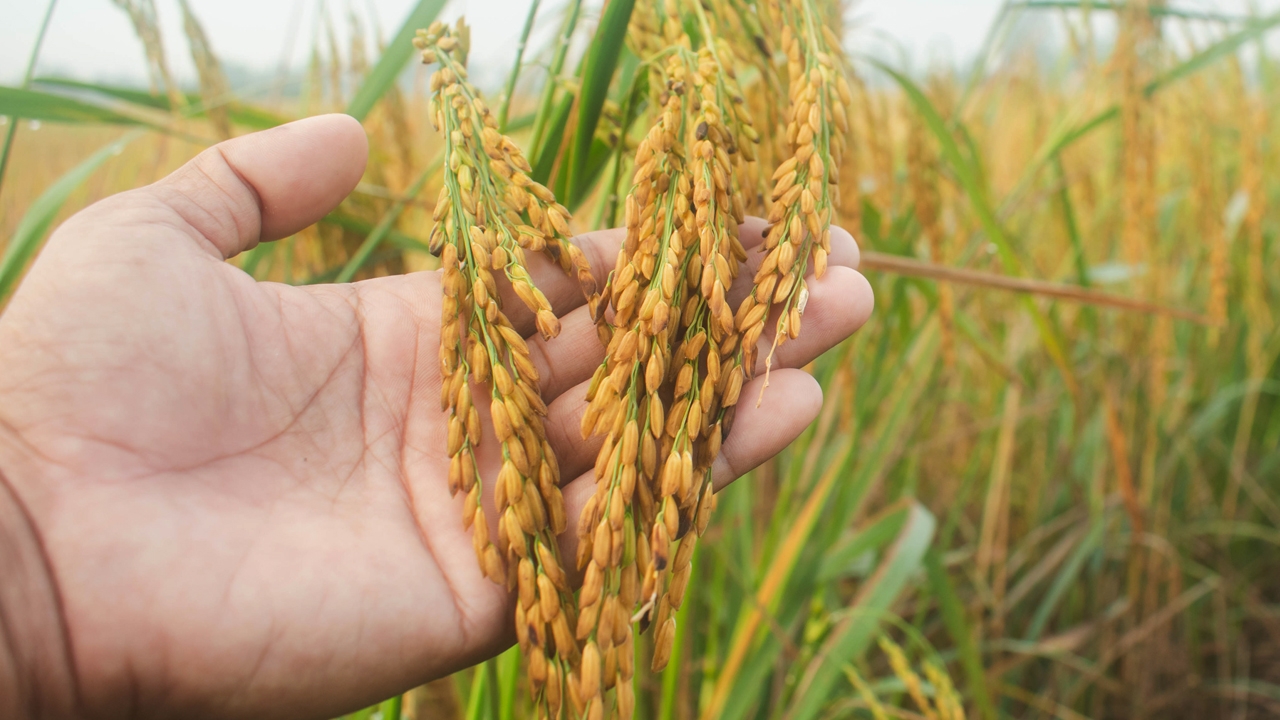
Farmers rejoice! "Suriya" assigned "Srawut" to attend the National Rice Policy and Management Committee meeting, which approved additional aid for 230,000 households at 1,000 baht per rai, boosting the budget by 1,846.96 million baht. Tags: [farmers, rice policy, financial aid, budget increase, agriculture]
Mr. Suriya Juangroongruangkit, Minister of Agriculture and Cooperatives, revealed that he assigned Mr. Srawut Nueangjamnong, Secretary to the Minister of Agriculture and Cooperatives, to attend the first meeting of the National Rice Policy and Management Committee (NRPMC) for 2026. The meeting was chaired by Mrs. Supachai Suthumpun, Deputy Prime Minister and Minister of Commerce, with Mr. Winaroj Supsomsuk, Permanent Secretary of the Ministry of Agriculture and Cooperatives, and relevant agencies under the ministry attending at the Phakdi Bodin Conference Room, Government House.

Mr. Suriya disclosed that the meeting approved the proposal from the Ministry of Agriculture and Cooperatives to extend the funding framework for the project to assist farmers growing wet-season rice and promote cultivation suitable to land potential for the 2025/26 production year. This extension aims to support farmer groups who have not yet received assistance.Rightscovering 233,729 households under the assistance measure of 1,000 baht per rai, capped at 10 rai per household or a maximum of 10,000 baht per household, with an additional budget of 1,846.96 million baht. This raises the total project budget from 37,906.20 million baht to 39,753.16 million baht, aiming to alleviate production costs and continuously support farmers' income. The meeting assigned the Rice Department, as the NRPMC secretariat, to propose the matter to the Ministry of Finance for consideration before submission to the Cabinet for approval in due course.
Regarding the original budget of 36,772.52 million baht, funds have already been transferred to 4.45 million households totaling 36,378.74 million baht, with an additional 59,794 households pending transfer. The remaining budget is 393.78 million baht.

Mr. Suriya added that the Ministry of Agriculture and Cooperatives will carefully implement the project as emphasized by the meeting chair, urging a thorough verification of data for both the groups that have already received aid and those under consideration, to confirm they are actual rice growers with genuine cultivation. Additionally, reports on increases in household numbers, cultivated areas, and rice production will be provided. The ministry will integrate data with related agencies such as the Department of Provincial Administration, the Department of Lands, and utilize aerial imagery to ensure that additional budget approval is well-supported, verifiable, and systematically managed.
Besides direct assistance measures, the meeting also approved rice paddy price stabilization measures for the 2026/27 production year and long-term structural improvement initiatives under the New Rice Economy concept, consisting of five projects targeting a total of 11.5 million tons of rice paddy with a budget of 10,192.58 million baht. These include: 1) a loan program to delay sales of wet-season rice paddy targeting 3 million tons, supporting storage fees at 1,500 baht per ton; 2) a loan program to support farmer institutions in collecting and adding value to rice, targeting 1.5 million tons; 3) an interest compensation scheme of 3% per year for rice traders stocking rice, targeting 4 million tons, to encourage stockpiling during harvest periods; 4) a rice paddy absorption project for 2026/27 targeting 3 million tons; and 5) a promotion and development project for premium rice to increase farmers' income in 2027, Phase 2, targeting 266 groups not previously selected, supporting production and processing capacity with 300,000 baht per group, along with marketing knowledge training and coaching to enhance premium rice value and meet market demand better.

Furthermore, the Ministry of Agriculture and Cooperatives, via the Office of Agricultural Economics, proposed the implementation of a wet-season rice insurance scheme for 2026 as a key measure to help farmers manage risks. However, the meeting assigned a careful study and detailed preparation, especially regarding coverage limits and premium rates, to ensure suitability, cost-effectiveness, and no overlap with other government aid before reconsideration. This aims to ensure the insurance program effectively assists farmers and optimizes budget use.
The meeting also acknowledged progress on projects under the “Thai Rice to Future Economy” framework, or New Rice Economy, including absorption of wet-season rice paddy for the 2025/26 production year, shifting dry-season rice cultivation to alternative income crops, support for high-quality rice cultivation to add value, and development of rice seeds aligned with market demand.
Regarding the plan to shift dry-season rice cultivation to alternative crops, the Ministry of Agriculture and Cooperatives, through the Rice Department, proposed a project to convert rice-growing areas to other economic crops such as oil palm, corn, and bananas, targeting 500,000 rai. The NRPMC Production Subcommittee approved the principle but requested a reassessment of area suitability and market support to reduce permanent rice planting areas.

Meanwhile, on the progress of developing rice seeds aligned with market needs, the Rice Department has prepared quality rice seed supplies for the 2026/27 production year, estimating nationwide demand at 1.411 million tons based on about 60 million rai of wet-season rice and 10 million rai of dry-season rice. The total quality seed sources amount to 730,000 tons, including 100,000 tons from the Rice Department, 200,000 tons from community rice centers, 400,000 tons from seed producers associations and private sector, and 30,000 tons from agricultural cooperatives. Farmers are also encouraged to save seeds for personal use or exchange seeds among themselves, adding another 780,000 tons.
The Rice Department continues research and development of new rice varieties that meet market demand, focusing on high yield, short maturity, good quality, and consumer preferences. This includes conventional breeding, biotechnology, radiation-induced mutation, and modern gene-editing technology to enhance quality and production potential. For 2026, new varieties under certification include Khao Kor 121 (hard rice), Khao Kor 123 (soft rice), Khao Kor 28 (glutinous rice), and Khao Kor Bo 1 (barley).
/read news " Government policy " more