

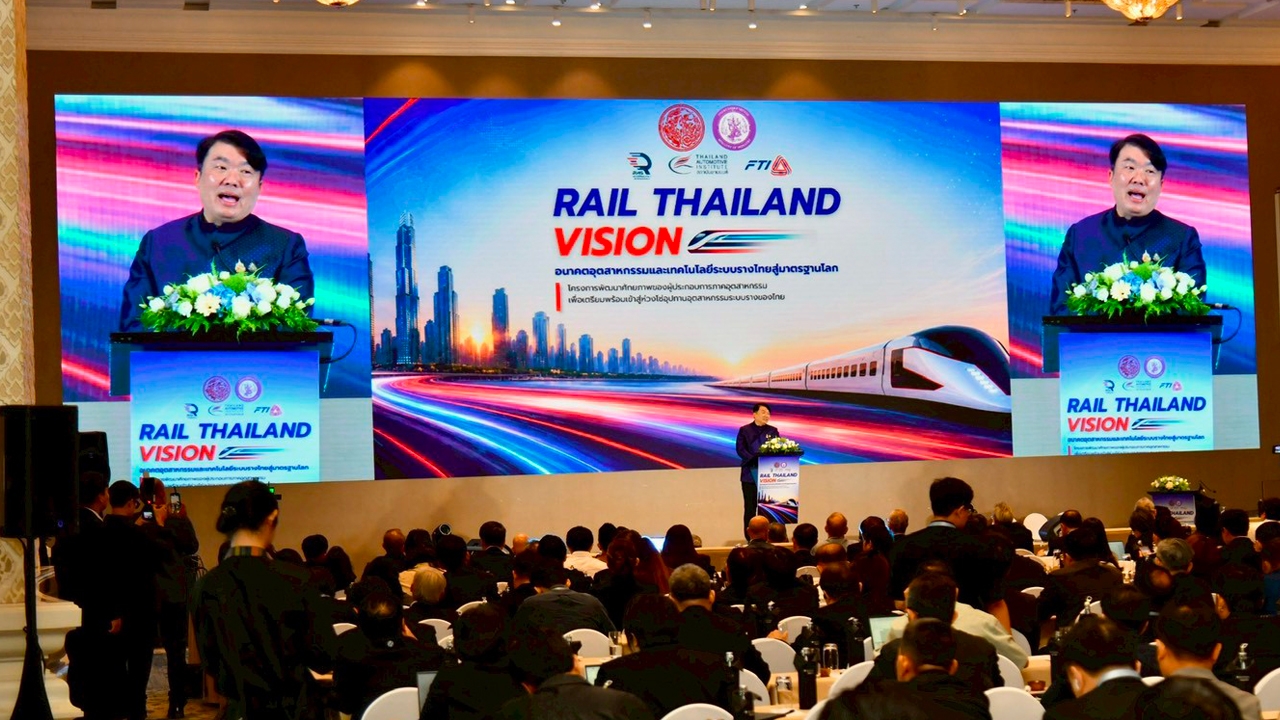
Siripong revealed that Thailand is advancing the upgrade of its rail industry from being a technology user to a manufacturer, starting by promoting 20% Local Content in 2031, with a goal to increase to 50% within five years. He also emphasized opening opportunities for private companies to join the supply chain, supporting the future expansion of double-track and high-speed rail projects.
Deputy Transport Minister Siripong Angkasukolkit said after the Rail Systems Research and Development Institute (Public Organization) (RSRDI) and the Automotive Institute jointly held a workshop titled “RAIL THAILAND VISION: The Future of Thai Rail Industry and Technology to Global Standards” under a project to enhance industrial operators' capabilities to prepare them for Thailand’s rail industry supply chain, that the Ministry of Transport’s policy is to increase private sector participation in rail service operation and management. The next phase involves transitioning Thailand’s rail industry from merely a technology recipient and importer of foreign equipment to becoming a self-sufficient manufacturer of parts, equipment, and rail vehicles.
The reason for accelerating the production and use of domestically made equipment is due to Thailand’s growing rail system, including double-track and high-speed rail projects, which open opportunities for private sector participation in train operation and services.

Therefore, the initial development of Local Content will focus on parts and equipment that Thai operators already have capabilities to produce, such as train car bodies, structures, seats, and related components, similar to the bus and automotive manufacturing industries. Existing knowledge and production capacity can be immediately applied. Subsequently, production will expand to more complex parts, assessing which components can be made domestically to reduce import dependence and increase economic value within the country. This represents a key technological transition for Thailand’s rail industry.
Siripong added that the government policy is to continuously increase the use of locally made parts and materials, starting from a baseline to 30%, then 50%, 70%, and in the long term aiming for 100% Local Content, so Thailand can fully produce and develop comprehensive rail technology.
However, according to studies by foreign consultants, Thailand’s rail industry has the potential to start using about 20% Local Content immediately. Currently, plans and roadmaps are being developed, with implementation expected to begin in 2031. The target is to raise Local Content from 20% to 50% within five years.
." Government Policy " Additional