

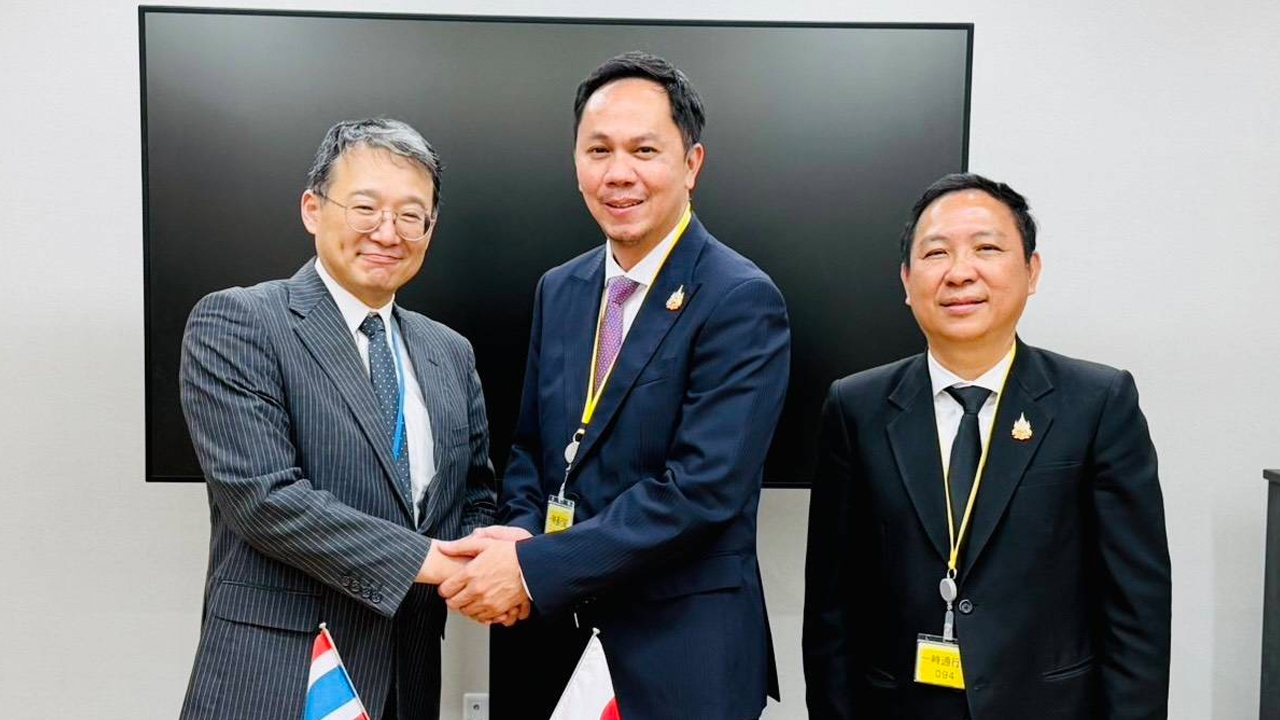
A delegation from Thailand's Ministry of Agriculture and Cooperatives met with Japan's Ministry of Agriculture, Forestry and Fisheries (MAFF) to follow up on progress in opening markets for livestock products and cooperation in animal disease prevention. Japan agreed in principle to Thailand's avian influenza disease-free zoning system and is considering expanding imports of cooked pork and beef, as well as new poultry by-product items.

Mr. Sarawut Nueangjamnong, Secretary to the Minister of Agriculture and Cooperatives, revealed that Mr. Suriya Jungrungreangkit, Minister of Agriculture and Cooperatives, assigned him along with Dr. Somchuan Rattanamangkalanon, Director-General of the Department of Livestock Development, and the delegation to visit Tokyo, Japan, to discuss livestock trade cooperation with representatives from Japan's Ministry of Agriculture, Forestry and Fisheries, led by Dr. Kazutoshi Matsuo, Chief Veterinary Officer (CVO).
Mr. Sarawut stated that Japan is an important market for Thai livestock products, especially poultry meat and products, which are trusted by Japanese consumers for quality and food safety standards. In 2025, Thailand exported poultry meat and products to Japan valued at 67.483 billion baht, while pet food exports were worth 14.352 billion baht. Exports of processed meat products and fresh eggs continue steadily, reflecting a food security partnership between the two countries.

Mr. Sarawut added that this discussion signals positive cooperation in livestock trade between Thailand and Japan. The Japanese side gave favorable responses to many Thai proposals, including accelerating approval of the avian influenza disease-free zoning system, reviewing expansion of livestock product imports, and accepting proposals for new export products in which Thailand has potential. This will enhance trade opportunities for Thai farmers and businesses in the future.
Dr. Somchuan said the most important topic of this discussion was pushing Japan to approve Thailand's avian influenza control zoning or AI Zoning/Regionalization measures. This would allow Thailand to continue exporting poultry meat and products from certified disease-free areas even if outbreaks occur elsewhere. MAFF representatives agreed in principle and will expedite certification consideration, ensuring continuous supply and strengthening Japan's food security.
Additionally, Thailand proposed expanding the export scope of cooked cloven-hoofed meats, including pork and beef, to cover bone-in products such as ribs and legs, as well as offal like intestines. Currently, Japan classifies these as high-risk items. MAFF welcomed Thailand's data for risk assessment, and if approved, Thailand will be able to export these product groups to Japan in the future.

To promote chilled pork market access, Thailand presented a compartmentalization system for disease-free pig areas developed according to World Organisation for Animal Health (WOAH) guidelines. The Japanese side praised the Department of Livestock Development's progress in establishing disease prevention and control systems but requested further study and technical information before proceeding to the next step.
Meanwhile, Thailand also discussed market opening and export conditions for poultry by-products, including poultry by-products meal and feather meal. Japan expressed interest in using these as raw materials for animal feed and is ready for further technical discussions.
The Director-General of the Department of Livestock Development stated that the department is ready to support Thai farmers and businesses in improving production and export standards to increase trade opportunities abroad and promote Thai livestock products certified to compete more effectively in the global market.
Read the news " Government Policy " for more