

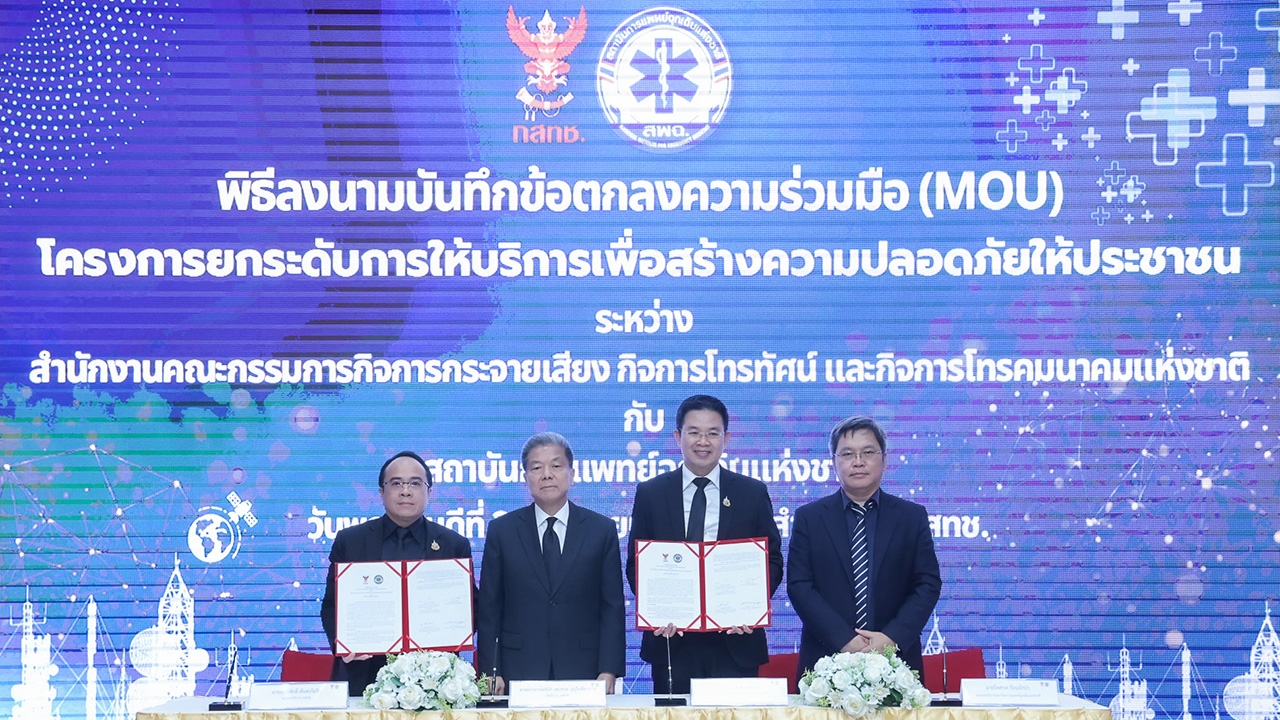
The National Broadcasting and Telecommunications Commission (NBTC) has joined forces with the National Institute of Emergency Medicine (NIEM) to invest 250 million baht in upgrading the emergency medical system by developing and installing more than 700 smart emergency alert systems equipped with AEDs nationwide, aiming to improve survival chances and reduce healthcare disparities.
Clinical Professor Dr. Soran Boonbaichayapruk, Chairman of the National Broadcasting and Telecommunications Commission (NBTC), said one of the NBTC's main missions in overseeing broadcasting and telecommunications is supporting basic telecommunication services and social services. This includes providing healthcare services in remote areas by utilizing information technology and internet networks as a medium to assist medical care, enabling people to access treatment faster and increase their chances of survival.

The NBTC Chairman stated that the NBTC office has held discussions with the National Institute of Emergency Medicine (NIEM) and signed a memorandum of understanding (MOU) under a project to upgrade services to ensure public safety. This links telecommunications infrastructure with the emergency medical system. The NBTC board approved this project, allocating 250 million baht from the Broadcasting and Telecommunications Research and Development Fund for the public benefit to develop and install a Smart Emergency Alert System, life-saving equipment, and emergency medical technology devices.
When an emergency occurs and the SOS button at an installation point is pressed, the system sends real-time video and audio signals via the internet to the National Digital Emergency Medical Service (NDEMS) of NIEM and the provincial command center (1669). Upon receiving the call and viewing the live footage and location, staff provide guidance on performing CPR and using the Automated External Defibrillator (AED) before dispatching an emergency ambulance to the scene. This reduces deaths from cardiac arrest. At least 700 safety points will be installed nationwide, focusing on remote and border areas.


"This issue has been close to my heart since I became NBTC Chairman: setting telecommunications infrastructure policies that use information technology to develop basic medical systems. Using telecommunications increases the chances of survival because people can access basic healthcare more easily. As a cardiologist, I know emergency medicine is critical. Aside from accidents, heart-related emergencies are the leading cause of death. Statistics show that without AED use, survival is only 5%, but with AED-assisted CPR, survival rises to about 25-28%. Therefore, we must ensure AEDs reach the scene quickly and are used properly. The faster the life-saving intervention, the better, because a heart stopped for five minutes means death," said Clinical Professor Dr. Soran.


Data from NIEM reports that currently about 84,000 Thais die annually outside hospitals due to delayed access to emergency medical services. Medical data indicates that a one-minute delay in reporting and assistance reduces survival rates by 10%. Additionally, over 46% of subdistricts lack sufficient rescue coverage. This collaboration integrates government agencies to utilize telecommunications infrastructure and digital technology for maximum public benefit, especially supporting emergency medical missions directly related to citizens' lives across all areas, increasing survival rates and reducing healthcare disparities between urban and remote regions.
, Government Policy ." Additional