

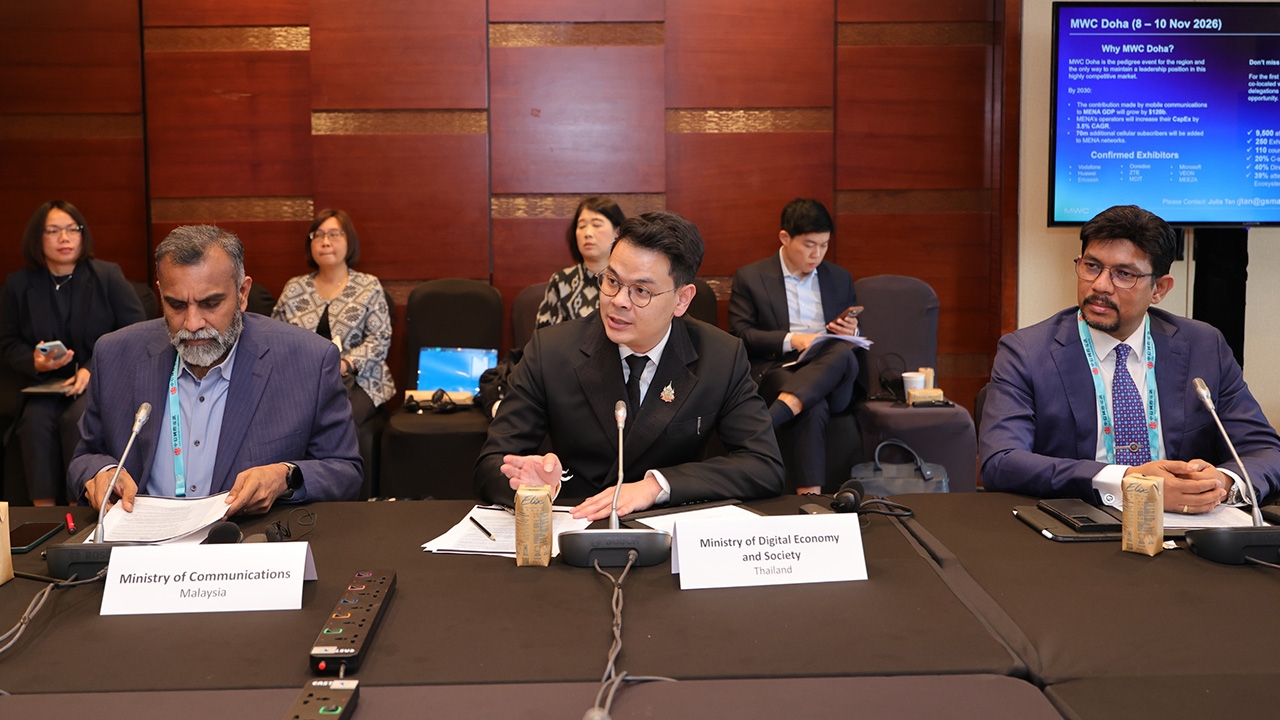
"Chaiyachonok" The Minister of Digital Economy and Society presents his vision to combat scammers on the stage MWC Shanghai 2026 Highlights the model "Shared Responsibility" Along with showcasing AOC 1441’s achievement of freezing mule accounts within 15 minutes
Mr. Chaiyachonok Chidchob, Minister of Digital Economy and Society, revealed during his participation at the GSMA Roundtable under the Mobile World Congress (MWC) Shanghai 2026 in Shanghai, People's Republic of China, that a key challenge in addressing online threats today, beyond the technological advances scammers use in their crimes, is the coordination gaps among relevant agencies.
For Thailand, efforts have been accelerated to build cooperation mechanisms among the government sector, financial institutions, telecommunications providers, digital platform operators, the Royal Thai Police, and related public and private agencies to respond to incidents more quickly and effectively.

Within the Ministry of Digital Economy and Society, a key mechanism is the Online Crime Resolution Operation Center or AOC 1441, which serves as a 24-hour coordination hub. It has reduced the time needed to freeze fraudulent accounts from about one hour to an average of just 15 minutes, increasing the chance to intercept damages and promptly trace financial flows.

In addition to developing operational mechanisms, Thailand has amended laws to support the lawful exchange of information related to financial crime prevention. It also promotes the principle of "Shared Responsibility," assigning financial institutions, telecommunications providers, and digital platforms a joint role in preventing and being accountable if they neglect necessary measures.
This principle is not intended to increase burdens or penalties on businesses but to motivate integration among all sectors working toward the common goal of protecting citizens from online threats and reducing the shifting of responsibility between agencies.
Another key issue is balancing online crime prevention with personal data protection by adhering to principles of data use under clear legal frameworks, limiting data use to what is necessary, and having independent oversight agencies to build public trust in the digital system.

Meanwhile, Thailand continues to promote Digital Literacy, considered essential infrastructure alongside internet networks and telecommunications systems. The aim is to integrate digital knowledge into education systems, workplaces, and elder care, particularly for the elderly who are vulnerable to online scams.
However, online crime is a global challenge that no single country can solve alone. Thailand is ready to share experiences and exchange best practices with other nations to enhance regional cooperation in creating a secure, safe, and trustworthy digital ecosystem for the public.

“Since scammers can share deceptive methods without borders, countries must collaborate more to share strategies to protect their citizens. Trust in the digital world is a vital foundation for developing a safe and sustainable economic and social future,” said the Minister of Digital Economy and Society.