

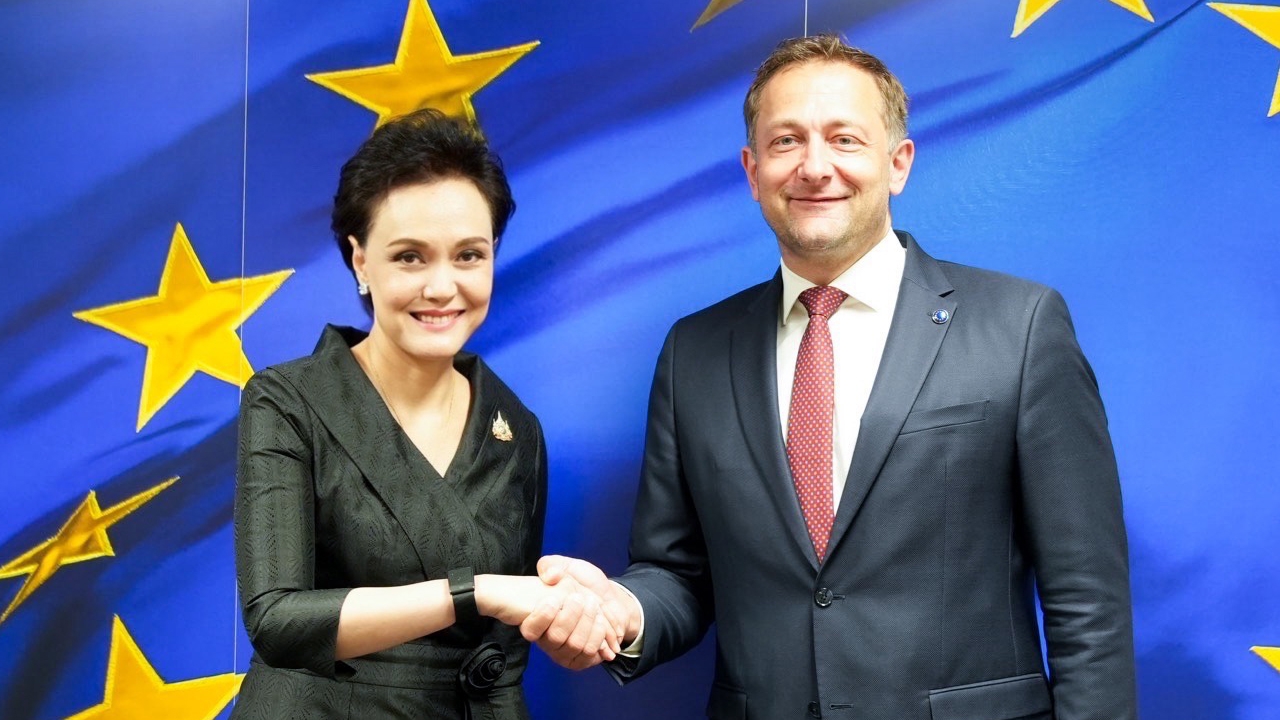
Supachai leads the Thailand team in negotiations with the EU to swiftly close the Thai-EU FTA deal, promoting trade, investment, and Thai agricultural products to build a strategic partnership in response to global economic volatility.
On 24 June 2026 local time in Brussels, Kingdom of Belgium, Supachai Sutthammanit, Deputy Prime Minister and Minister of Commerce, accompanied by Veerapong Prapa, Thailand's Trade Representative, Wuttikrai Leewirapan, Permanent Secretary of Commerce, and Chotima Iamsawatikul, Director-General of the Department of International Trade Negotiations, visited Brussels to meet with senior European Union officials in trade and agriculture alongside the Thailand team. They met H.E. Mr. Maroš Šefčovič, European Commissioner for Trade and Economic Security, Institutional Relations and Transparency, and Mr. Christophe Hansen, EU Commissioner for Agriculture and Food, to accelerate progress on the Thai-EU Free Trade Agreement (FTA) negotiations and establish a long-term economic partnership between Thailand and the EU.

Supachai stated that the Thai-EU FTA negotiation is a key government policy to expand trade and investment opportunities and enhance national competitiveness amid global economic and trade volatility. Both sides agreed on the importance of closer economic and trade partnership to strengthen supply chain resilience, diversify trade risks, and jointly secure economic stability.
In discussions with the EU Trade Commissioner, both parties exchanged views on key Thai-EU FTA negotiation issues, including market access for goods, services and investment, government procurement, Sanitary and Phytosanitary Measures (SPS), and intellectual property. They emphasized leveraging both parties’ strengths while considering readiness, differing situations, and sensitive issues carefully to balance economic benefits with public interests. Both sides agreed to accelerate negotiations on ready topics to finalize more results in the ninth round and proceed to discuss final critical issues. They will closely monitor progress between negotiating teams and prepare for further talks before the next round.
Meanwhile, in talks with the EU Commissioner for Agriculture and Food, both parties agreed that agricultural issues and SPS measures are crucial for advancing the Thai-EU FTA negotiations. The EU stressed the importance of agricultural and livestock products and SPS measures, while Thailand emphasized that agriculture is a sensitive and vital sector for both sides, urging a balanced approach to mutually beneficial outcomes that consider concerns from both Thailand and the EU.

The two sides also exchanged views on opening agricultural markets, a key negotiation topic. Thailand highlighted agricultural and food products with export potential, while the EU expressed interest in expanding trade opportunities for European agricultural and food products. Both agreed that opening agricultural markets requires close discussions due to many sensitive items affecting farmers’ interests on both sides.
Supachai added that Thailand is committed to expediting the Thai-EU FTA negotiations to achieve results as soon as possible, pushing to conclude ready topics and constructively addressing outstanding issues while considering the readiness of domestic sectors. This includes protecting the interests of farmers, entrepreneurs, and SMEs to ensure broad benefits from the FTA.
Currently, Thai-EU FTA negotiations related to agriculture cover seven main topics:
(1) Trade in goods
(2) Rules of origin
(3) Sanitary and Phytosanitary Measures (SPS)
(4) Technical barriers to trade
(5) Intellectual property
(6) Trade and sustainable development
(7) Sustainable food systems
So far, the two sides have concluded negotiations on four topics:
Topics still under negotiation requiring urgent resolution include:
The European Union (EU) is Thailand's fourth-largest trading partner. In 2025, total trade between Thailand and the EU reached $45.03 billion (accounting for 6.58% of Thailand’s total trade), consisting of $26.45 billion in exports and $18.58 billion in imports.
Focusing on agricultural and processed agricultural products, total trade was approximately $2.01 billion, with Thailand exporting $1.47 billion to the EU and importing $540 million from the EU, resulting in a substantial agricultural trade surplus of about $940 million. The Ministry of Commerce aims to maintain this momentum and use negotiation results on ready topics to finalize further progress in the ninth round.
Read news " State Policy " for more