

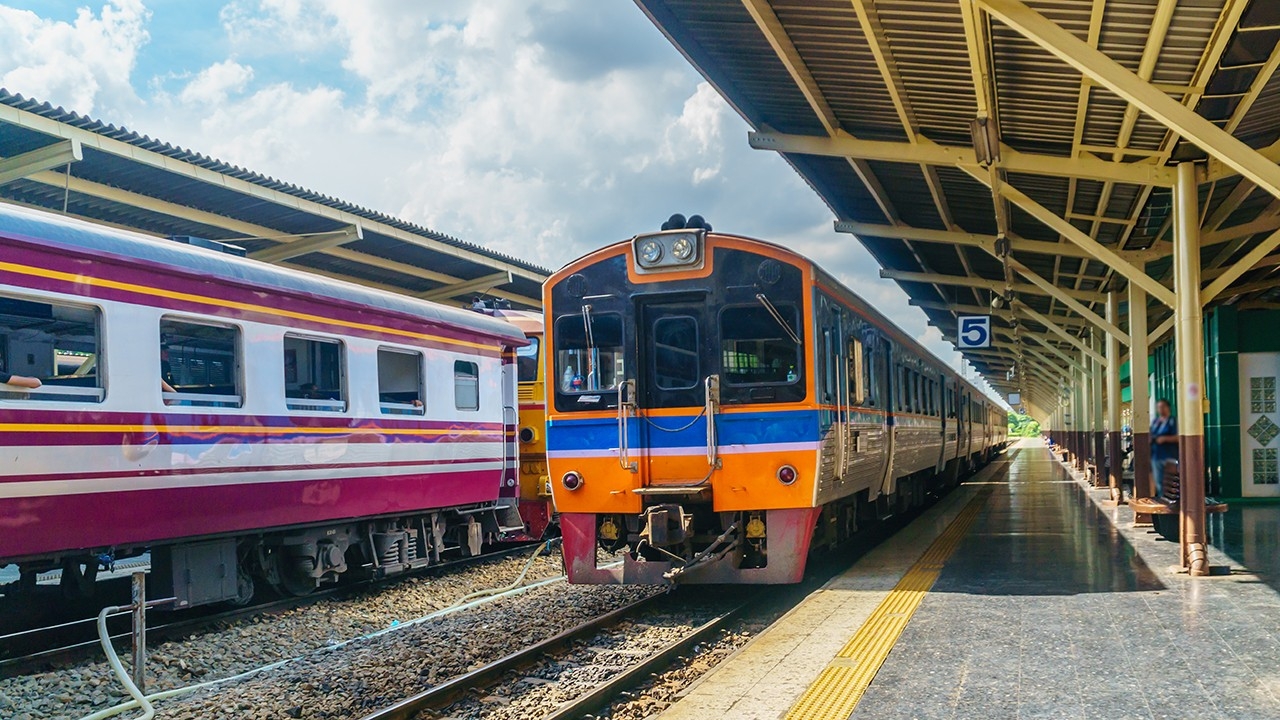
The State Railway of Thailand (SRT) has made a historic breakthrough by allowing private companies to use railway tracks for the first time, setting rental fees starting at 44 baht per car-kilometer. The goal is to reduce monopolies, increase options for the public, and stimulate Thailand's logistics economy.
Mr. Pichet Kunathumrak, Director-General of the Department of Rail Transport (DRT). He revealed that the government has invested in developing double-track railway infrastructure and new lines, bearing all construction costs. Meanwhile, the State Railway of Thailand (SRT) is responsible for investing in rolling stock, operations, and maintenance. Once the double-track projects are completed, rail capacity will more than double. However, the SRT still faces limitations in investing in rolling stock, leaving unused capacity during non-operational times.
To address these issues and maximize infrastructure utilization, the Rail Transport Act B.E. 2568 (2025), effective from 27 March 2026, allows private entities to participate in using SRT's railway tracks. This change marks a significant step in expanding rail transport options for the public and reducing resource wastage.
On 25 June 2026, the SRT, as the manager of intercity railway infrastructure, published the "2026 Track Network Document" a 598-page guide available on the SRT website, serving as a standard manual for operators interested in becoming "track users." It details conditions for access, capacity allocation criteria, and track usage fees.

Track Access Charges have been clearly defined to ensure transparency and fairness as follows:
Shared passenger trains (minimum 4 cars): 44 baht per car per kilometer.
Tourist trains: 77 baht per car per kilometer.
Freight trains: 0.2065 baht per ton-kilometer (calculated by multiplying total train weight by distance traveled).
Mr. Pichet said that after publishing the Track Network Document, the next step is for the Cabinet to appoint a committee to allocate rail operation times as mandated by law. This is the first time in Thai history that the private sector can legally use SRT's tracks. As infrastructure manager, the SRT must administer track usage based on neutrality, transparency, and non-discrimination, according to Section 68 of the Rail Transport Act B.E. 2568 (2025), to optimize infrastructure use and generate revenue for future rail system development.
. Mr. Anan Phonnimdaeng, Acting Governor of the State Railway of Thailand (SRT). He said this disclosure marks a crucial turning point to reduce monopolies and promote fair competition in the rail industry. The 598-page document serves as a standard manual detailing technical information, conditions, and rules for accessing the railway. It enables private companies or new operators interested in entering the rail transport business to study, plan investments, and prepare to become joint rail service providers in the future.
"The SRT is committed to being an efficient infrastructure manager alongside a standards-compliant train operator. Opening the door to free competition will stimulate investment in logistics and drive the national economy. Ultimately, the public will benefit from more diverse travel and freight options, modern services that fit lifestyles, and fairer fares driven by market mechanisms," Mr. Anan said.
Read more news " Government policy " More