

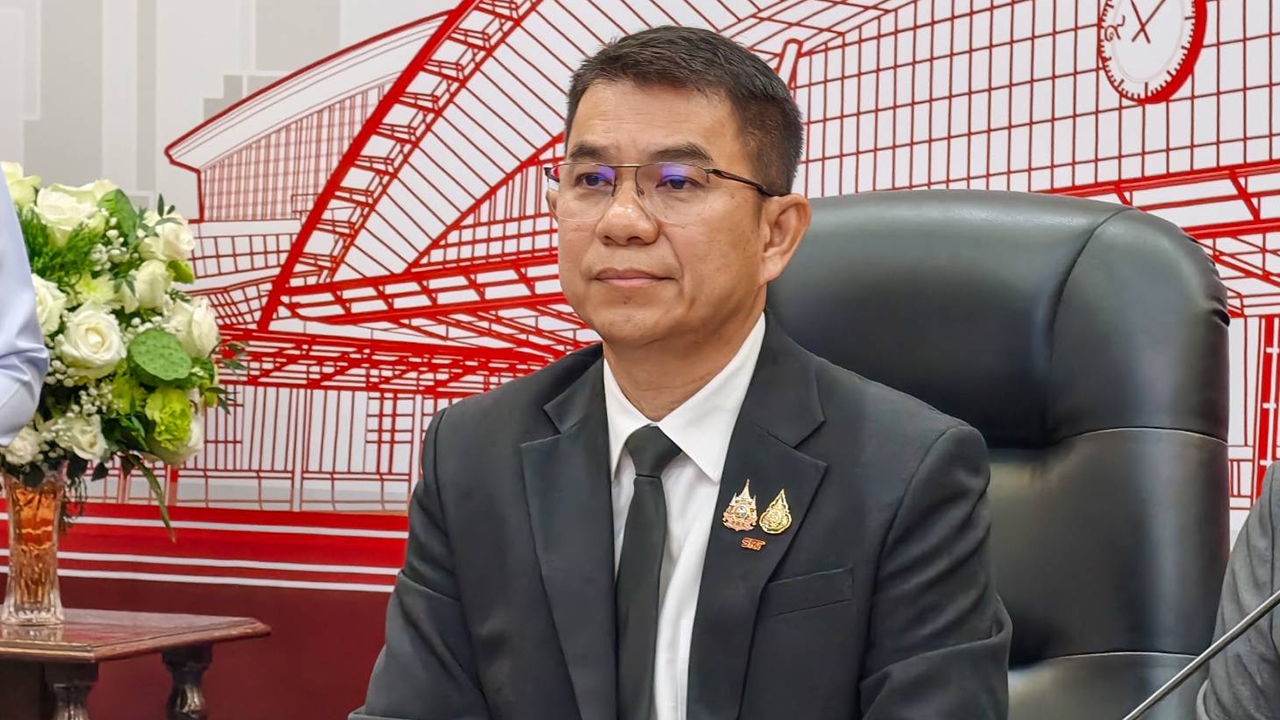
The State Railway of Thailand (SRT) signed a contract appointing Anan Phonimdaeng as its 21st governor, unveiling a four-year plan to resolve a 100 billion baht debt, accelerate the Red Line commuter rail, and present two options on the fate of the 3-airport high-speed rail project this August.
Mr. Anan Phonimdaeng, Governor of the State Railway of Thailand (SRT). After officially signing the contract as the new 21st SRT governor, he revealed that over the next four years, he will push forward construction projects to open services as planned, while focusing on increasing revenue and reducing costs. In the urgent phase (Quick Win), priority will be given to expediting ongoing construction, especially the Red Line commuter rail projects: the dark red line between Rangsit and Thammasat University Rangsit Center, and the light red line from Siriraj to Taling Chan to Salaya, plus three additional stations (Rama VI Bridge, Bang Kruai-EGAT, and Ban Chim Phli stations) scheduled to begin construction in July 2026 and open in 2029.
Simultaneously, he will advance the second phase of double-track rail projects for Cabinet consideration in 2026, covering three routes: Chumphon-Surat Thani (168 km), Surat Thani-Hat Yai-Songkhla junction (321 km), and Hat Yai junction-Padang Besar (45 km). He plans to expedite opening track access to private operators (Open Access) under the law, expecting private entities to apply by August 2026. Emphasis will be placed on safety in operations and infrastructure construction, especially along railway routes. Additionally, within four years, he aims to tackle the accumulated debt of about 300 billion baht. Currently, operating profit (EBITDA) is negative by 3-4 billion baht annually; the goal is to reduce losses by at least 500 million baht per year, totaling approximately 2 billion baht over four years.

Mr. Anan also updated on progress of the high-speed rail project connecting three airports (Don Mueang, Suvarnabhumi, U-Tapao). Following discussions among three parties—the SRT, the Office of the Eastern Economic Corridor Policy Committee (EECPC), and the private partner Asia Era One (CP Group)—two proposals have been finalized for submission to the EECPC, chaired by Prime Minister Anutin Charnvirakul. The options are contract amendment in line with the original EECPC resolution, which, if approved, will proceed to Cabinet for principle approval and move toward signing a new joint venture contract amendment.
The second option to be presented to the EECPC is contract termination. This would apply if the EECPC concludes that the contract cannot be amended per the original resolution. In this case, the SRT and private partner must review the legal aspects and joint venture contract conditions carefully to determine the grounds and each party’s obligations under the public-private partnership law. They will assess past investments and responsibilities for liabilities.
“Negotiations with the private partner revealed that they have been unable to secure funding due to financial institutions’ lack of confidence and the high-risk perception of the project. Currently, the private partner has stated that if the original contract is not amended, the project may not continue, necessitating termination of the joint venture agreement.”
. Mr. Piyapong Jiwattanakulpaisan, Director-General of the Department of Highways, in his capacity as chairman of the SRT board, said the board aims for the new governor’s four-year term to be a period of adaptation and forward momentum (Take Off) in network development, service improvement, and enhancing safety in construction and operations. An urgent matter is the approval of 2,850 new staff positions, a topic discussed for years but yet to be realized. This increase is a crucial foundation for improving SRT’s operational efficiency.
Read more news " Government Policy " Additional