

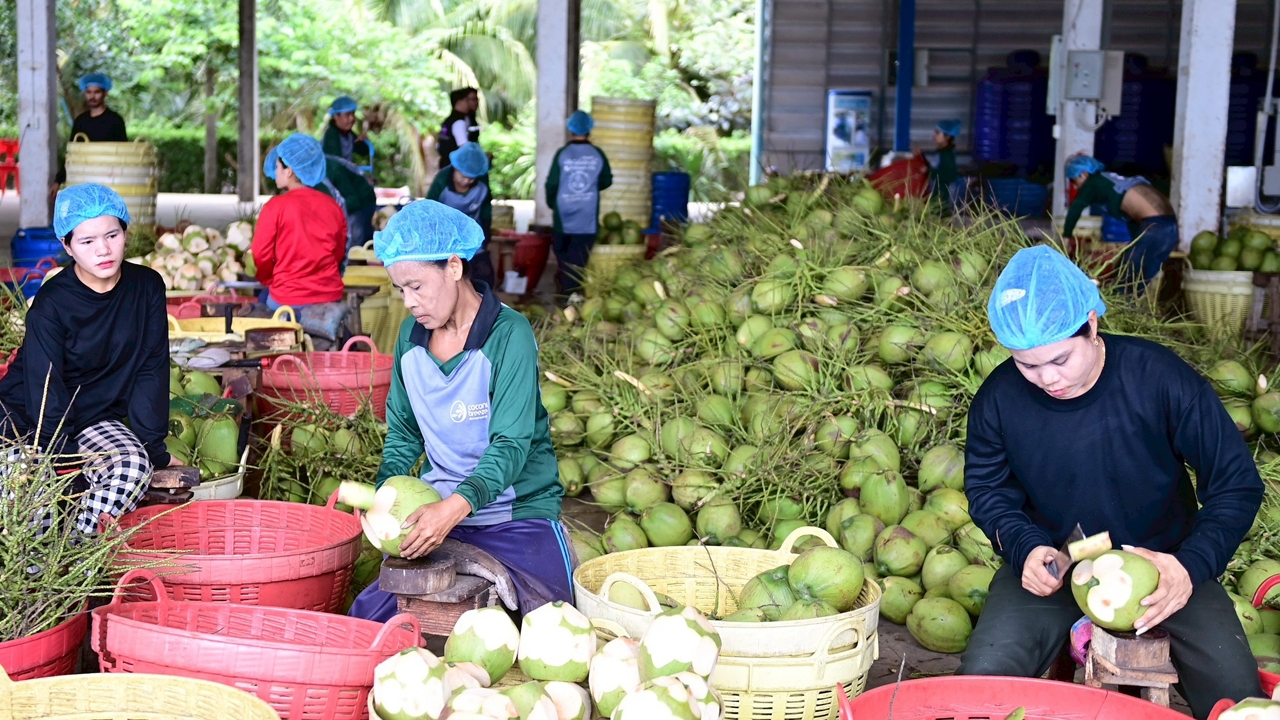
The Commerce Ministry visited Ratchaburi to monitor progress of the "Aromatic Coconut Community Hub," a model project aimed at upgrading Thailand's entire coconut supply chain. The initiative supports processing and zero waste approaches to create stable income for farmers.
Supachai Suthammanun, Deputy Prime Minister and Minister of Commerce, visited the Aromatic Coconut Community Hub at the Thai Aromatic Coconut Central Market Enterprise (Coconut Breeze Company) in Damnoen Saduak District, Ratchaburi Province. She met with aromatic coconut farmers and local entrepreneurs to promote upgrading Thailand's aromatic coconut industry throughout the supply chain, including product collection, marketing, processing, access to capital, and value addition from all coconut parts. The initiative also advances a circular economy and zero waste concept to stabilize prices and sustainably increase farmers' incomes.

Supachai said the visit aimed to track tangible and sustainable progress in resolving aromatic coconut issues. The Ministry of Commerce, together with government agencies, the private sector, and farmers, has driven the establishment of the Aromatic Coconut Community Hub as a model center to collect produce from farmers, control quality, elevate standards, sorting, processing, and link domestic and international markets. The goal is to provide farmers with a fair price sales channel and create a community-managed system for long-term sustainability.
The Deputy Prime Minister and Minister of Commerce stated the ministry prioritizes systematic solutions for aromatic coconut problems in the short, medium, and long term. Recently, farmers faced market oversupply causing low prices due to multiple factors. Urgently, the ministry assigned the Department of Internal Trade to purchase products at prices above market, coordinating with private sectors including gas stations, modern trade, and shops to buy over 10 million coconuts. However, with daily market supply around 2 million coconuts, this measure alone is insufficient, necessitating a full system structure to ensure sustainability of Thailand's aromatic coconut industry.

Supachai noted another key issue is the product collection system, with both standard-compliant and non-standard operators causing price suppression for farmers. The ministry discussed with local MPs and the Thai Aromatic Coconut Association to promote establishing "community hubs" to serve as centers collecting quality produce from members, offering fair price sales options, and upgrading quality standards before export. Ratchaburi is the pilot area with plans to expand to key production provinces including Samut Songkhram, Samut Sakhon, Nakhon Pathom, and other aromatic coconut growing regions.
Additionally, the Commerce Ministry requested collaboration with Kasetsart University to develop a master plan and management model for the community hubs to enable sustainable self-operation in the future. The knowledge and operational model will be extended to other areas, especially in Ratchaburi, where feasibility studies are underway to establish additional community hubs in Bang Phae District before expanding to major aromatic coconut producing provinces nationwide.

Supachai added the ministry is intensifying strict inspections of coconut processing and purchasing hub businesses after detecting risks of raw material adulteration, which could impact the entire aromatic coconut market. So far, 24 processing factories have been inspected, with some operators suspected of violations. The ministry is working with the Royal Thai Police, the Department of Special Investigation (DSI), provincial authorities, and farmer networks to continuously report leads, particularly regarding coconut water adulteration that affects product standards, consumer confidence, and farmers’ prices.
"This community hub is a model reflecting local farmers' cooperation to collect quality products into a standardized system, providing members with fair price sales options. The government and Commerce Ministry are ready to support necessary machinery and equipment such as coconut peeling machines, conveyor systems, and sorting tools to improve efficiency, reduce costs, and accommodate increased future production," Supachai said.
The Commerce Ministry is also connecting domestic and international markets. During this visit, domestic buyers participated in business negotiations with the community enterprise, while efforts continue to expand new export markets to reduce overreliance on any single market and ensure long-term market stability for farmers.

Another key approach is adding value from all coconut parts under the zero waste concept by turning coconut shells, husks, and waste materials into value-added products such as packaging materials, fuels, biochar, eco-friendly products, and renewable energy. This is done in cooperation with the National Innovation Agency (NIA) and supported by access to funding through Government Savings Bank and SME D Bank to promote investment in innovation and processing.
Supachai said developing all stages—from upstream production, collection via community hubs, processing, utilizing waste materials, to diversifying export markets—will sustainably resolve aromatic coconut issues throughout the system and elevate Thai aromatic coconuts into high-value agricultural products competitive in global markets.
Charan Charoensap, President of the Thai Aromatic Coconut Association, said the community hub officially began operations on 1 April 2026, initially focusing on serving domestic markets through cooperation with Thailand Post, modern trade, and local agencies before expanding to exports. Several buyers are already interested in business connections, with plans to increase production capacity and collaborate with standard factories via OEM arrangements to enhance processing without building large factories.
Charan stated the community hub’s key goal is to ensure income stability for farmers by purchasing products at prices reflecting production costs and reasonable returns, preventing severe price drops as low as 2–3 baht per coconut seen in the past.
During the visit, Supachai also reviewed the Aromatic Farm in Ratchaburi, a model for high-value aromatic coconut development. It exemplifies upgrading Thai agricultural products from "volume" to "high value" through technology and innovation across the production chain, including traceability systems, DNA marker variety testing, use of clean solar energy, branding, and developing premium markets domestically and internationally.

The visit included Wutthikrai Leewiraparn, Permanent Secretary of the Commerce Ministry; Banjongjit Angsusingh, advisor to the Minister of Commerce; Worawut Poskanon, secretary to the Minister of Commerce; Wityakorn Maneenetr, Director-General of the Department of Internal Trade; Komkrit Charoenpattanasombat, Deputy Governor of Ratchaburi; Kulwalee Nopomrobdee, Member of Parliament for Ratchaburi; Boonlue Prasertsopa, MP for Ratchaburi; Akkaradej Wongpitakrot, MP for Ratchaburi; Seri Akkathimakul, Chairperson of the Thai Aromatic Coconut Central Market Community Enterprise; Charan Charoensap, President of the Thai Aromatic Coconut Association; along with local entrepreneurs and farmers.
According to data on Thailand’s aromatic coconut situation in 2025, there were 56,522 farming households with 305,706 rai under cultivation, a 1% increase from the previous year. Total production was 877,681 tons, up 49.80% from 2024 due to favorable weather and continuous rainfall, increasing average yield to 4,643 kilograms per rai, a 43% rise. In 2026 (January-May), total coconut exports reached 533,353 tons valued at 568.07 million USD, growing 9.18%. Key production areas include Ratchaburi, Samut Sakhon, Nakhon Pathom, Samut Songkhram, and Songkhla. Approximately 30% of production is sold domestically, with 70% exported mainly to China, the US, Singapore, Hong Kong, the UAE, and Australia.
Read more " Government Policy " Additional