

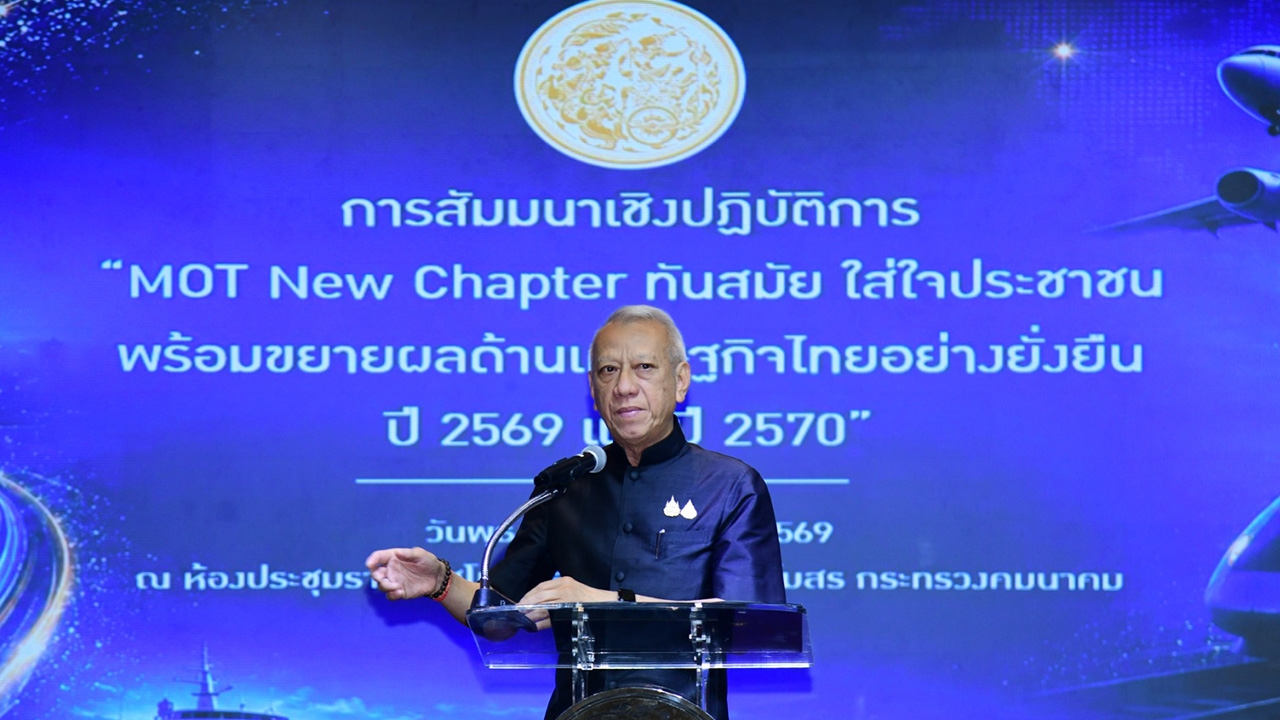
The Ministry of Transport has launched the MOT New Chapter, revealing a 20-year development plan that aims to attract investment from the Thailand Future Fund and public-private partnerships (PPP) to develop infrastructure. The goal is to reduce reliance on government budgets and accelerate Thailand’s role as an ASEAN logistics hub.
Mr. Pipat Ratchakitprakarn, Deputy Prime Minister and Minister of Transport, disclosed details about the workshop titled "MOT New Chapter: Modern, People-Centered, and Ready to Expand Sustainable Economic Outcomes for 2026-2027." This initiative aims to translate policies assigned since April 2026 into concrete action plans. After nearly a quarter of a year of progress, the meeting serves both to review updates and to integrate efforts across all affiliated agencies.
The Ministry has divided work into five main groups: land, road, rail, water, and air transport, to provide a platform for collaborative discussion, reduce inter-agency constraints, and align projects efficiently in a unified direction. The Quick Win policies for 2026–2027 are urgent measures designed to deliver immediate benefits and visible results to the public. However, national transport development is not only focused on the short term; a long-term 10–20 year strategy is also being planned. A national infrastructure master plan will be developed to ensure future investments are fully interconnected, moving beyond isolated projects toward a comprehensive national and regional network.

Mr. Siripong Angkasukolkit, Deputy Minister of Transport, said the Ministry has begun setting a new direction for transport infrastructure development that covers short-, medium-, and long-term plans extending through 2027 and continuing for 5, 10, and 20 years. This approach ensures all agencies share common operational goals. Transport infrastructure differs from typical projects as it requires several years to complete and cannot be finished within 3-6 months. Hence, long-term planning is essential, involving consultation across all Ministry sectors covering land, rail, water, and air transport. Work is divided into five groups as directed by the Permanent Secretary of the Ministry, with all proposals to be summarized again on 13 July to formulate the Ministry’s action plan.
Mr. Siripong added that the Ministry of Transport should no longer rely solely on the national budget but seek to mobilize funding from other sources to support infrastructure investment. This would accelerate project completion times, potentially shortening timelines from more than 20 years to 15, 10, or even 5 years if additional investment capital can be secured.

If infrastructure can be rapidly connected into an integrated network, it will reduce travel costs for citizens, lower logistics and freight expenses, and enhance the country’s competitiveness. Speedy infrastructure development is a key factor for Thailand to maintain its leadership in transport and logistics within ASEAN, despite neighboring countries’ ongoing investment efforts.
Mr. Siripong stated that the Ministry remains confident Thailand will lead its neighbors for several more years. However, to sustain this advantage, infrastructure development must be accelerated. Relying solely on the state budget may be insufficient, so the Ministry plans to open opportunities for increased funding from the private sector and capital markets. Funding strategies will focus on projects capable of generating revenue or charging fees, such as expressway projects under the Expressway Authority of Thailand or motorway projects under the Department of Highways. Future revenues from these projects can be leveraged as funding tools through the Thailand Future Fund or other capital market mechanisms.
Regarding rail projects, the Ministry aims for the State Railway of Thailand to improve its financial performance to reach breakeven in the future, as financial stability allows
. "Read more news " Government policy " here.