

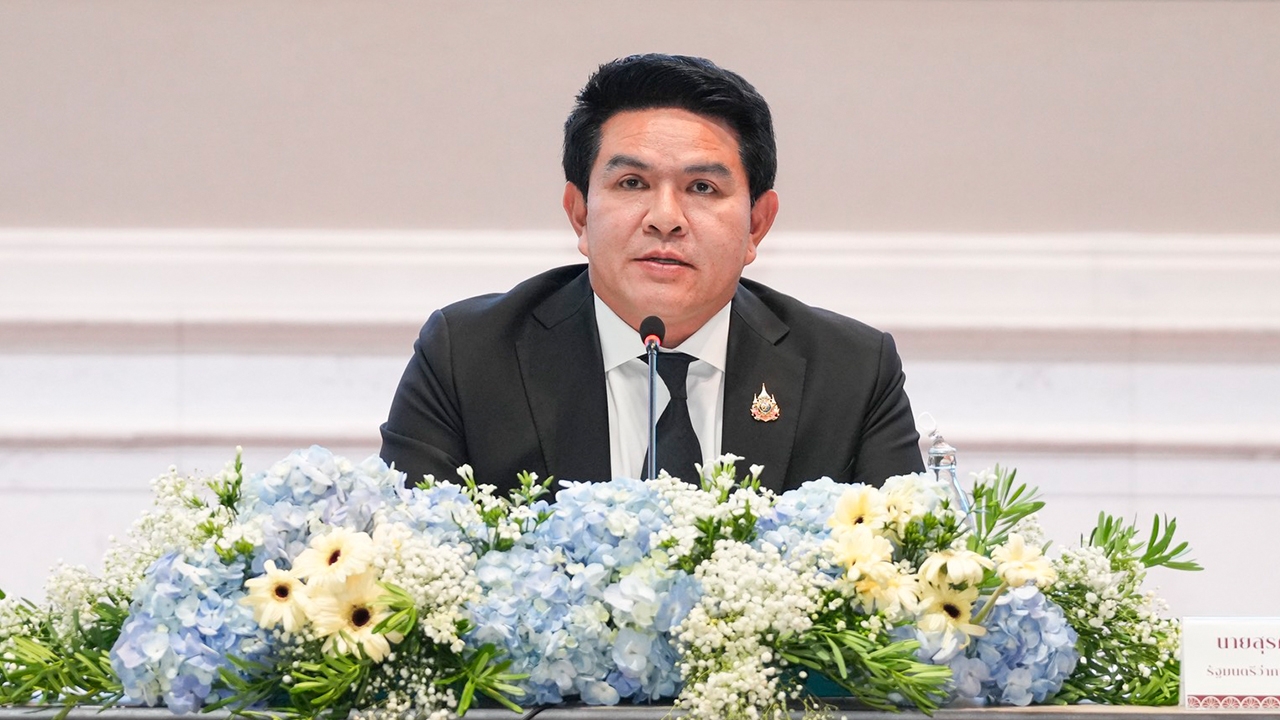
The Minister of Tourism launched TAT's 2027 action plan targeting total tourism revenue of 2.9 trillion baht, aligning with government economic policies. The plan involves leveraging AI to enhance competitiveness and penetrating quality and new markets worldwide. Tags: [Tourism policy, AI technology, Thailand tourism, Economic target, Global market]
Mr. Surasak Phanjaroenworakul, Minister of Tourism and SportsTags: [Minister of Tourism, Sports ministry, Thailand government] He chaired the integrated planning meeting for the Tourism Authority of Thailand (TAT) for 2027, delivering policies and directions amid rapidly changing global contexts. He emphasized tourism as a strategic industry linked to the economy, trade, investment, and international relations. Adaptation to challenges and boosting national competitiveness are essential. Under the leadership of the Prime Minister, the government prioritizes tourism as a key economic engine and has assigned him to participate in official foreign visits to promote tourism cooperation alongside trade, investment, and tourist confidence in key global markets under the Team Thailand approach.Tags: [Tourism strategy, Government policy, International cooperation, Economic development]
“This week, the Prime Minister included me in the delegation to China to discuss cooperation with leading companies, operators, and airlines such as Sichuan Airlines, as well as talks with the Chinese government to integrate information and ensure tourist safety. Last week’s visit to Malaysia involved discussions on cross-border travel, trade collaboration, and peacebuilding along the border to support tourism. Earlier, during the visit to Vietnam, the Prime Minister outlined a vision to view Vietnam as a parallel partner developing the industry together to strengthen the region rather than as a competitor.”Tags: [Diplomatic visits, Tourism cooperation, Regional partnership, Safety assurance]
TAT's 2027 action plan focuses on driving Thailand toward quality tourism by prioritizing increased revenue from high-quality tourists rather than solely increasing visitor numbers. This aims to generate greater economic value and sustainable growth. Concurrently, TAT must accelerate digital and AI technology adoption for data analysis, marketing, and operational efficiency to enhance Thailand's competitive edge in line with rapidly evolving tourist behavior. Another key mission is raising safety standards, a top government priority, as safety is a crucial factor influencing global tourists’ travel decisions. TAT will proactively communicate and promote accurate information to continuously restore confidence in Thailand. Regarding sustainable development, the government also aims to genuinely distribute tourism income to local communities.Tags: [Quality tourism, AI adoption, Safety standards, Sustainable development, Community income]
Mr. SurasakTags: [Minister of Tourism] He also reassured TAT executives and staff amid rumors of future ministry restructuring, such as a possible merger with the Ministry of Culture. He stated that TAT has consistently delivered excellent results, and regardless of structural changes, the government continues to regard tourism as crucial. Any changes will be positive. He encouraged all personnel, expressing confidence in their capability and dedication to drive Thai tourism as a future industry that adds economic value, brings happiness to tourists and Thais alike, and achieves steady, balanced, and sustainable growth.Tags: [Organizational restructuring, Staff morale, Tourism industry future, Government support]

RegardingTags: [] Ms. Thapanee Kiatphaibul, Governor of the Tourism Authority of Thailand (TAT)Tags: [TAT Governor, Tourism leadership] She revealed that TAT has set goals to drive Thailand’s tourism industry, expecting total tourism revenue of 2.68-2.78 trillion baht in 2026 and aiming to push international tourist arrivals to 33 million. However, the 2026 revenue target was lowered from the original policy goal of 3 trillion baht due to impacts from Middle East conflicts, which affected global travel sentiment and the tourism sector.Tags: [Tourism forecast, Revenue adjustment, Global conflict impact]
For 2027, TAT aims to increase total tourism revenue policy-wise to 2.8-2.9 trillion baht, growing 5-7% from the budget target of 2.76 trillion baht, while maintaining international tourist arrivals above 33 million. The focus is on quality growth and increasing per capita tourist spending.Tags: [Revenue growth, Tourist arrivals, Quality tourism]
Regarding the domestic market, TAT plans to encourage Thai people to travel more frequently—from currently over 2 trips per person annually to 3 trips per person—to drive domestic trips to 200 million annually. This compensates for population stabilization limits and fosters growth through increased travel frequency instead.Tags: [Domestic travel promotion, Population trends, Tourism growth strategy]
For international marketing strategy, TAT aims to grow the share of high-spending tourists, who spend about 52,000 baht per trip on average, by at least 10% annually through marketing to purpose-driven travel segments such as health and wellness tourism, meetings and business, sports tourism, education, and digital nomads.Tags: [High-spending tourists, Purpose-driven travel, Market segmentation]
Additionally, TAT will continue to open new visitor markets (First Visitor) to broaden the traveler base and increase repeat visits. Focus markets include Eastern Europe—such as Poland and Belarus—South Africa in Africa, and Latin American countries like Brazil, Mexico, and Colombia, which have growing potential due to improved international flight connectivity.Tags: [New markets, Repeat visitors, Eastern Europe, Africa, Latin America, Air connectivity]
Read more news "Tags: [] State policiesTags: [Government policy] " additionalTags: []