

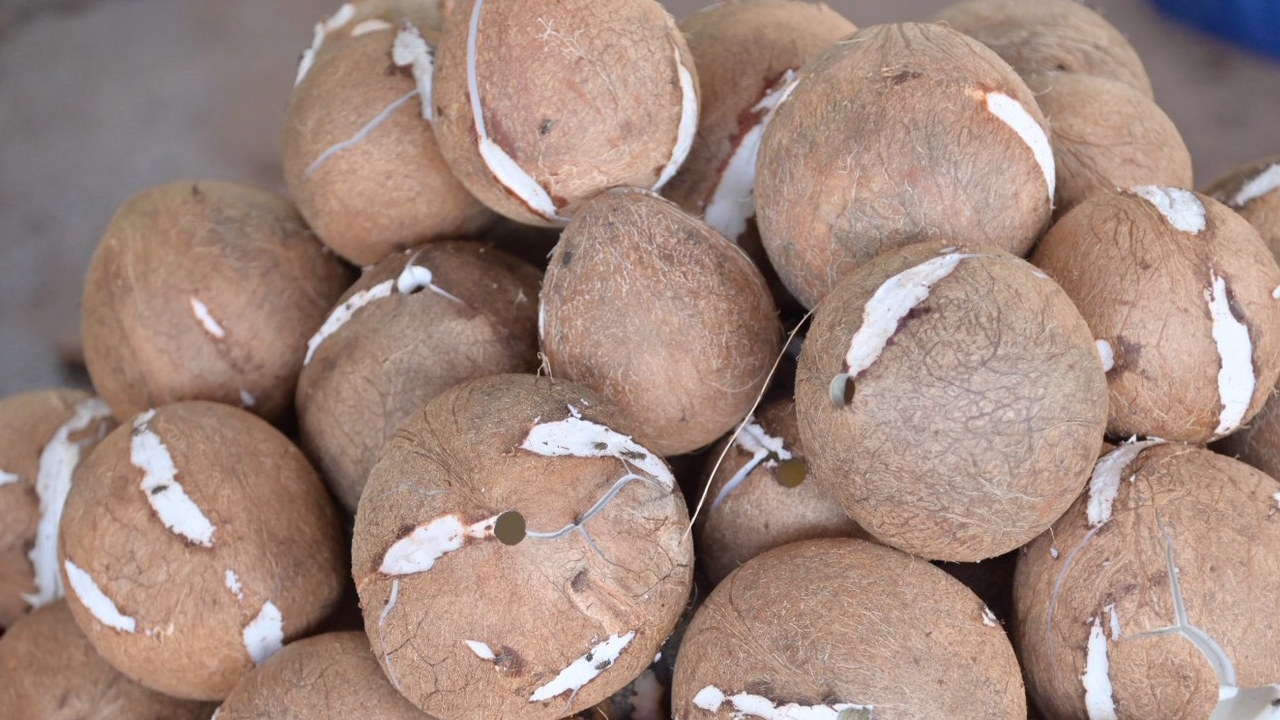
The Commerce Ministry spokesperson explained the progress on resolving issues with 'coconut for curry' following directives from Deputy Prime Minister and Commerce Minister Supachai Suthammanusorn. After the ministry expedited coordination with factories and purchasing centers to buy 'coconut for curry' from farmers in four key provinces, they have cleared over 11 million coconuts from a backlog of about 10 million. However, recent field checks revealed some farmers still lack adequate support. Therefore, the Department of Internal Trade was assigned to request central funds to buy additional 'coconut for curry' at market-leading prices, conduct surveys, assist overlooked farmers, and closely monitor imports to ensure full absorption of domestic production.

Kornit Nonjui, the Commerce Ministry spokesperson, stated that the ministry, together with provincial commerce offices in major coconut-growing areas—Prachuap Khiri Khan, Nakhon Si Thammarat, Surat Thani, and Chumphon—has continuously coordinated with factories and operators to purchase 'coconut for curry' from farmers. They have bought over 11 million coconuts, exceeding the 10 million target, with 5.88 million from Prachuap Khiri Khan, 0.724 million from Nakhon Si Thammarat, and 5.36 million from Surat Thani, Chumphon, and other areas.
However, monitoring data shows some farmers remain unassisted because most operators purchase through established networks and partner farmer groups. Additionally, importers impose standards such as GAP, Monkey-free Certificates, and Traceability systems, limiting purchases. Consequently, the Commerce Ministry has tasked the Department of Internal Trade to request central funds to buy 'coconut for curry' at prices above market rates, while surveying overlooked farmers to ensure comprehensive support and accommodate the ongoing market supply.

Regarding imports, the Department of Foreign Trade has requested importers and coconut milk manufacturers to refrain from importing coconuts during the domestic harvest period. Factories confirmed they primarily use domestic coconuts as raw material, with surveys of nine processing factories showing 80% domestic use and 20% imports. Coconut imports during the first five months of 2026 (January-May) totaled 79,388 tons, down over 60% from 190,734 tons in the same period last year. The department closely monitors factory imports, requiring certificates to confirm entitlement to pay taxes outside WTO quotas.
Kornit added that the Commerce Ministry will continue to manage 'coconut for curry' prices by requesting central funds to buy at market-leading prices, regulating imports to avoid impacting domestic production, and promoting processing to increase product value, enabling farmers to sell coconuts above production cost.

In the long term, the Commerce Ministry will integrate efforts with the Ministry of Agriculture, educational institutions, and financial organizations to address the entire supply chain. The focus is on reducing costs, improving production efficiency, helping farmers and operators access export standards, adding value through processing under the Circular Economy concept, and supporting access to financial resources.

Currently, the Office of Agricultural Economics forecasts 2026 'coconut for curry' production at 608 million units, a 2.4% increase from last year. Production began in June, with about 69 million units expected to enter the market from now until August 2026. Since factories and purchasing centers may not absorb all the supply, the Commerce Ministry has prepared measures in advance to ensure farmers can sell coconuts at prices covering production costs and receive comprehensive assistance.
/news "" Government Policy " Additional