

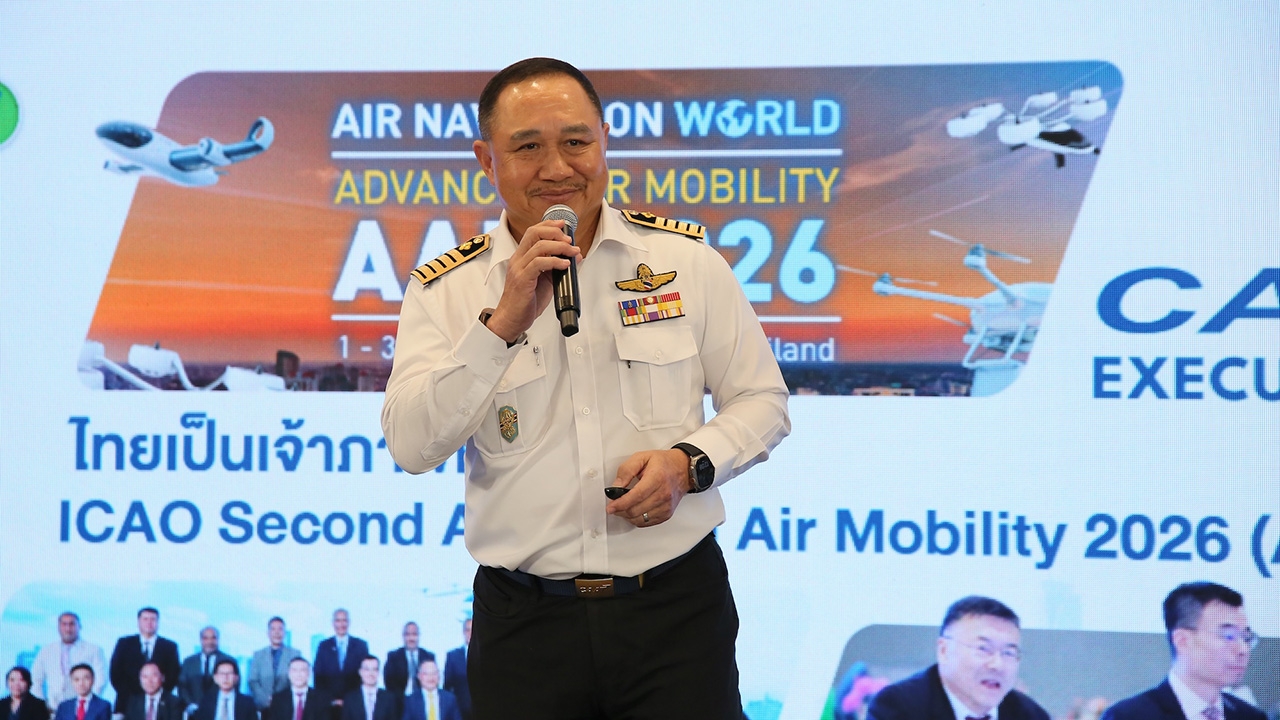
CAAT outlines its strategy to drive Thailand's aviation industry with four policies aimed at cost reduction and green aviation support to cope with global economic volatility, while announcing Thailand's readiness to host the ICAO AAM 2026 event—the first in Asia.
The Civil Aviation Authority of Thailand (CAAT) organized an event. "CAAT Executive Policy Dialogue: Building Confidence to Support Thai Aviation Amid Global Uncertainty." The event communicated CAAT's key aviation policy directions in four main areas to industry operators: cost reduction and public safety, stimulating aviation economy, promoting green aviation, and laying the foundation for future aviation systems. The goal is to position Thailand as a Regional Aviation Hub. It also revealed preparations for hosting the ICAO Second Advanced Air Mobility 2026 (AAM 2026), marking the first such international meeting in Asia. Additionally, CAAT opened a forum to collect feedback and suggestions from the aviation industry to inform strategies for sustainable growth.
Air Chief Marshal Manat Chawnaprayoon, Director of CAAT, said, "Due to the war and energy crises, the global aviation industry has faced a slowdown. Data from the International Air Transport Association (IATA) has revised the global aviation industry's net profit forecast from $41 billion to $23 billion. As the situation improves, the global aviation sector has accelerated operational strategy adjustments to better compete amid volatility. As the regulatory body overseeing aviation standards and driving sustainable industry growth, CAAT has developed proactive plans and policies to handle industry volatility while emphasizing the goal of making Thailand a Regional Aviation Hub to industry operators."
This event invited all sectors of Thailand's aviation industry—including airlines, airports, air navigation service providers, aircraft maintenance units, aviation training institutions, and related agencies—to hear CAAT's plans for accelerating and driving Thailand's aviation industry aligned with government and Ministry of Transport policies. The focus is on four proactive policies: cost reduction and public safety, stimulating aviation economy, promoting environmentally friendly aviation, and laying the foundation for future aviation systems.
Air Chief Marshal Manat continued, regarding care for the public and operators, CAAT has implemented measures to reduce air travel expenses while maintaining air transport system stability. This includes cooperation with the Department of Airports, Aeronautical Radio of Thailand Limited (AEROTHAI), and Airports of Thailand Public Company Limited (AOT) to enhance passenger handling during peak seasons, increase flights, and facilitate safety. Cost reduction measures for airlines include lowering air navigation fees, aircraft landing, parking charges, and extending payment deadlines to ease operators' cost pressures, maintain fare levels, and increase travel options for the public.
Regarding airlines' urgent energy cost issues, CAAT has coordinated with aviation, energy, and tax agencies, holding joint discussions with the Department of Energy Business, Excise Department, Bangchak Corporation, and PTT Public Company Limited. They have surveyed Thai airlines' JET A-1 fuel usage and monitored fuel price trends from producers to assess impacts and prepare appropriate measures. CAAT also listens to operator suggestions and advocates support measures with related agencies to sustain air transport continuity, reduce public impact, and improve operator liquidity.
. On promoting environmentally friendly aviation and laying the foundation for future aviation systems, plans include developing the Thailand UAS and AAM Master Plan, creating laws and standards to support Advanced Air Mobility (AAM), promoting Sustainable Aviation Fuel (SAF) use, developing the aviation carbon credit market, encouraging the General Aviation (GA) ecosystem and seaplane operations, as well as upgrading aviation infrastructure and data systems to prepare for long-term industry growth.

With readiness in various aspects, Thailand was selected to host the international conference "ICAO Second Advanced Air Mobility 2026 (AAM 2026)," a global forum on future aircraft development gathering policymakers, regulators, aircraft manufacturers, and experts worldwide to chart the future direction of the aviation industry. This is the first such event in Asia. The International Civil Aviation Organization (ICAO) has respectfully invited His Majesty the King and Her Majesty the Queen to attend and plans to confer a commemorative medal honoring His Majesty's exceptional aviation skills as a pilot, reflecting global aviation community confidence in Thailand's potential and role as a regional hub for future aviation technology development.
Besides unveiling these significant policies, CAAT also organized the forum "Voices from Industry, Shaping Thailand's Aviation" to provide aviation industry operators a platform to exchange opinions, suggestions, and business challenges. This input will help CAAT formulate policies and improve regulations aligned with industry contexts to support sustainable growth of Thai aviation.
"Being honored to host the ICAO Second Advanced Air Mobility 2026 conference is a significant opportunity to showcase Thailand's capabilities to the global aviation community and propel the country as a regional hub for future aviation technology. CAAT is committed to working with all sectors—government, private, and international organizations—to ensure the event's success and leverage it for long-term economic and aviation industry development," concluded Air Chief Marshal Manat.
Read more news " State Policies " here