

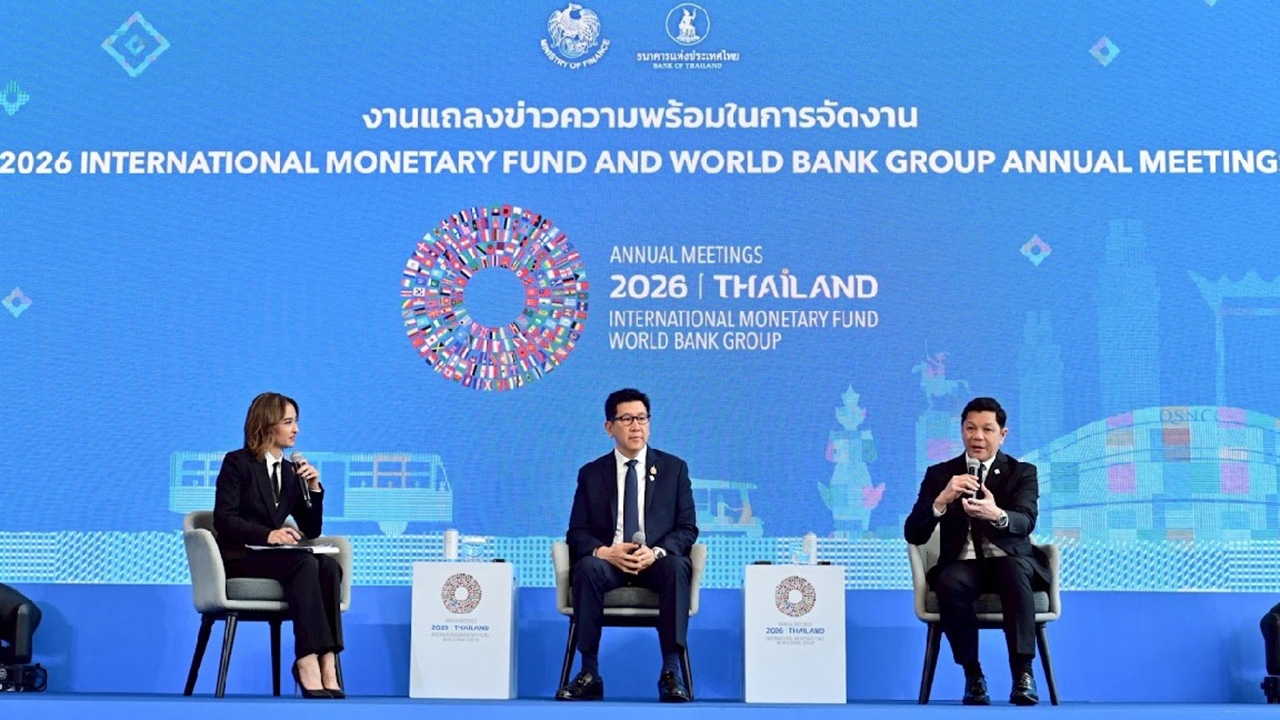
The Ministry of Finance and the Bank of Thailand announced their full readiness to host the IMF-World Bank meetings in October 2026 at the Queen Sirikit Center, highlighting the 'Bangkok Blueprint' to elevate global digital finance and attract over 15,000 participants, boosting Thailand's economy.
The Ministry of Finance, together with the Bank of Thailand, issued a statement confirming Thailand's preparedness to serve as host. “The 2026 Annual Meetings of the International Monetary Fund and the World Bank Group.” (The 2026 Annual Meetings of the International Monetary Fund and the World Bank Group) This is the world's most significant economic and financial forum, often called the “Financial Olympics,” scheduled from 12-18 October 2026 at the Queen Sirikit National Convention Center in Bangkok. Over 15,000 policymakers, economists, government and private sector representatives, and media from 191 countries will gather to exchange views on the future global economy. Thailand previously made history by successfully hosting this meeting for the first time in 1991.

Mr. Akniti Nitithanprapas, Deputy Prime Minister and Minister of Finance, stated that Thailand's honor as host represents a major opportunity to deliver tangible benefits to the nation and its people, including economic stimulus, enhanced image and credibility, showcasing local communities on a global stage (Empowering Community: From Local to Global), and driving sustainable development. Thailand's hosting theme is “Thailand’s New Horizons: Empowering People, Building Resilience,” inspired by the sufficiency economy philosophy to promote a balanced, sustainable, and resilient global economy centered on its people.

For policy advancement on the global stage, the Thai government aligns its vision and fiscal policies to address current challenges, strengthen the economy, and adapt to change across all dimensions through four strategic pillars that are key global concerns.
Additionally, a key highlight is showcasing Thailand’s unique identity and soft power to elevate its image and impress global delegates. This includes selecting distinctive traditional textiles from 21 provinces and 26 communities, totaling 37 unique patterns nationwide, such as Tai Lue woven fabrics, elephant-patterned pha khao ma, and batik prints titled “Queen Mother's Flowers.” These will decorate the venue and reflect Thai wisdom to the world. The event will also feature displays and tastings of GI-certified Thai food and beverages, such as 100% premium jasmine rice, representing Thailand’s fertile land and rich agricultural heritage.

Mr. Akniti said that in the final preparation phase, the organizing committee is promoting this opportunity as a “national agenda” through communication campaigns to raise awareness and understanding across all sectors in Thailand, including government agencies, educational institutions, businesses, and the public. The “Road to Thailand” campaign emphasizes that this meeting concerns not only policymakers and academics but also affects everyday life. It encourages youth, local communities, and small entrepreneurs to participate in preparation and during the event, ensuring benefits for all Thai people. In the short term, the influx of high-spending international visitors will immediately boost tourism and service sectors.
“Thailand’s preparations are thorough and detail-oriented. The government has elevated operations through three subcommittees: the substantive subcommittee overseeing the meeting’s core themes to be clear and impactful; the protocol and administration subcommittee ensuring Thailand’s hosting exceeds expectations; and the security subcommittee, crucial for maintaining order, safety, and confidence for all participants. Thailand is now 100% ready according to the preparation plan. In July, delegations from the International Monetary Fund and the World Bank Group conducted a close final readiness inspection known as the July Mission. The organizing team has established seamless control and coordination systems with cooperation from all sectors to ensure maximum preparedness in every aspect,” Mr. Akniti said.

. Mr. Vithai Ratanakorn, Governor of the Bank of Thailand, stated that Thailand’s global digital finance system achievements, including PromptPay and cross-border QR payments, will be showcased at the meeting. The Bank aims to present the potential of developing a new era of finance under the concept of Safe & Inclusive Digital Finance (SIDF), demonstrating to the world that digital finance systems must be not only fast but also secure and accessible to all groups.
For a financial system to be safe and inclusive, three mechanisms are essential.
(1) Tackling digital fraud, scams, and cybercrimes that directly undermine confidence in the financial system.
(2) Enhancing cyber resilience to manage risks from technology reliance, as current financial systems depend heavily on concentrated infrastructure and providers.
(3) Building an enabling financial ecosystem that is easily accessible and fair, preventing exclusion from financial services and inequality, especially as AI and digital footprints may create new disparities without careful policy design.
The key is policy-making centered on people—not only building cyber financial defenses but also unlocking access for vulnerable groups, seniors, and SMEs to fair funding and credit, improving quality of life with safety and equality.

As meeting host, the Bank of Thailand is set to make history with the 'Bangkok Blueprint' policy framework, a global outcome developed in partnership with the International Monetary Fund and the World Bank Group. This serves as a “policy compass” that countries can adapt to their contexts to strengthen trust in digital financial systems.
This approach encompasses establishing strong policy and legal foundations, fraud prevention and detection, enhancing inter-agency and international cooperation, and raising public awareness and resilience.
“The Bangkok Blueprint is designed as one of the key deliverables of this meeting and will link Thailand’s themes with global ones. Digital financial threats are a worldwide challenge, demonstrating Thailand’s universal vision and leadership in translating ideas into practical actions to reduce problems and foster concrete international cooperation,” Mr. Vithai concluded.
Read more news " Government Policy "