

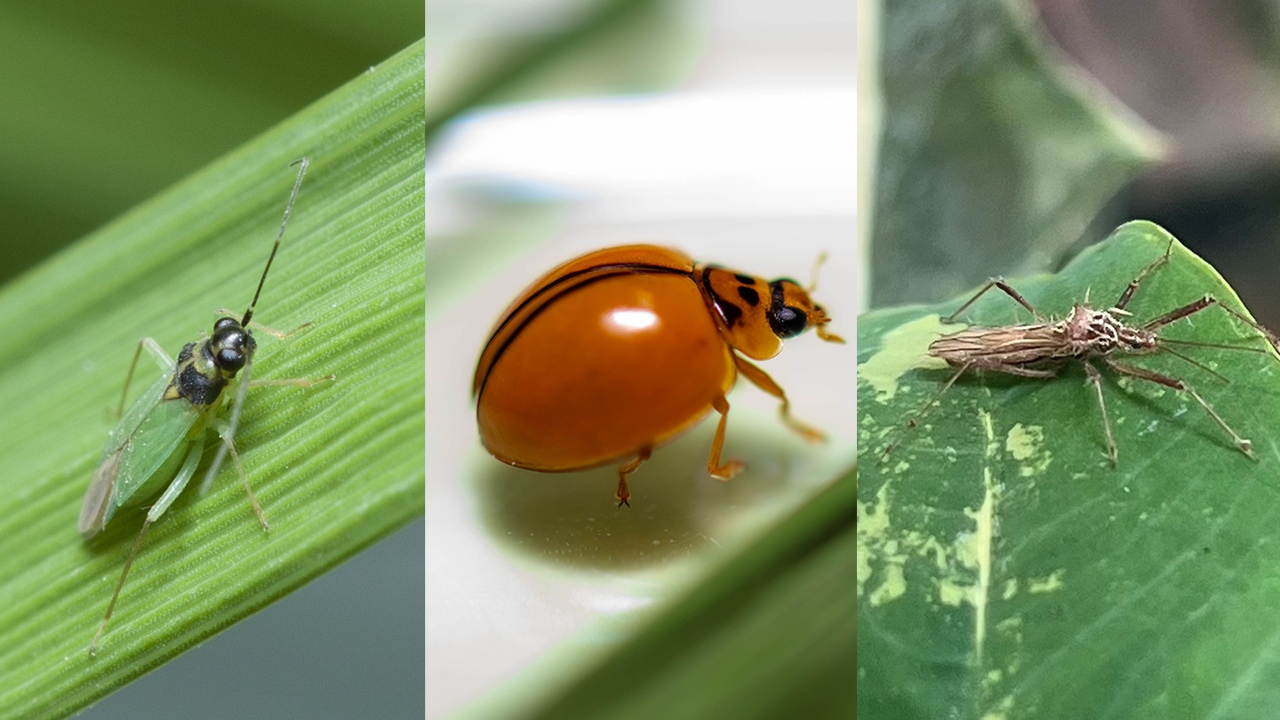
The Department of Agricultural Extension advises farmers to conserve five beneficial insects in rice fields. These insects act as natural pest control knights, helping reduce chemical use and lower production costs safely without any expense.
Current unpredictable weather conditions directly affect Thailand's agriculture sector, especially the spread of diseases and pests in rice fields. This situation forces many farmers to rely on stronger chemicals to protect their crops, which not only increases farming costs but also causes a major risk called “insecticide resistance,” where pests develop tolerance to chemicals.
Moreover, continuous chemical use has wide-ranging effects by destroying natural pest enemies or "beneficial insects" in the fields. Therefore, the Department of Agricultural Extension has implemented policies to reduce chemical use continuously and encourages farmers to adopt natural methods to maintain ecological balance in rice fields.
Mr. Weerasak Boonchoen, Deputy Director-General of the Department of Agricultural Extension, revealed that conserving natural pest enemies at a balanced level is a cost-free plant care method that benefits and ensures farmer safety. There are five important beneficial insects that act as predators and parasites to control eggs, larvae, and pupae of pests as follows:
General characteristicsEgg stage (6–11 days) is milky white and elongated. The nymph stage (10–16 days) is green without wings. Adults measure about 2.5 millimeters, with a black head and antennae, green at the base of the forewings, and gray or dark tips on the wings.
Benefits Helps control brown planthoppers.
General characteristicsEggs are brown clusters held together by milky white mucus, 20–30 eggs per cluster. Adults are 2–2.5 centimeters long with brown head, antennae, and legs, a long neck and mouthparts, and sharp spines on the thorax.
BenefitsControls armyworms, rice leaf folders, and large moth caterpillars.

General characteristicsEggs are bright yellow, laid singly or in groups. Larvae have six legs with spiny bumps on the back and sides. Adults have a convex body, hard shiny wings, and come in various colors.
BenefitsControls nymphs and adults of planthoppers, leafhoppers, eggs of rice leaf folders, rice stem borers, and leaf-eating caterpillars.
General characteristicsA predator that can fly and crawl on rice plants, both upper and lower parts, searching for prey.
BenefitsControls planthoppers, leafhoppers, caterpillars and pupae of leaf-eating moths, as well as eggs, larvae, and pupae of rice water weevil.
General characteristicsLays eggs in water 50–60 centimeters deep; larvae hatch after about 8 months and emerge from the water. Commonly found in rice fields, flying over the tops of rice plants, appearing from the seedling stage onward.
BenefitsAn aerial predator that controls rice stem borer moths and other adult rice pests. Its aquatic larvae also feed on mosquito larvae.

Mr. Weerasak added that chemical pesticides should only be used when absolutely necessary—that is, when pest outbreaks exceed 50 percent of the field. If infestations are mild, chemicals should be avoided to allow beneficial insects to work naturally.
Farmers should regularly inspect their fields at least once or twice weekly and accurately identify whether insects found are pests or natural enemies, in order to conserve beneficial insects, reduce production costs, and ensure safety for both crops and farmers. Additional advice is available at local district or provincial agricultural offices.
Read the news " State Policy " for more information.