

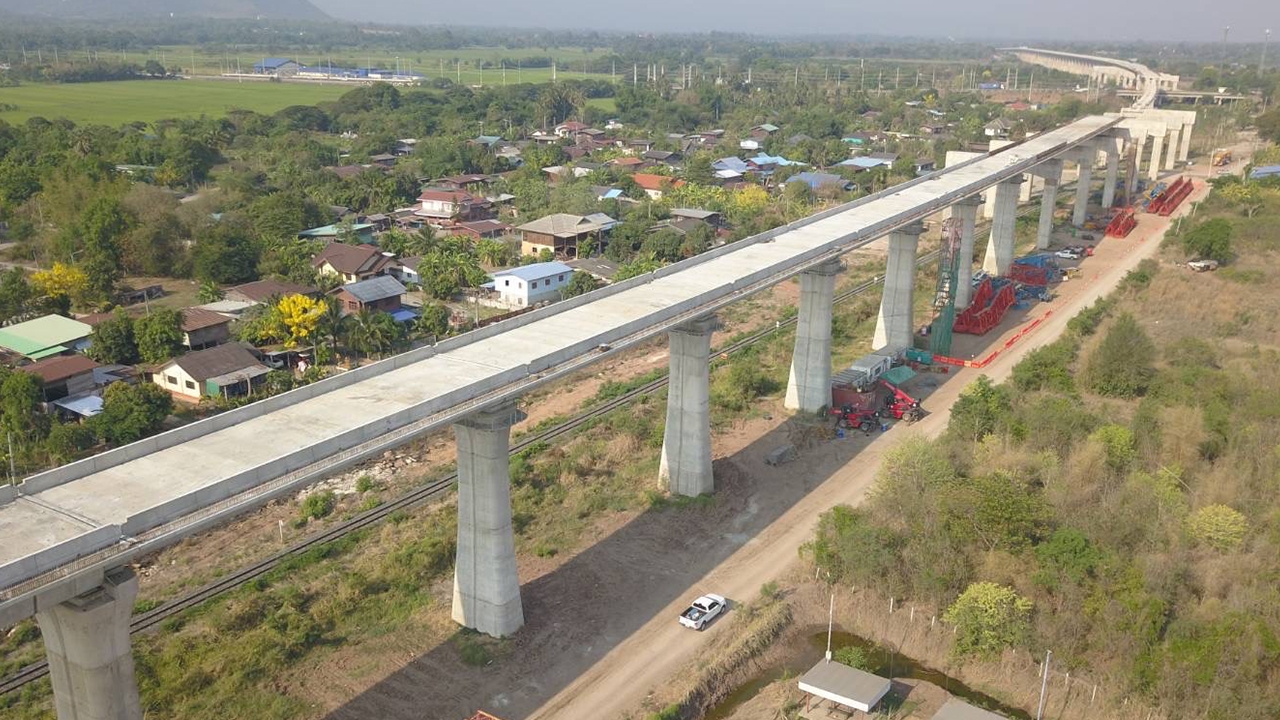
The Ministry of Transport updated that the Thai-Chinese high-speed rail Phase 1 from Bangkok to Korat is over 55% complete, with service planned to begin in 2030. The timeline for Phase 2 from Korat to Nong Khai is being accelerated, with eight contracts scheduled for auction in December 2026, aiming for completion in 2031 to support Thailand becoming a regional logistics hub.
Mr. Phiphat Ratchakitprakarn, Deputy Prime Minister and Minister of Transport, revealed after chairing the executive committee meeting on Thai-Chinese railway cooperation to monitor progress and accelerate construction of the high-speed rail and prepare Phase 2 from Korat to Nong Khai. The meeting reviewed progress of Phase 1 from Bangkok to Nakhon Ratchasima, a 250.77-kilometer stretch with six stations and a budget of 179,412.21 million baht. Of 14 civil contracts, two have been completed, ten are under construction, and two are in procurement, resulting in overall construction progress of 55.27%.
Notably, near-completion works include the Muak Lek and Lam Takhong tunnels under Contract 3-2, as well as the Lam Takhong–Sikhio and Kut Jik–Khok Kruat sections under Contract 3-4. Contracts 4-1 (Bang Sue–Don Mueang) and 4-5 (Ban Pho–Phra Kaeo) are in accelerated stages to finalize agreements and start construction promptly.

Mr. Phiphat added that with this progress, the Ministry of Transport aims to open the Bangkok–Nakhon Ratchasima section in 2030. Once operational, this route will offer an alternative for travel between Bangkok and the Northeast region, supporting economic growth in key provinces and cities along the line. Beyond improving travel, areas around stations have potential to develop into centers for commerce, services, housing, and tourism, which will generate jobs, increase incomes, and attract new investment—an important economic linkage stemming from rail infrastructure development.
Meanwhile, the meeting also reviewed preparations for Phase 2 from Nakhon Ratchasima to Nong Khai, covering 357.12 kilometers with five stations and a budget of 341,351.42 million baht. Currently, the draft Terms of Reference (TOR) and standard prices for construction and supervision are being prepared alongside land expropriation efforts. The Ministry plans to announce tenders for eight civil contracts by December 2026, aiming to start construction in 2027 and complete the project by 2031. Completion of Phase 2 will enable full high-speed rail connection from Bangkok to Nong Khai.

Mr. Phiphat further stated that the Ministry of Transport places great importance on monitoring progress and resolving obstacles in the Thai-Chinese government cooperation on the high-speed rail connecting Bangkok, the Northeast, and Nong Khai—a strategic area for border trade and regional connectivity. Completion of the Bangkok–Nong Khai route will enhance travel efficiency between Bangkok and key regional cities, reduce distance and time constraints, encourage decentralization of investment, stimulate development around stations, and create new opportunities for business, tourism, and services along the route. This connection not only improves interregional travel but also boosts the Northeast's role as an economic gateway linking Thailand with Laos and China, strengthening Thailand’s position as a regional center for transportation, tourism, and logistics.

Besides accelerating construction, the meeting was informed of the approach for Contract 4-1 (Bang Sue–Don Mueang), assigning the State Railway of Thailand to handle civil works. The meeting also reviewed the color scheme and design patterns of the train sets developed by the Rail System Technology Research and Development Institute, to inform engineering specifications and domestic production processes.
This approach is key to establishing Thailand’s rail industry foundation by developing knowledge, technology, personnel, and manufacturing processes, which will reduce long-term reliance on foreign technology while creating added value and employment within the domestic rail industry supply chain.
Additionally, the meeting approved separating the construction of railway crossing bridges in Phase 1 into a new contract to increase operational flexibility, reduce procedural constraints, and enable faster progress to meet set timelines.
." Government Policy ." Additional